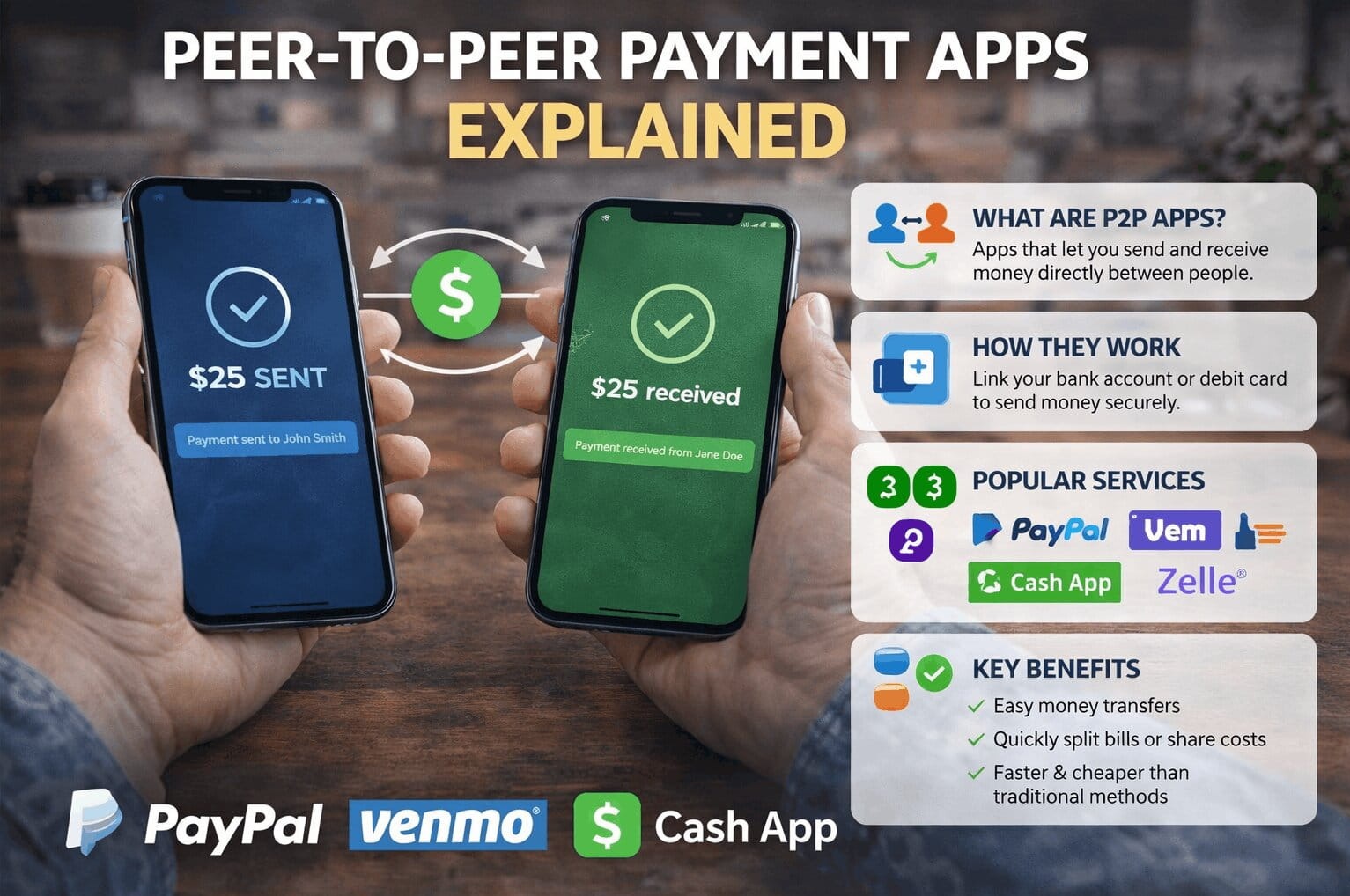
Splitting a bill, paying rent, or sending money to a friend used to involve cash or checks. Today, it takes just a few taps on your phone. That’s the power of peer-to-peer (P2P) payment apps.
In the United States, P2P apps have become a daily habit. From roommates sharing expenses to freelancers getting paid, these apps make money movement fast and simple.
But while they’re convenient, they also come with risks and limitations. Let’s break everything down so you can use them smartly.
What Are Peer-to-Peer Payment Apps?
Peer-to-peer (P2P) payment apps allow individuals to send and receive money directly between bank accounts or digital wallets.
There’s no need for cash, checks, or even traditional bank transfers.
Here’s a simple overview:
| Feature | P2P Payment Apps |
|---|---|
| Speed | Instant or same day |
| Cost | Free or small fees |
| Use case | Personal payments |
| Access | Mobile apps |
In simple terms, they’re designed for everyday money exchanges between people—not businesses.
How P2P Payment Apps Work
The process is quick and user-friendly.
Step 1: Create an Account
Sign up using your phone number or email.
Step 2: Link Payment Method
Connect your bank account, debit card, or wallet.
Step 3: Choose Recipient
Select a contact from your phone or enter their details.
Step 4: Send Money
Enter the amount and confirm.
Step 5: Funds Delivered
Money arrives instantly or within a short time.
Behind the scenes, many transactions rely on systems like:
👉 ACH Transfers Explained
Popular P2P Payment Apps in the USA
Several apps dominate the U.S. market. Each has its strengths.
1. Zelle
Best for: Instant bank transfers
Zelle is often built directly into your banking app.
Key Features:
- Instant transfers between bank accounts
- No fees in most cases
- No separate app required (for many banks)
Example:
You send your friend $25 for lunch, and they receive it instantly.
Pros:
- Extremely fast
- Direct bank integration
Cons:
- Limited fraud protection
- Only works within the U.S.
2. Venmo
Best for: Social and casual payments
Venmo adds a social element to payments.
Key Features:
- Social feed
- Easy bill splitting
- Instant transfers (with fee)
Example:
You split a group dinner and track who paid.
Pros:
- Easy to use
- Popular among younger users
Cons:
- Privacy concerns if settings aren’t adjusted
- Fees for instant withdrawals
3. Cash App
Best for: Versatility
Cash App goes beyond payments.
Key Features:
- Send and receive money
- Debit card (Cash Card)
- Investing features
Example:
You receive money and spend it instantly using the app’s card.
Pros:
- Multi-functional
- Quick setup
Cons:
- Fees for instant transfers
- Limited support options
4. PayPal
Best for: Broader use and security
PayPal works for both personal and business payments.
Key Features:
- Strong buyer protection
- International transfers
- Widely accepted
Example:
You pay a freelancer or send money overseas.
Pros:
- Trusted platform
- Global reach
Cons:
- Higher fees
- Currency conversion costs
P2P Apps vs Other Payment Methods
Let’s compare P2P apps with other common options.
| Feature | P2P Apps | ACH Transfers | Wire Transfers |
|---|---|---|---|
| Speed | Instant | 1–3 days | Same day |
| Cost | Low | Free/low | High |
| Best for | Personal payments | Bills | Large urgent transfers |
For deeper insights:
👉 How Wire Transfers Work
Real-World Examples
Example 1: Splitting Rent
Roommates use Zelle to send their share instantly.
Example 2: Group Dinner
Friends use Venmo to split the bill.
Example 3: Paying a Freelancer
Someone uses PayPal for added security.
Example 4: Sending Emergency Money
Cash App delivers funds instantly.
Advantages of P2P Payment Apps
1. Speed
Most transfers are instant or near-instant.
2. Convenience
You can send money anytime, anywhere.
3. Low Cost
Many transfers are free.
4. Easy to Use
User-friendly interfaces make payments simple.
Disadvantages of P2P Payment Apps
1. Limited Protection
Sending money to the wrong person can be hard to fix.
2. Fees for Instant Transfers
Some apps charge for faster withdrawals.
3. Not Ideal for Large Payments
Better options exist for high-value transfers.
4. Fraud Risks
Scammers often target P2P platforms.
Common Fees Explained
| Fee Type | Example |
|---|---|
| Instant transfer fee | 1%–3% |
| Credit card fee | Around 3% |
| Currency conversion | Applies to international payments |
To reduce costs:
👉 How to Avoid Bank Fees
Safety Tips for Using P2P Apps
P2P apps are safe—but only if you’re careful.
Follow these tips:
- Send money only to people you trust
- Double-check usernames and phone numbers
- Enable two-factor authentication
- Avoid sending money for unknown deals
For more protection:
👉 How to Protect Your Bank Account from Fraud
When Should You Use P2P Apps?
They’re perfect for:
- Splitting bills
- Paying friends or family
- Small everyday transactions
- Quick transfers
When You Should Avoid P2P Apps
Avoid them when:
- Sending large amounts
- Paying strangers
- Making business transactions without protection
- You need guaranteed or reversible payments
Practical Tips for Smarter Use
- Keep small balances in the app
- Transfer funds to your bank regularly
- Turn on notifications for all transactions
- Use apps with strong security features
- Avoid linking credit cards unless necessary
One important rule:
Treat P2P payments like cash—once sent, it’s usually gone.
The Future of P2P Payments
P2P apps are evolving quickly.
Trends include:
- Faster real-time payments
- Integration with digital wallets
- Expanded international features
- Enhanced security tools
They’re becoming a central part of modern banking.
Final Thoughts
Peer-to-peer payment apps have transformed how people send and receive money. They’re fast, convenient, and often free—but they require responsible use.
The biggest mistake people make is treating them like reversible bank transactions. In reality, they work more like digital cash.
Use them wisely, double-check every payment, and choose the right app for the situation. When used correctly, P2P apps can make everyday financial life significantly easier.