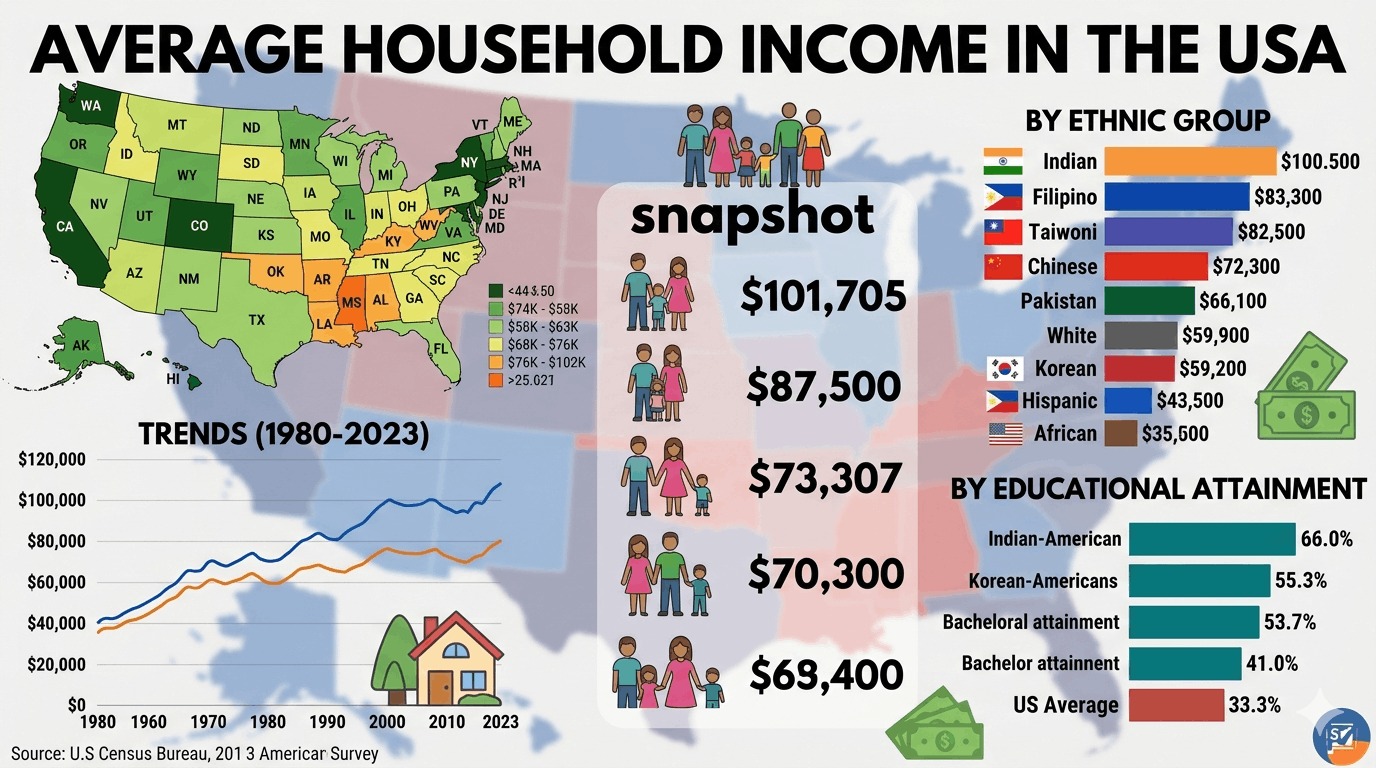
Understanding average household income in the United States gives you a snapshot of how people earn, live, and build wealth across the country. But if you only look at the number itself, you’ll miss the deeper story. Income is influenced by location, age, taxes, and cost of living—and all of these factors shape real financial outcomes.
To truly understand what “average income” means, you need to go beyond surface-level statistics and look at how income behaves in real life.
What Is Household Income?
Household income refers to the combined earnings of everyone living in a single household. This includes salaries, business income, investment returns, and even retirement income.
The important thing here is that it reflects shared financial resources. For example, a household with two earners making $40,000 each has a household income of $80,000. That combined income often provides more financial stability than a single individual earning the same amount.
However, higher household income doesn’t always mean better financial health. Expenses, debt, and taxes still play a major role in determining how much money is actually available for saving or investing.
To understand how this income is taxed:
How Income Taxes Work in the USA – https://statush.com/finance-statistics/how-income-taxes-work-in-the-usa
Average vs Median Income: Why It Matters
When people hear “average income,” they often assume it represents what most households earn. But that’s not always true.
| Measure | Explanation | Real-World Meaning |
|---|---|---|
| Average Income | Adds up all incomes and divides by number of households | Can be inflated by very high earners |
| Median Income | The middle value where half earn more and half earn less | More realistic picture of typical households |
In reality, the median income is usually more useful. The average can be skewed because a small number of very high-income households pull the number upward.
Real Example
Imagine 5 households earn:
- $40k, $50k, $60k, $70k, and $500k
The average looks very high because of the $500k income, but most households are actually in the $40k–$70k range. The median reflects that reality much better.
How Income Changes Over Time
Income is not static—it evolves over a person’s lifetime.
Early in your career, earnings are typically lower because you’re still building skills and experience. As you move into your 30s and 40s, income tends to increase due to promotions, career shifts, or business growth. Eventually, income stabilizes and may decline slightly as retirement approaches.
| Age Range | Income Pattern Explanation |
|---|---|
| 20–30 | Lower income due to entry-level jobs and career building |
| 30–50 | Rapid growth from promotions, skill development, and peak productivity |
| 50–65 | Stable or slightly declining as career plateaus |
| 65+ | Lower income as people transition to retirement and fixed income sources |
This progression is important because it shows that income should be viewed over decades, not just a single year.
The Role of Location in Income
Where you live has a major influence on both income and lifestyle.
A household earning $80,000 in a smaller city may live comfortably, while the same income in a major city might feel tight due to higher housing, transportation, and daily expenses.
Real-World Comparison
- A family earning $90,000 in a low-cost state may afford a home, save regularly, and invest
- A family earning $120,000 in a high-cost city may struggle with rent and have limited savings
This shows that income alone doesn’t define financial success—cost of living must always be considered.
To understand this better:
Average Cost of Living by State – https://statush.com/finance-statistics/average-cost-of-living-by-state
How Taxes Affect Household Income
One of the biggest misconceptions is that your income equals your financial capacity. In reality, taxes reduce what you actually take home.
Households typically pay:
- Federal income tax
- State income tax (in many states)
- Payroll taxes
Example
If a household earns $100,000:
- After taxes, the actual take-home income may be closer to $75,000–$80,000
This difference directly impacts spending, saving, and investing decisions.
You can estimate this using:
Paycheck Calculator – https://statush.com/paycheck-calculator
Income vs Wealth: A Critical Difference
Income is what you earn. Wealth is what you keep.
Two households with the same income can end up in completely different financial situations depending on how they manage their money.
Real Example
- Household A earns $100,000 but spends almost everything
- Household B earns $80,000 but saves and invests consistently
Over time, Household B may become significantly wealthier despite earning less.
This highlights an important point: income creates opportunity, but financial habits determine outcomes.
To explore this further:
How Taxes Impact Wealth Building – https://statush.com/finance-statistics/how-taxes-impact-wealth-building
Income Inequality in the USA
Income in the United States is not evenly distributed. A small percentage of households earn a disproportionately large share of total income.
This affects:
- The average income figures
- Economic opportunities
- Wealth distribution
While some households experience rapid income growth, others may see little change over time. This gap plays a major role in financial inequality across the country.
For deeper insights:
Income Inequality Statistics in the USA – https://statush.com/finance-statistics/income-inequality-statistics-in-the-usa
Turning Income Into Financial Growth
Earning a higher income is helpful—but it’s only the starting point.
What truly matters is how that income is used. Households that consistently:
- Save a portion of their income
- Invest wisely
- Manage expenses carefully
tend to build wealth over time, regardless of their starting income level.
Even small differences in saving rates can lead to large differences over decades.
Using Tools to Understand Your Financial Position
To make better financial decisions, it helps to track and analyze your income.
- Net Worth Calculator – https://statush.com/net-worth-calculator
- Savings Goal Calculator – https://statush.com/savings-goal-calculator
- Retirement Calculator – https://statush.com/retirement-calculator
These tools help you connect your income to long-term financial outcomes.
A Broader Perspective on Income
Instead of focusing only on how your income compares to the national average, it’s more useful to ask:
- How much of your income do you keep after taxes?
- How much are you able to save and invest?
- How does your income align with your lifestyle and expenses?
These questions provide a much clearer picture of financial health.
Final Thoughts
Average household income in the USA is a helpful benchmark, but it doesn’t define financial success. Income varies widely based on age, location, and economic conditions, and it’s only one part of a much larger financial picture.
The key takeaway is simple:
- Income provides opportunity
- Taxes and expenses shape reality
- Long-term habits determine wealth
When you understand how income works—and how to manage it—you can turn earnings into lasting financial growth.