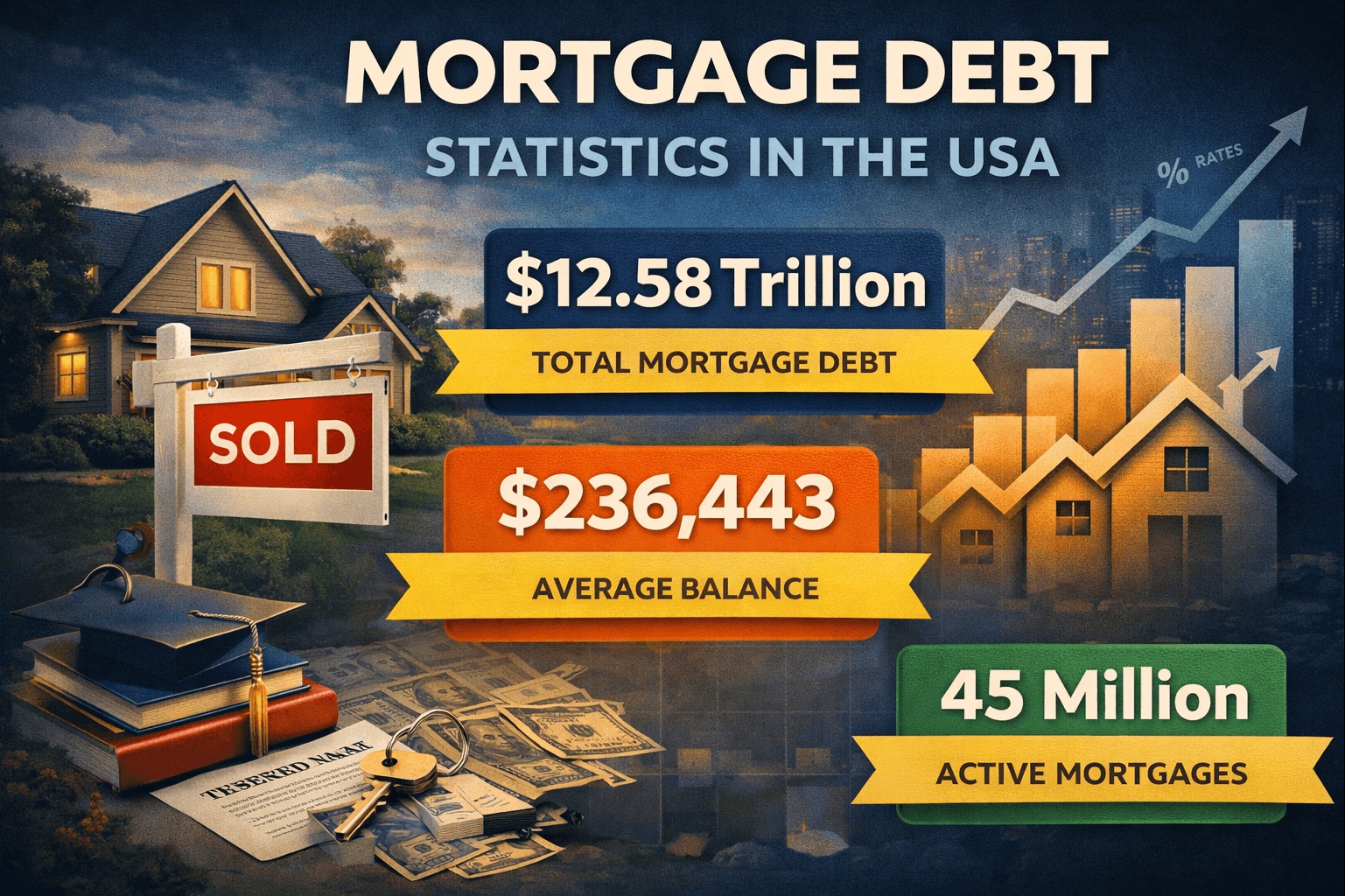
Mortgage debt is one of the largest financial commitments most Americans will ever take on. For many households, it represents both a major liability and a pathway to building long-term wealth through homeownership.
Understanding mortgage debt statistics in the United States helps you see how common mortgages are, how debt levels vary across age groups, and how housing costs shape financial decisions. More importantly, it provides context for your own situation—whether you’re planning to buy a home or already paying one off.
What Is Mortgage Debt?
Mortgage debt is money borrowed to purchase real estate, typically a home. The loan is secured by the property itself, which means the lender can claim the property if payments are not made.
Mortgage payments usually include:
- Principal (the amount borrowed)
- Interest (cost of borrowing)
- Property taxes
- Insurance
Unlike credit card debt, mortgage debt is considered “secured” and often comes with lower interest rates, but it is long-term and substantial.
The Big Picture: Mortgage Debt in the USA
Mortgage debt in the U.S. is massive and continues to grow alongside housing prices.
Key trends include:
- Total mortgage debt reaching trillions of dollars
- Most homeowners carrying long-term loans (15–30 years)
- Rising home prices increasing average loan sizes
These trends show that mortgages are not just common—they are central to how Americans build and finance wealth.
Mortgage Debt by Age Group
Mortgage debt changes significantly throughout a person’s life, reflecting both financial growth and lifestyle changes.
| Age Group | Debt Pattern | Explanation |
|---|---|---|
| Under 35 | Lower but rising | First-time homebuyers entering the market |
| 35–44 | Rapid increase | Larger homes, growing families |
| 45–54 | Peak mortgage balances | High-value homes, refinancing, or upgrades |
| 55–64 | Gradual decline | Paying down principal |
| 65+ | Lower but still present | Some mortgages remain into retirement |
Real-World Example
Let’s say you buy a home for $300,000 with a 20% down payment.
- Loan amount: $240,000
- Interest rate: 6%
- Monthly payment: around $1,400
Over 30 years:
- Total paid: over $500,000
This shows how interest significantly increases the total cost of homeownership.
Mortgage Debt vs Other Debt Types
Mortgage debt differs from other forms of debt in both cost and purpose.
| Debt Type | Interest Level | Long-Term Impact |
|---|---|---|
| Mortgage | Low | Builds equity over time |
| Credit Card Debt | High | Drains financial resources |
| Student Loans | Moderate | Long-term but not asset-backed |
While mortgages involve large amounts, they also provide an asset—your home—which can increase in value over time.
The Role of Home Equity
One of the key advantages of mortgage debt is the ability to build equity.
Equity is the portion of your home that you truly own.
Example
If your home is worth $400,000 and your remaining mortgage is $250,000:
- Your equity = $150,000
As you pay down your loan and property values rise, your net worth increases.
Impact on Household Finances
Mortgage payments are often the largest monthly expense for households.
This affects:
- Cash flow
- Ability to save and invest
- Financial flexibility
A higher mortgage payment can limit your ability to build wealth in other areas, especially if it takes up a large portion of your income.
Mortgage Debt and Wealth Building
Despite its size, mortgage debt can contribute to long-term wealth.
Homeownership allows:
- Property value appreciation
- Equity accumulation
- Stability in housing costs (with fixed-rate loans)
However, this depends on factors like location, market conditions, and financial discipline.
To understand broader financial impact:
How Taxes Impact Wealth Building – https://statush.com/finance-statistics/how-taxes-impact-wealth-building
Common Patterns in Mortgage Trends
Across the U.S., certain patterns are consistent:
- Most homeowners carry mortgages for decades
- Many refinance to adjust interest rates or terms
- Mortgage debt tends to peak in midlife
These patterns reflect both financial growth and changing housing needs.
Risks Associated with Mortgage Debt
While mortgages can support wealth building, they also carry risks.
These include:
- Overborrowing beyond affordability
- Market downturns reducing home value
- Job loss affecting repayment ability
Managing these risks is key to maintaining financial stability.
Tools to Plan Your Mortgage
Before taking on a mortgage—or to better manage one—it helps to use financial tools.
- Mortgage Calculator – https://statush.com/mortgage-calculator
- Home Affordability Calculator – https://statush.com/home-affordability-calculator
- Net Worth Calculator – https://statush.com/net-worth-calculator
These tools help you understand what you can afford and how your mortgage fits into your overall finances.
A Practical Perspective
Instead of focusing only on national statistics, it’s more useful to evaluate your own situation.
Ask yourself:
- Is my mortgage affordable relative to my income?
- Am I building equity over time?
- Am I balancing homeownership with other financial goals?
These questions provide a clearer picture than averages alone.
Final Thoughts
Mortgage debt statistics in the USA highlight a key reality: while mortgages are a major financial obligation, they are also a primary tool for building wealth.
The key takeaway is simple:
- Mortgage debt is long-term but structured
- It can build equity if managed properly
- Affordability and planning are essential
When approached carefully, a mortgage can be more than just debt—it can be a foundation for long-term financial growth.