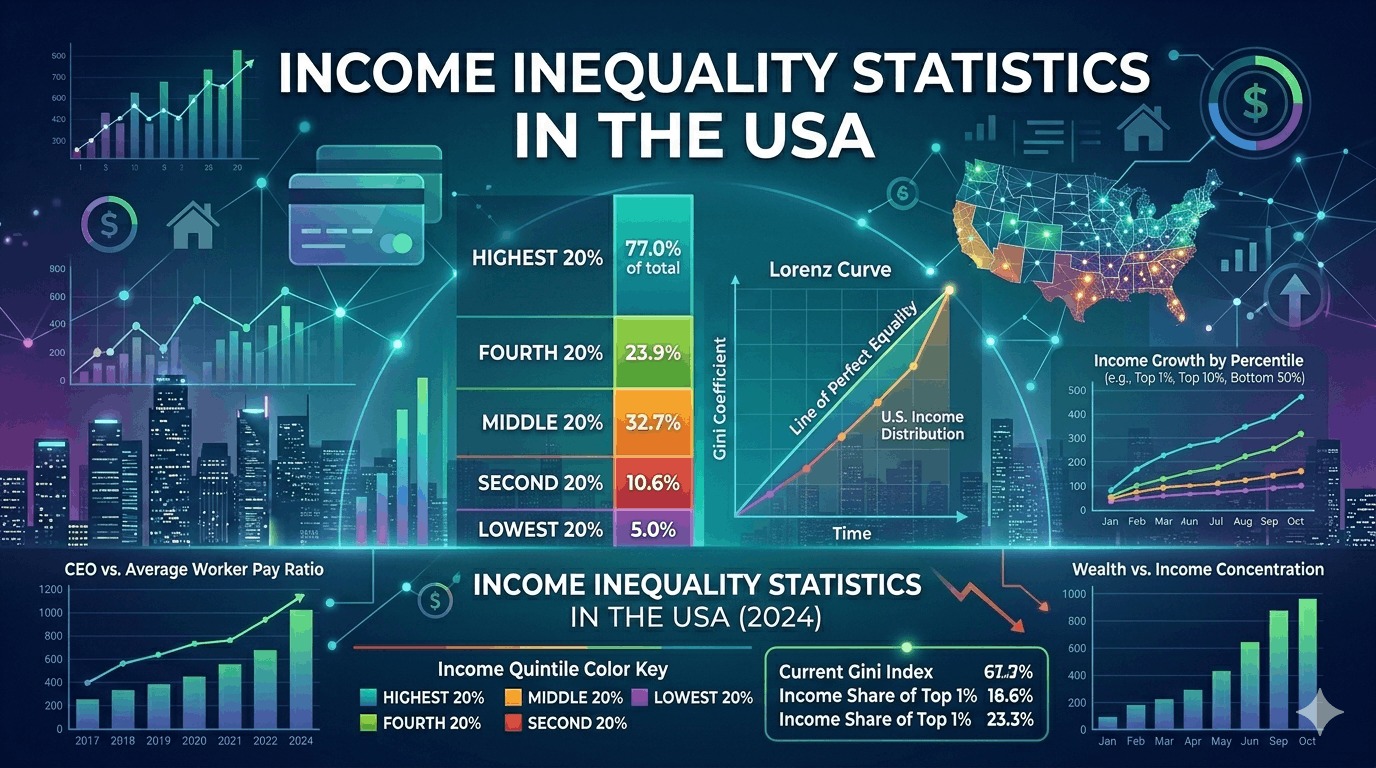
Income inequality is one of the most discussed topics in the U.S. economy—and for good reason. While the country has seen overall economic growth, that growth has not been evenly shared. Some households have experienced significant increases in income, while others have seen much slower progress.
Understanding income inequality statistics helps you see how income is distributed, why gaps exist, and how these differences affect financial opportunities across the population.
What Is Income Inequality?
Income inequality refers to the uneven distribution of income across individuals or households. In simple terms, it measures how much more some people earn compared to others.
Income includes:
- Salaries and wages
- Business income
- Investment income
It reflects earnings over time, not accumulated wealth.
To understand how income works in general:
Average Household Income in the USA – https://statush.com/finance-statistics/average-household-income-in-the-usa
How Income Is Distributed in the USA
Income in the United States is not evenly distributed. A significant portion of total income is earned by higher-income households.
A common way to understand this is by dividing the population into groups.
| Income Group | Share of Total Income | Explanation |
|---|---|---|
| Top 10% | Large share | High earners, executives, business owners |
| Middle 40% | Moderate share | Typical working households |
| Bottom 50% | Smaller share | Lower-income households with limited earnings |
This structure shows that income becomes more concentrated as you move toward higher percentiles.
Measuring Income Inequality
Economists use different methods to measure inequality. One of the most common is the Gini coefficient, which ranges from 0 to 1.
| Gini Value | Meaning |
|---|---|
| 0 | Perfect equality |
| 1 | Maximum inequality |
The United States typically has a higher Gini coefficient compared to many developed countries, indicating greater income inequality.
Real-World Example
Let’s compare two individuals:
Person A
- Income: $40,000 per year
Person B
- Income: $400,000 per year
Even though both are part of the same economy, their financial realities are vastly different.
Person B has:
- More savings potential
- Greater investment opportunities
- Higher financial security
This gap illustrates how income inequality affects everyday life.
Income Inequality by Age
Income inequality also varies across age groups, as earnings change over a lifetime.
| Age Group | Income Trend | Explanation |
|---|---|---|
| 20–30 | Lower income | Entry-level jobs, limited experience |
| 30–50 | Rising income | Career growth and promotions |
| 50+ | Wider gap | Some reach high earnings, others plateau |
Over time, differences in career paths and opportunities can widen income gaps.
Factors Driving Income Inequality
Income inequality is shaped by multiple factors that interact over time.
Education and Skills
Higher education and specialized skills often lead to higher-paying jobs, creating income differences.
Industry and Occupation
Certain industries, such as technology or finance, tend to offer higher salaries compared to others.
Economic Changes
Automation, globalization, and economic shifts can impact job availability and wages.
Geographic Location
Income levels vary widely depending on where people live, with urban areas often offering higher wages but also higher living costs.
Income vs Wealth Inequality
It’s important to distinguish between income inequality and wealth inequality.
| Category | Focus | Long-Term Impact |
|---|---|---|
| Income | Earnings over time | Affects daily living |
| Wealth | Accumulated assets | Determines long-term financial security |
Income inequality often leads to wealth inequality because higher earners have more capacity to save and invest.
To explore this further:
Wealth Distribution in America Explained – https://statush.com/finance-statistics/wealth-distribution-in-america-explained
The Role of Taxes
Taxes play a role in shaping income inequality by redistributing income through government programs and tax policies.
They can:
- Reduce inequality through progressive tax systems
- Fund public services and benefits
However, taxes alone do not eliminate income gaps.
Learn more:
How Taxes Impact Wealth Building – https://statush.com/finance-statistics/how-taxes-impact-wealth-building
Impact on Everyday Life
Income inequality affects more than just numbers—it influences real-life opportunities.
It can impact:
- Access to education
- Housing affordability
- Healthcare access
- Ability to save and invest
For example, lower-income households may struggle to build savings, while higher-income households can invest and grow wealth more easily.
Long-Term Trends
Income inequality in the U.S. has generally increased over time, influenced by economic and technological changes.
Key patterns include:
- Faster income growth at the top
- Slower growth for lower-income groups
- Increasing gap between high and low earners
These trends shape the broader economic landscape.
Can Income Inequality Change?
Income inequality is influenced by both structural factors and individual actions.
While large-scale changes depend on policy and economic conditions, individuals can still improve their financial position through:
- Skill development
- Career advancement
- Financial planning
However, systemic factors also play a significant role.
Tools to Understand Your Financial Position
Tracking your income and finances helps you navigate economic differences.
- Paycheck Calculator – https://statush.com/paycheck-calculator
- Net Worth Calculator – https://statush.com/net-worth-calculator
- Savings Goal Calculator – https://statush.com/savings-goal-calculator
These tools help you focus on your own progress rather than just national statistics.
A Practical Perspective
Instead of focusing only on inequality itself, it’s useful to think about your own financial growth.
Ask yourself:
- Am I increasing my income over time?
- Am I building skills that improve earning potential?
- Am I managing my finances effectively?
These factors are within your control.
Final Thoughts
Income inequality statistics in the USA highlight a complex reality: while opportunities exist, outcomes are not evenly distributed.
The key takeaway is simple:
- Income varies widely across the population
- Multiple factors influence earning potential
- Long-term financial progress depends on both opportunity and strategy
Understanding income inequality gives you perspective—not just on the economy, but on how to navigate your own financial path more effectively.