Real estate investing in the United States offers more than just cash flow and appreciation—it comes with powerful tax advantages that can significantly increase your overall returns. In fact, many experienced investors consider tax benefits one of the biggest reasons to invest in rental properties.
But here’s the reality: tax deductions can be confusing, especially if you’re just starting out. The rules are detailed, and missing key deductions can mean leaving thousands of dollars on the table.
This guide breaks down real estate tax deductions in a simple, practical way—so you understand what you can deduct, how it works, and how to use these benefits effectively.
What Are Real Estate Tax Deductions?
Tax deductions reduce your taxable income, which lowers the amount of tax you owe. For real estate investors, many expenses related to owning and managing property are deductible.
In simple terms:
- More deductions = Lower taxable income = Less tax paid
If you’re new to real estate investing, start here:
How Real Estate Investing Works — https://statush.com/real-estate/how-real-estate-investing-works
How Tax Deductions Work in Real Estate
Let’s look at a simple example:
- Rental Income: $30,000/year
- Expenses + Deductions: $20,000
Taxable Income = $10,000
Even though you earned $30,000, you only pay taxes on $10,000. That’s the power of deductions.
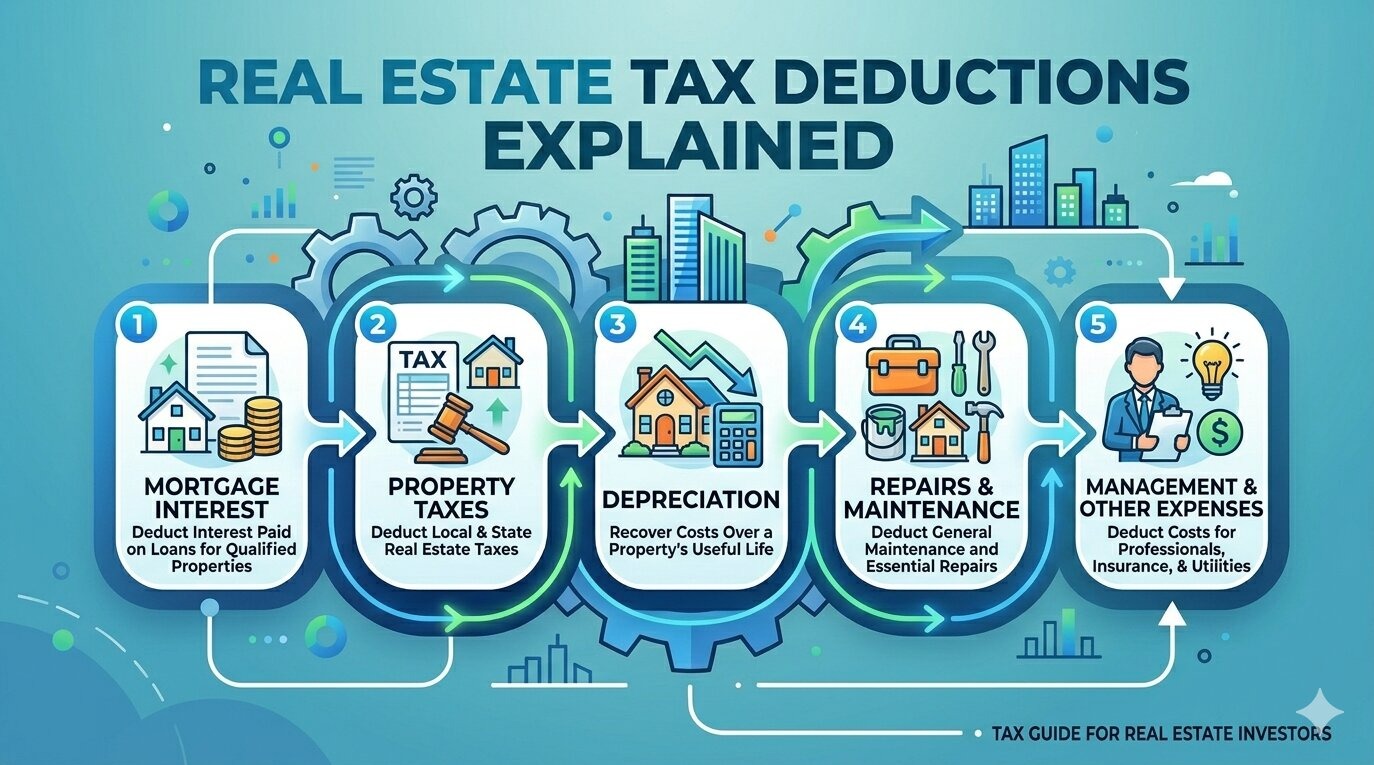
Major Real Estate Tax Deductions
Here are the most important deductions every U.S. investor should understand:
| Deduction | What It Covers | Why It Matters |
|---|---|---|
| Mortgage Interest | Interest on property loans | Often the largest deduction |
| Property Taxes | Local government taxes | Fully deductible expense |
| Depreciation | Property value wear over time | Non-cash deduction (very powerful) |
| Repairs & Maintenance | Fixes and upkeep | Reduces taxable income |
| Insurance | Property coverage | Required and deductible |
| Operating Expenses | Utilities, HOA fees, etc. | Ongoing cost reduction |
Each of these plays a role in reducing your taxable income.
Depreciation: The Most Powerful Benefit
Depreciation is often the biggest tax advantage in real estate.
It allows you to deduct the cost of a property over time—even if the property is actually increasing in value.
For residential rental properties:
- IRS allows depreciation over 27.5 years
Example:
- Property Value (building only): $275,000
- Annual Depreciation: $10,000
You can deduct $10,000 each year—even though you didn’t actually spend that money annually.
To understand this in depth:
Depreciation in Real Estate Investing — https://statush.com/real-estate/depreciation-in-real-estate-investing
Repairs vs Improvements (Important Distinction)
This is where many investors get confused.
| Type | Example | Tax Treatment |
|---|---|---|
| Repairs | Fixing a leak, repainting | Fully deductible in the same year |
| Improvements | New roof, major remodel | Must be depreciated over time |
Quick rule:
- Repairs maintain the property
- Improvements increase value
Misclassifying these can lead to tax issues.
Operating Expense Deductions
Most day-to-day expenses of running a rental property are deductible.
Common examples include:
- Property management fees
- Advertising costs
- Utilities (if paid by owner)
- HOA fees
- Legal and accounting fees
To better understand expenses:
How to Reduce Rental Property Expenses — https://statush.com/real-estate/how-to-reduce-rental-property-expenses
Travel and Mileage Deductions
If you travel for your rental business, you may be able to deduct:
- Mileage to and from properties
- Trips for maintenance or inspections
- Travel for property-related activities
The IRS typically allows a standard mileage rate or actual expense method.
Home Office Deduction
If you manage your real estate business from home, you may qualify for a home office deduction.
Requirements:
- Dedicated workspace
- Used regularly for business
This can include a portion of:
- Rent or mortgage
- Utilities
- Internet
Passive Loss Rules (Important for U.S. Investors)
Rental income is generally considered passive income, which means:
- Losses can only offset passive income
- Not always deductible against active income (like salary)
However, there are exceptions:
- If you qualify as a real estate professional
- If your income falls within certain limits
Understanding this rule is critical for tax planning.
Real-World Example: Tax Savings in Action
Let’s look at a practical U.S. scenario:
- Rental Income: $24,000
- Mortgage Interest: $8,000
- Expenses: $6,000
- Depreciation: $9,000
Total Deductions: $23,000
Taxable Income: $1,000
Even though the investor made $24,000 in rent, they only pay taxes on $1,000.
That’s a massive tax advantage.
Record-Keeping and Documentation
To claim deductions properly, you need solid documentation.
Best practices:
- Keep receipts for all expenses
- Track mileage and travel
- Maintain clear financial records
- Use accounting software if possible
Poor record-keeping is one of the easiest ways to lose deductions.
Common Mistakes to Avoid
Even experienced investors make tax mistakes.
Missing Deductions
Many beginners don’t realize how much they can deduct.
Poor Classification
Mixing repairs and improvements incorrectly.
Ignoring Depreciation
Not claiming depreciation means paying more tax than necessary.
Lack of Professional Advice
U.S. tax laws are complex—working with a CPA is often worth it.
For broader pitfalls:
Real Estate Investing Mistakes to Avoid in USA — https://statush.com/real-estate/real-estate-investing-mistakes-to-avoid-in-usa
How Tax Deductions Fit Into Your Strategy
Tax benefits are not just a bonus—they’re a core part of real estate returns.
They can:
- Increase net cash flow
- Improve overall ROI
- Accelerate portfolio growth
To understand how real estate generates returns:
Real Estate Investment Metrics Explained — https://statush.com/real-estate/real-estate-investment-metrics-explained
When Tax Benefits Matter Most
Tax deductions become especially valuable when:
- You own multiple properties
- Your rental income increases
- You’re in a higher tax bracket
- You actively reinvest profits
They are less impactful if:
- You have minimal rental income
- You don’t track expenses properly
Final Thoughts
Real estate tax deductions are one of the biggest advantages of investing in U.S. property. They allow you to:
- Reduce taxable income
- Keep more of your profits
- Scale your investments more efficiently
But they require understanding, discipline, and proper planning.
If you take the time to learn how deductions work—and apply them correctly—you can dramatically improve your long-term results as a real estate investor.
To explore how tax strategy fits into a bigger plan:
Best Real Estate Investment Strategies — https://statush.com/real-estate/best-real-estate-investment-strategies