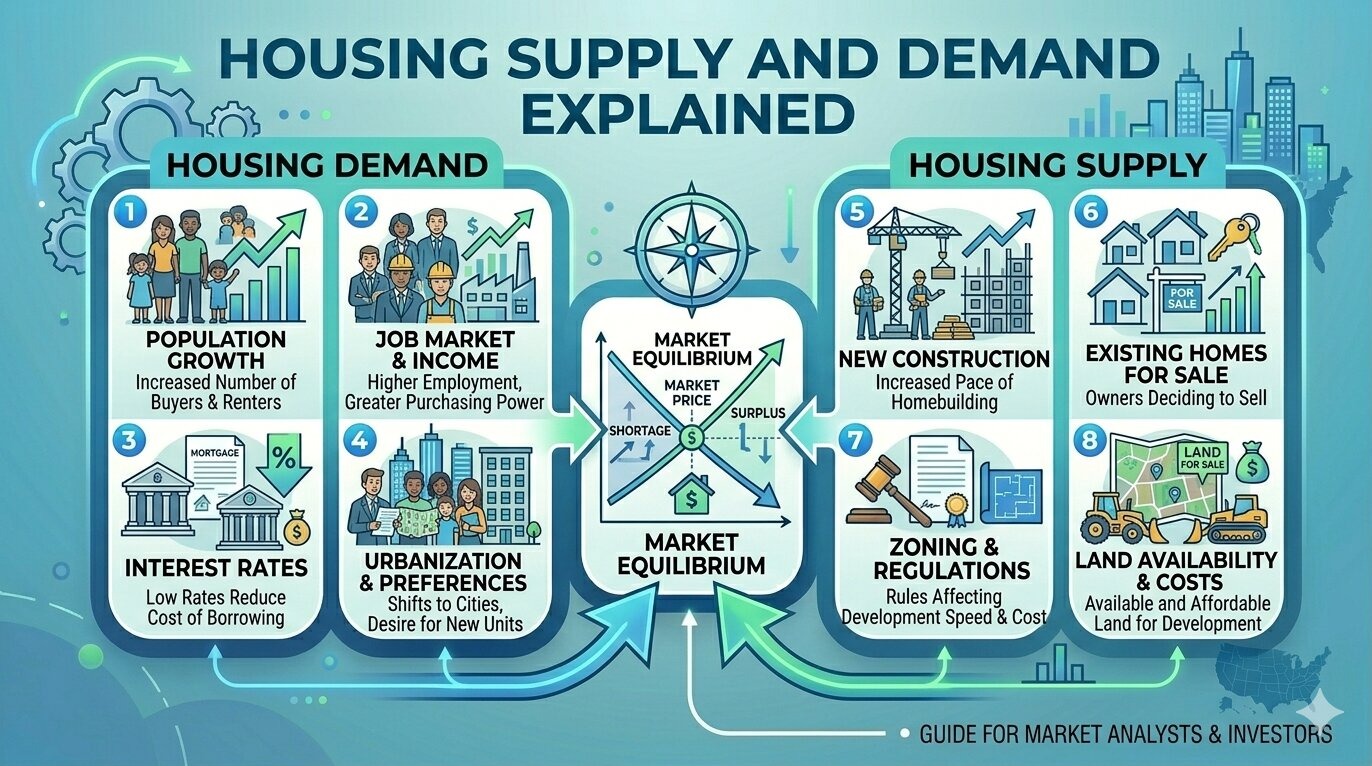
Housing supply and demand is one of the most fundamental concepts in real estate—and one of the biggest drivers of property prices, rent levels, and investment opportunities in the United States.
At its core, every shift in the real estate market—whether prices rise, rents increase, or inventory tightens—comes down to the balance (or imbalance) between supply and demand.
This guide explains how housing supply and demand works in the U.S., with real-world examples, practical insights, and how investors can use this knowledge to make better decisions.
What Is Housing Supply and Demand?
Housing supply refers to the number of properties available for sale or rent.
Housing demand refers to the number of buyers or renters actively looking for housing.
Simple Rule:
- High demand + Low supply → Prices increase
- Low demand + High supply → Prices decrease
This basic principle drives nearly every movement in the real estate market.
If you're new to real estate investing, start here:
How Real Estate Investing Works — https://statush.com/real-estate/how-real-estate-investing-works
How Supply and Demand Works in Real Estate
The interaction between supply and demand determines:
- Home prices
- Rental rates
- Time on market
- Investment opportunities
| Market Condition | Supply | Demand | Result |
|---|---|---|---|
| Seller’s Market | Low | High | Prices rise |
| Buyer’s Market | High | Low | Prices fall |
| Balanced Market | Equal | Equal | Stable prices |
Understanding which market you’re in is critical for making smart decisions.
Real-World Example: Supply and Demand in Action
Scenario 1: High Demand, Low Supply (Seller’s Market)
- Limited homes available
- Many buyers competing
Result:
- Bidding wars
- Rising home prices
- Faster sales
This was common during 2020–2022 in many U.S. markets.
Scenario 2: Increasing Supply, Moderate Demand
- More homes listed
- Buyers become selective
Result:
- Stable or slightly declining prices
- Longer selling times
- More negotiation opportunities
This reflects many U.S. markets today.
What Drives Housing Demand?
Demand is influenced by several key factors:
1. Population Growth
More people = more housing demand.
2. Job Market
Strong employment increases purchasing power.
3. Interest Rates
Lower rates make homes more affordable, increasing demand.
Learn more:
How Interest Rates Affect Real Estate Prices — https://statush.com/real-estate/how-interest-rates-affect-real-estate-prices
4. Income Levels
Higher incomes support higher home prices and rents.
5. Lifestyle Trends
Migration patterns (e.g., moving to suburban or Sun Belt states) affect demand.
What Affects Housing Supply?
Supply is slower to change than demand.
1. New Construction
Building new homes increases supply—but takes time.
2. Existing Home Listings
Homeowners deciding to sell adds to supply.
3. Regulations and Zoning
Local laws can limit how much new housing is built.
4. Construction Costs
Higher costs reduce new development.
5. Interest Rates
Higher rates discourage selling (owners hold onto low-rate mortgages).
Supply Constraints in the U.S.
The U.S. housing market has faced a long-term supply shortage.
Reasons:
- Underbuilding after the 2008 financial crisis
- Rising construction costs
- Labor shortages
- Zoning restrictions
This has led to:
- Higher home prices
- Increased rent levels
- Strong competition in many markets
Supply and Demand in Rental Markets
The same principles apply to rental properties.
High Demand, Low Supply:
- Higher rents
- Lower vacancy rates
High Supply, Lower Demand:
- Rent reductions
- Increased vacancy
For rental strategy insights:
Long-Term Rental Investing Strategy — https://statush.com/real-estate/long-term-rental-investing-strategy
How Supply and Demand Affects Investors
Understanding supply and demand helps investors make better decisions.
When Demand Is High:
- Easier to rent properties
- Higher rent potential
- Strong appreciation
When Supply Is High:
- More buying opportunities
- Better negotiation power
- Slower rent growth
The best investors adjust their strategy based on market conditions.
Identifying Market Conditions
You can analyze supply and demand using simple indicators.
| Indicator | What It Tells You |
|---|---|
| Days on Market | How fast homes sell |
| Inventory Levels | Number of available properties |
| Price Trends | Direction of market |
| Rental Vacancy Rates | Demand for rentals |
These indicators help you understand whether the market favors buyers or sellers.
Practical Tips for Investors
1. Focus on High-Demand Areas
Look for:
- Job growth
- Population increase
- Strong rental demand
2. Avoid Oversupplied Markets
Too many properties = lower rents and slower sales.
3. Track Local Data
Real estate is local—national trends don’t tell the full story.
4. Time Your Strategy
- Buy in high-supply markets
- Sell or rent in high-demand markets
Common Mistakes to Avoid
Ignoring Local Market Conditions
National trends may not reflect your specific market.
Overestimating Demand
Assuming properties will rent quickly without research.
Buying in Oversupplied Areas
Leads to vacancy and lower returns.
Not Monitoring Trends
Markets change—stay updated.
For more pitfalls:
Real Estate Investing Mistakes to Avoid in USA — https://statush.com/real-estate/real-estate-investing-mistakes-to-avoid-in-usa
Supply and Demand Across Market Cycles
Supply and demand shift during different phases of the real estate cycle.
- Expansion → Demand rises faster than supply
- Peak → Prices stabilize
- Contraction → Supply increases, demand slows
- Recovery → Balance returns
To understand cycles:
Real Estate Market Cycles Explained — https://statush.com/real-estate/real-estate-market-cycles-explained
When Supply and Demand Matters Most
This concept becomes especially important when:
- Choosing investment locations
- Setting rental prices
- Timing property purchases
- Scaling your portfolio
It’s one of the most powerful tools for making informed decisions.
Final Thoughts
Housing supply and demand is the foundation of real estate investing. It influences:
- Property prices
- Rental income
- Investment opportunities
The most successful investors don’t just look at properties—they understand the market forces behind them.
If you learn to analyze supply and demand effectively, you’ll be able to:
- Identify better deals
- Reduce risk
- Maximize long-term returns
In real estate, understanding the market is just as important as owning property.
To explore how this fits into a broader strategy:
Best Real Estate Investment Strategies — https://statush.com/real-estate/best-real-estate-investment-strategies