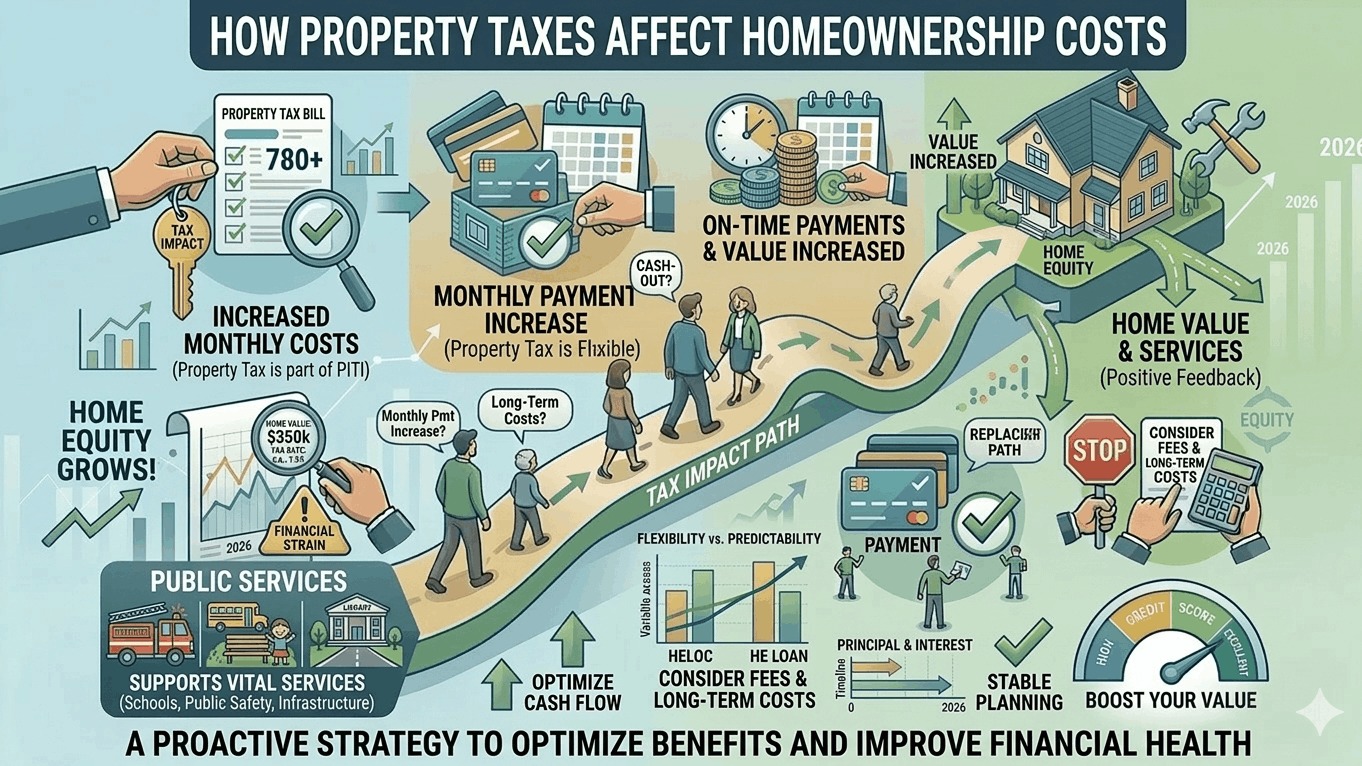
In 2026, property taxes are no longer a "set and forget" expense. With the national average property tax bill now topping $3,500 (up 4.2% from last year), these taxes have become the single largest "invisible" cost of homeownership.
Understanding how property taxes are calculated and how they impact your monthly budget is essential for any 2026 homebuyer, especially as several states—including Texas, Florida, and Ohio—are undergoing major legislative shifts in how these taxes are collected.
1. The 2026 Property Tax Formula
Your property tax is an ad valorem tax, meaning it is based on the value of the property. In 2026, the calculation follows a standardized three-step process:
- Assessed Value: A local tax assessor determines your home's value. This is often 80% to 90% of the fair market value.
- Assessment Ratio: Some states apply a secondary percentage to that value (e.g., Colorado uses a 6.8% rate for local government assessments).
- Mill Rate: This is the tax rate expressed in "mills" (tax per $1,000 of value). One mill equals $1 for every $1,000 of assessed value.
Simple Math: If your home is assessed at $400,000 and your local mill rate is 15 mills (1.5%), your annual tax is $6,000, or $500 per month.
2. State-by-State Impact (Highest vs. Lowest)
Where you buy in the USA can change your tax bill by over 600%. In 2026, the gap between high-tax and low-tax states has widened due to varying local school funding needs.
| State | Avg. Effective Rate (2026) | Est. Tax on $400k Home |
|---|---|---|
| New Jersey | 2.23% | $8,920 |
| Illinois | 2.07% | $8,280 |
| Texas | 1.81% | $7,240 |
| Florida | 0.89% | $3,560 |
| Alabama | 0.41% | $1,640 |
| Hawaii | 0.32% | $1,280 |
3. How Taxes Impact Your Buying Power
Lenders include property taxes in your Debt-to-Income (DTI) ratio. In 2026, every $100 increase in monthly property taxes reduces your mortgage buying power by approximately $15,000.
- The Escrow Cushion: Most 2026 lenders require an escrow account. At closing, you may need to "pre-pay" 3 to 9 months of property taxes upfront to create a reserve, which can add thousands to your initial closing costs.
- The "New Construction" Trap: If you buy a new home in 2026, your initial tax bill might be based only on the land value. Once the local assessor "sees" the completed house, your tax bill could double or triple in the second year.
4. 2026 Tax Relief & Exemptions
Legislative "tax revolts" in 2024 and 2025 have led to record-high exemptions in 2026. You must manually apply for these; they are rarely automatic.
- Homestead Exemption: The most common relief. In Texas, for example, the 2026 school district exemption recently jumped to $140,000, meaning a homeowner with a $300,000 house only pays school taxes on $160,000.
- The "Save Our Homes" Cap: States like Florida limit how much your assessed value can rise each year (typically capped at 3%), protecting long-term owners from rapid market spikes.
- Circuit Breakers: These are targeted credits for seniors, veterans, or low-income households that "break" the tax bill if it exceeds a certain percentage of their income.