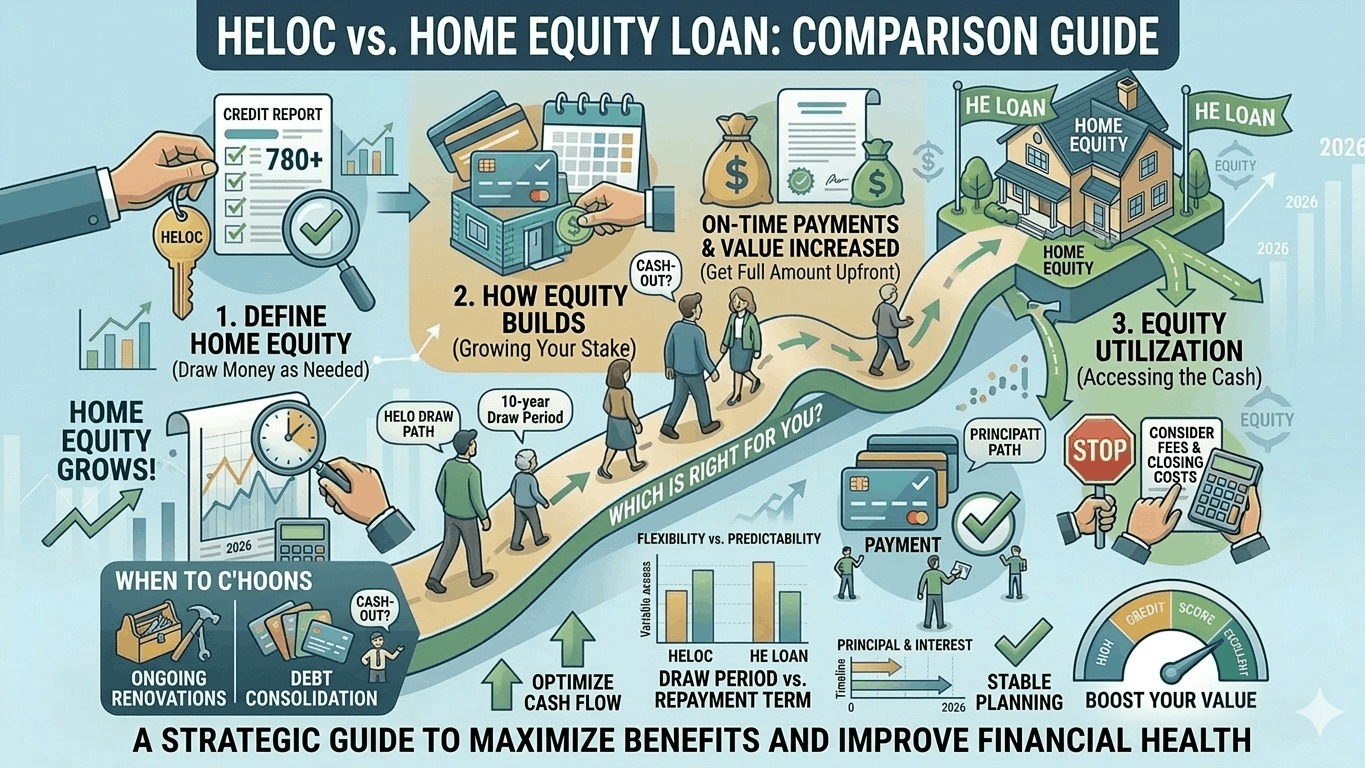
As of March 2026, American homeowners are sitting on record-breaking levels of equity. While mortgage rates for new purchases have remained high, home equity products have become the go-to "survival tool" for funding renovations, consolidating debt, or managing cash flow.
Choosing between a Home Equity Line of Credit (HELOC) and a Home Equity Loan depends on whether you need a flexible "safety net" or a predictable lump sum.
1. Quick Comparison: 2026 Market Averages
In the current rate environment, HELOCs generally offer lower starting rates, while Home Equity Loans offer the security of a fixed rate.
| Feature | HELOC (Line of Credit) | Home Equity Loan (Lump Sum) |
|---|---|---|
| Average Rate (March 2026) | 7.18% (Variable) | 7.84% (Fixed) |
| Typical Rate Range | 4.74% – 11.74% | 5.49% – 10.75% |
| Structure | Revolving (Like a credit card) | Installment (Like a car loan) |
| Payout | As-needed draws | One-time lump sum |
| Repayment | Interest-only options (Draw period) | Principal + Interest (Immediate) |
2. Deep Dive: The Home Equity Line of Credit (HELOC)
A HELOC is a revolving line of credit secured by your home. It consists of two phases: the Draw Period (usually 10 years) and the Repayment Period (usually 10–20 years).
Pros in 2026:
- Pay Only for What You Use: If you have a $50,000 line but only spend $5,000 on a new roof, you only pay interest on that $5,000.
- Flexible Payments: Many 2026 lenders offer "interest-only" payments during the draw period, which is great for short-term cash flow.
- Falling Rate Potential: Since HELOCs are variable (tied to the Prime Rate), your rate will automatically drop if the Federal Reserve cuts rates later in 2026.
Cons:
- Rate Uncertainty: If inflation spikes and the Fed raises rates, your monthly payment will increase.
- Overspending Risk: Because it feels like a credit card, it’s easy to borrow more than you strictly need.
3. Deep Dive: The Home Equity Loan
Often called a "second mortgage," this is a straightforward loan where you receive all the cash upfront and pay it back in equal monthly installments.
Pros in 2026:
- Rate Lock Security: Your interest rate is fixed at closing. You are protected from market volatility for the next 5 to 30 years.
- Predictable Budgeting: You know exactly what your payment is every month, making it easier to manage long-term financial goals.
- Discipline: Since you can't "re-borrow" the money once it's paid back, there's less risk of staying in debt.
Cons:
- Interest on Total Amount: You pay interest on the full loan from Day 1, even if you don't spend it all immediately.
- Higher Initial Rates: In 2026, fixed-rate equity loans are roughly 0.65% higher than variable HELOCs on average.