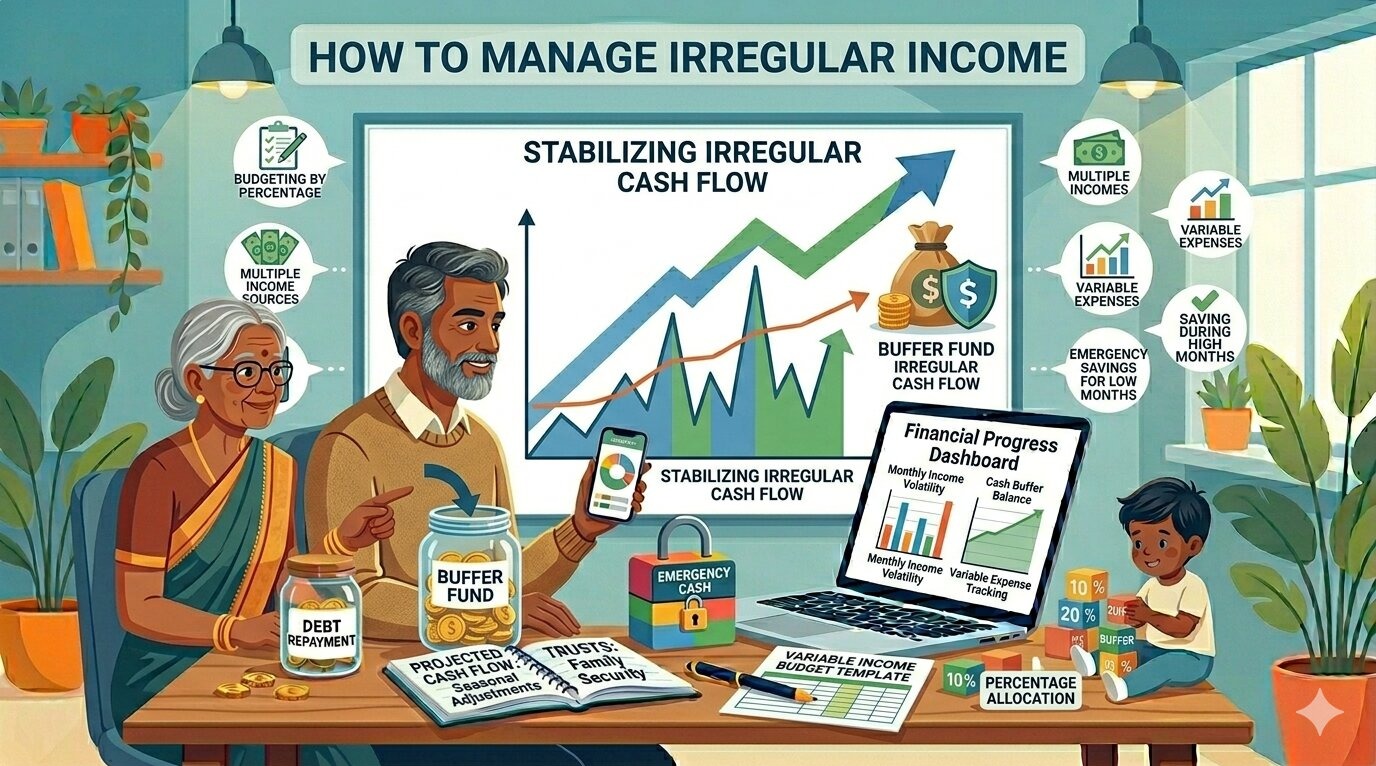
Managing money is challenging enough with a fixed salary. But when your income is irregular—like freelancing, business earnings, or commissions—it becomes even more complicated.
Some months you earn more, some months less. That inconsistency can make budgeting, saving, and planning feel difficult.
But with the right system, you can create stability—even with unpredictable income.
Let’s break down how to manage irregular income in a practical way.
Why Irregular Income Feels Difficult
The biggest challenge isn’t earning—it’s managing uncertainty.
Common issues include:
- Unpredictable cash flow
- Difficulty planning monthly expenses
- Inconsistent savings
- Financial stress during low-income months
For example:
You might earn ₹80,000 one month and ₹30,000 the next. Without planning, this leads to overspending in high-income months and stress in low-income months.
That’s why you need a system that smooths out these fluctuations.
Step 1: Calculate Your Average Income
The first step is to create a stable baseline.
Look at your last 6–12 months of income and calculate the average.
Example:
| Month | Income |
|---|---|
| Jan | ₹60,000 |
| Feb | ₹40,000 |
| Mar | ₹80,000 |
| Apr | ₹30,000 |
| Average | ₹52,500 |
Use this average as your working monthly income.
This prevents you from overestimating your finances.
Step 2: Build a “Minimum Income Budget”
Instead of budgeting based on average income, create a budget based on your lowest earning month.
This ensures you can survive even during low-income periods.
Example:
- Lowest income month: ₹30,000
- Budget based on ₹30,000
This approach creates financial safety.
If you need help creating a budget, read
How to Create a Monthly Budget That Works
https://statush.com/money/how-to-create-a-monthly-budget-that-works
Step 3: Separate Business and Personal Finances
If you earn through freelancing or business, avoid mixing finances.
Use:
- One account for income
- One account for personal expenses
This helps you:
- Track earnings clearly
- Avoid overspending
- Maintain discipline
Step 4: Create an Income Buffer
An income buffer is different from an emergency fund.
It helps you manage uneven income.
How it works:
- Save extra income during high-earning months
- Use it during low-income months
For example:
- Earn ₹80,000 → spend ₹50,000 → save ₹30,000 buffer
- Next month earn ₹30,000 → use ₹20,000 from buffer
This creates stability.
To build your initial safety base, read
How to Build an Emergency Fund from Zero
https://statush.com/money/how-to-build-an-emergency-fund-from-zero
Step 5: Prioritize Essential Expenses First
When income is uncertain, priorities matter.
Focus on:
- Rent and housing
- Food and groceries
- Utilities
- Insurance
Lifestyle expenses should come after essentials are covered.
Step 6: Save During High-Income Months
One of the biggest mistakes is increasing spending when income increases.
Instead:
- Maintain a consistent lifestyle
- Save the extra income
Example:
- Normal expenses: ₹40,000
- Income this month: ₹80,000
- Save ₹40,000 instead of increasing spending
This builds long-term stability.
Step 7: Track Your Cash Flow Regularly
With irregular income, tracking becomes even more important.
Monitor:
- Income received
- Expenses paid
- Available balance
A simple weekly check can prevent financial surprises.
To improve tracking, read
How to Track Your Spending Effectively
https://statush.com/money/how-to-track-your-spending-effectively
Step 8: Control Variable Expenses
Flexible expenses should be adjusted based on income.
Examples:
- Dining out
- Shopping
- Travel
In low-income months:
- Reduce these expenses
In high-income months:
- Avoid unnecessary upgrades
If you want to reduce expenses, read
How to Reduce Monthly Expenses Quickly
https://statush.com/money/how-to-reduce-monthly-expenses-quickly
Step 9: Build Strong Financial Discipline
Irregular income requires stronger discipline than fixed income.
You need to:
- Avoid impulsive spending
- Plan ahead
- Stick to your budget
To strengthen this, read
How to Build Financial Discipline
https://statush.com/money/how-to-build-financial-discipline
Real-Life Example: Managing Fluctuating Income
Ankit is a freelancer.
Monthly income varies:
- ₹25,000 to ₹90,000
His strategy:
- Budget based on ₹30,000
- Save extra income during high months
- Maintain ₹50,000 buffer
Result:
- No stress during low months
- Consistent savings
- Better financial control
The key wasn’t earning more—it was managing better.
Common Mistakes to Avoid
While managing irregular income, avoid these mistakes:
- Spending based on high-income months
- Not saving extra income
- Ignoring low-income planning
- Mixing business and personal money
These mistakes create instability.
Final Thoughts
Irregular income doesn’t have to mean financial instability.
With the right system:
- You create consistency
- You reduce stress
- You build long-term security
Focus on stability, not just income.
Because when you manage uneven income wisely, your finances become predictable—even when your earnings are not.