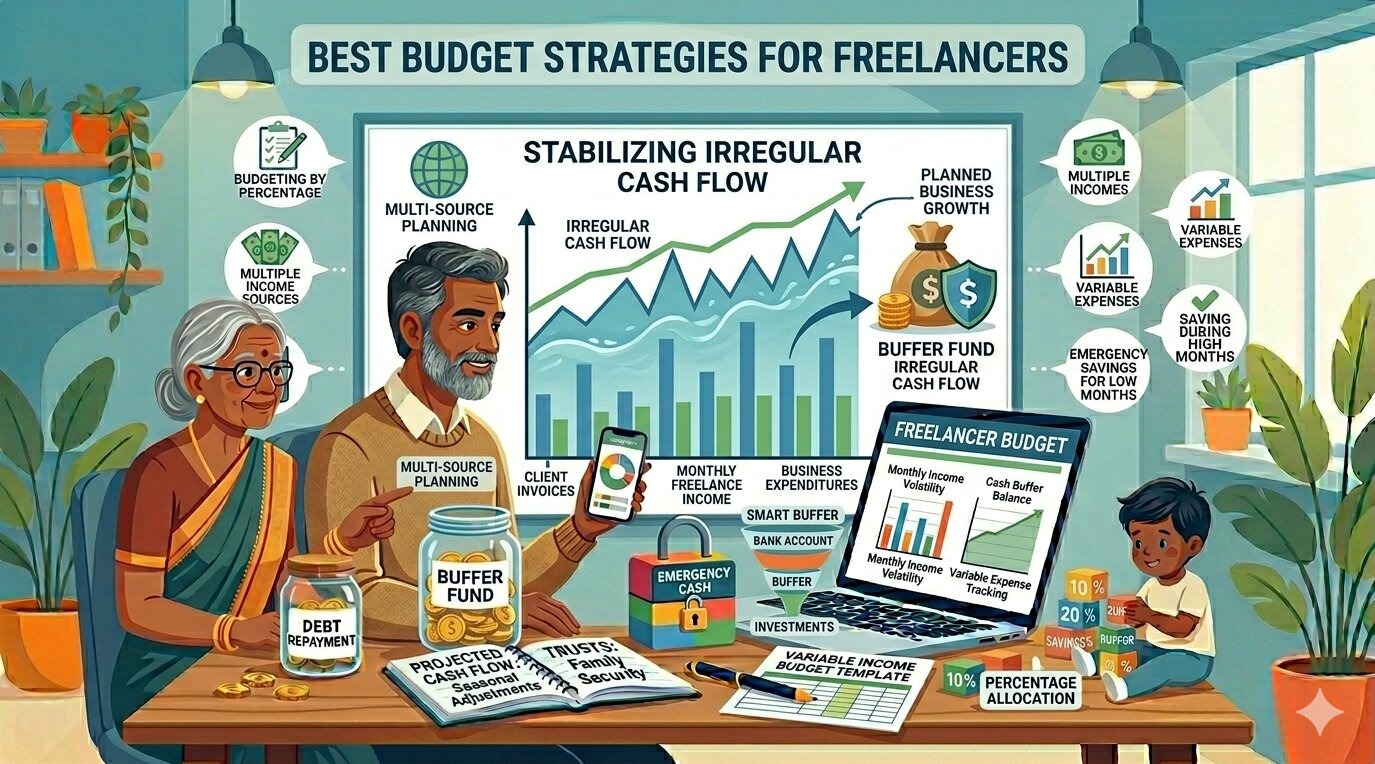
Freelancing offers freedom, flexibility, and unlimited earning potential. But it also comes with one major challenge—income unpredictability.
Unlike a fixed salary, freelance income can vary significantly from month to month. That’s why traditional budgeting methods often don’t work well for freelancers.
To stay financially stable, freelancers need a different approach—one that focuses on flexibility, consistency, and control.
Let’s explore the best budgeting strategies designed specifically for freelancers.
Why Freelancers Need a Different Budgeting Approach
Freelancers face unique financial challenges:
- Irregular income
- Delayed payments
- No fixed benefits (like PF or insurance)
- Higher financial responsibility
For example:
You might earn ₹1,00,000 in one month and ₹30,000 the next. Without a system, this leads to overspending and stress.
That’s why budgeting for freelancers is less about strict rules—and more about smart systems.
If you’re new to managing variable income, read
How to Manage Irregular Income
https://statush.com/money/how-to-manage-irregular-income
Strategy 1: Use a Base Income Budget
Instead of budgeting based on your highest income, use a minimum or average income baseline.
Example:
| Scenario | Amount |
|---|---|
| Highest month | ₹1,00,000 |
| Lowest month | ₹30,000 |
| Budget base | ₹30,000 |
This ensures you can manage expenses even during slow months.
If you need help building a budget, read
How to Create a Monthly Budget That Works
https://statush.com/money/how-to-create-a-monthly-budget-that-works
Strategy 2: Separate Income Into Buckets
A powerful strategy for freelancers is dividing income into categories as soon as you receive it.
Here’s a simple structure:
| Bucket | Percentage | Purpose |
|---|---|---|
| Expenses | 50% | Living costs |
| Savings | 20% | Emergency and future |
| Taxes | 20% | Tax obligations |
| Lifestyle | 10% | Personal spending |
This prevents overspending and ensures all priorities are covered.
Strategy 3: Build an Income Buffer
An income buffer is essential for freelancers.
It helps you:
- Handle low-income months
- Avoid financial stress
- Maintain consistency
How to build it:
- Save extra income during high-earning months
- Use it during low-income periods
If you haven’t started yet, read
How to Build a Financial Safety Net
https://statush.com/money/how-to-build-a-financial-safety-net
Strategy 4: Pay Yourself a Fixed Salary
Instead of spending directly from your income, create a system where you pay yourself a fixed monthly amount.
Example:
- Total income (variable)
- Fixed monthly “salary”: ₹40,000
Extra income stays in your business account as buffer or savings.
This creates stability and makes budgeting easier.
Strategy 5: Track Cash Flow, Not Just Expenses
Freelancers must track both:
- Income inflow
- Expense outflow
This gives a complete picture of financial health.
A simple weekly review can help you stay on track.
To improve tracking, read
How to Track Your Spending Effectively
https://statush.com/money/how-to-track-your-spending-effectively
Strategy 6: Plan for Taxes in Advance
One of the biggest mistakes freelancers make is ignoring taxes.
Always:
- Set aside a portion of income for taxes
- Avoid spending tax money
Example:
If you earn ₹50,000, set aside ₹10,000–₹15,000 for taxes.
This prevents last-minute stress.
Strategy 7: Control Lifestyle Inflation
When income increases, it’s tempting to increase spending.
But this creates instability.
Instead:
- Maintain consistent lifestyle expenses
- Save or invest extra income
If you want to reduce unnecessary spending, read
How to Reduce Monthly Expenses Quickly
https://statush.com/money/how-to-reduce-monthly-expenses-quickly
Strategy 8: Maintain Emergency and Business Funds
Freelancers need two types of funds:
- Personal emergency fund (3–6 months expenses)
- Business buffer fund (to manage income gaps)
This dual protection ensures financial stability.
If you’re starting from zero, read
How to Build an Emergency Fund from Zero
https://statush.com/money/how-to-build-an-emergency-fund-from-zero
Strategy 9: Build Financial Discipline
Freelancing requires strong self-control.
Without discipline:
- Income gets mismanaged
- Savings become inconsistent
- Stress increases
To strengthen discipline, read
How to Build Financial Discipline
https://statush.com/money/how-to-build-financial-discipline
Real-Life Example: Freelance Stability System
Rohit is a freelance designer.
Income range:
- ₹30,000 to ₹1,20,000/month
His system:
- Budget based on ₹40,000
- Saves extra income in buffer
- Pays himself fixed salary
Result:
- Stable monthly lifestyle
- No stress during low-income months
- Consistent savings growth
The key wasn’t earning more—it was managing smarter.
Common Mistakes to Avoid
Freelancers often make these mistakes:
- Spending based on high-income months
- Not saving for taxes
- Mixing personal and business money
- Ignoring financial planning
Avoiding these mistakes can dramatically improve stability.
Final Thoughts
Freelancing doesn’t have to mean financial uncertainty.
With the right strategies:
- You create stability
- You reduce stress
- You build long-term wealth
Focus on systems, not just income.
Because when your money is managed well, freelancing becomes not just flexible—but financially secure.