If you are new to investing, you have probably come across the term ETF more than once. It shows up in retirement discussions, brokerage accounts, beginner investing guides, and personal finance articles across the United States. For many investors, ETFs have become one of the easiest and most flexible ways to build a portfolio without making investing feel overly complicated.
An ETF can give you exposure to dozens, hundreds, or even thousands of investments through a single purchase. That simplicity is one of the main reasons so many people like them. But convenience is not the only reason ETFs have become so popular. Investors also appreciate their low costs, diversification, flexibility, and the wide variety of options available in the U.S. market.
To understand why ETFs are so widely used, it helps to start with the basics. Once you understand what an ETF is and how it works, it becomes easier to see why both beginners and experienced investors continue to rely on them.
What Is an ETF?
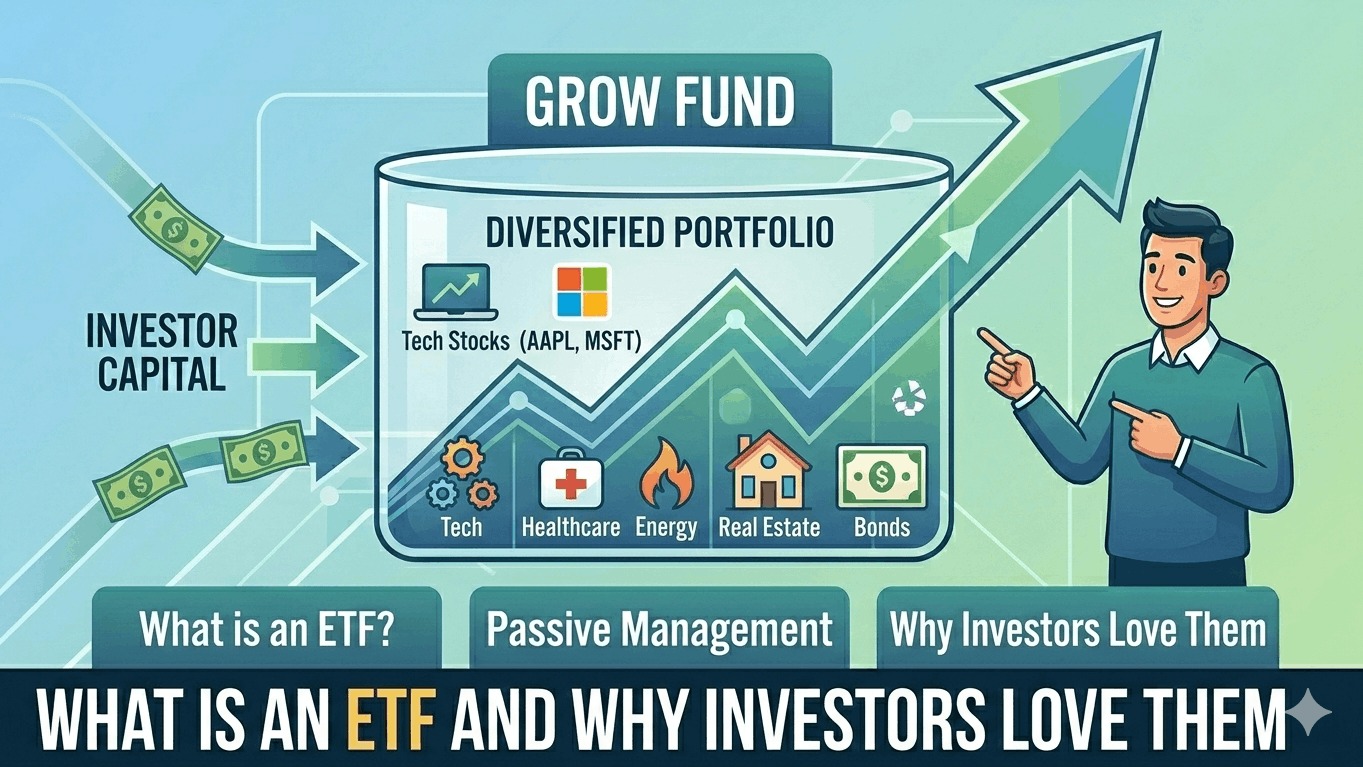
ETF stands for exchange-traded fund. It is a type of investment fund that holds a collection of assets, such as stocks, bonds, commodities, or a mix of investments. Instead of buying each asset individually, you buy shares of the ETF, and those shares represent a slice of the full portfolio inside the fund.
In simple terms, an ETF bundles multiple investments together into one product that trades on the stock market.
That is one of the most important differences between an ETF and some other types of funds. Because ETFs trade on an exchange, you can buy and sell them during the trading day, much like individual stocks. Their prices move throughout the day based on supply, demand, and the value of the assets held inside the fund.
For example, if an ETF tracks the S&P 500, then buying one share of that ETF gives you exposure to many of the largest publicly traded companies in the United States. Instead of buying hundreds of stocks one at a time, you can buy one fund that owns them for you.
How an ETF Works
An ETF is created by a fund provider that builds a portfolio around a certain strategy or market segment. Some ETFs track a major index, while others focus on a sector, theme, asset class, or investment style.
Once the ETF is launched, its shares trade on a stock exchange. Investors can purchase shares through a brokerage account, retirement account, or investment platform that supports ETF trading.
The value of an ETF comes from the investments it holds. If the underlying stocks or bonds inside the ETF rise in value, the ETF price generally rises too. If those holdings fall, the ETF price generally falls.
Many ETFs are designed to track an index. These are called index ETFs. For example:
- A U.S. large-cap ETF may track the S&P 500
- A total market ETF may track a broad stock index
- A bond ETF may track a bond market benchmark
- An international ETF may track stocks from outside the United States
Other ETFs are actively managed, which means professionals decide what to buy and sell inside the fund based on the strategy.
Why ETFs Became So Popular
ETFs have grown in popularity because they make investing more accessible, efficient, and flexible. They appeal to both beginner investors who want simplicity and experienced investors who want precise control over portfolio construction.
Over time, many U.S. investors realized that ETFs solve several common investing challenges at once. They can reduce the need to research individual securities, help spread risk across multiple holdings, and often do so at a lower cost than many traditional funds.
The growth of online brokerages and commission-free trading has also made ETFs even more attractive. Investors can now buy and sell many ETFs with ease, often with low barriers to entry.
Main Reasons Investors Love ETFs
There is no single reason ETFs became popular. Their appeal comes from a combination of benefits that work well for modern investors.
1. Easy diversification
One of the biggest advantages of ETFs is diversification. Instead of putting all your money into one stock, an ETF can spread your investment across many securities.
For example, buying a single technology stock can expose you to company-specific risk. But buying a technology ETF can spread your money across multiple tech companies. The same logic applies to broad market ETFs, bond ETFs, and international ETFs.
This makes ETFs a useful choice for investors who want to reduce concentration risk without having to manage a long list of individual holdings.
2. Lower costs
Many ETFs, especially passive index ETFs, have relatively low expense ratios compared with actively managed mutual funds. Lower costs can make a significant difference over long periods because more of your money remains invested.
Cost-conscious investors often prefer ETFs for this reason alone. Even a small difference in annual fees can have a noticeable impact on portfolio growth over time.
3. Flexibility in trading
Unlike mutual funds, which are usually priced once at the end of the trading day, ETFs can be bought and sold throughout market hours. This gives investors more flexibility in how they enter or exit positions.
For long-term investors, this feature may not be the main attraction, but it can still be useful. For active traders or investors who want more control over execution price, ETF trading flexibility is a meaningful benefit.
4. Broad range of choices
The U.S. ETF market offers a huge variety of options. Investors can choose from ETFs focused on:
- U.S. stocks
- International stocks
- Bonds
- Dividend strategies
- Growth or value investing
- Specific sectors like healthcare or energy
- Real estate
- Commodities
- Thematic trends
This variety allows investors to build simple portfolios or highly customized strategies depending on their needs.
5. Simplicity for beginners
Many new investors feel overwhelmed by the idea of choosing individual stocks. ETFs simplify the process. Instead of trying to identify the next winning company, a beginner can buy a broad market ETF and instantly gain exposure to many investments.
This makes ETFs a practical starting point for learning how markets work.
6. Transparency
Most ETFs clearly state what they track and what they hold. Investors can usually see the fund’s strategy, sector exposure, expense ratio, and holdings relatively easily.
This transparency can help investors make more informed choices.
Common Types of ETFs
Not all ETFs are the same. Different funds serve different purposes, and understanding the major categories can help investors choose the right ones.
Stock ETFs
Stock ETFs invest in shares of companies. They may track broad indexes, sectors, styles, or market-cap categories.
Examples include:
- S&P 500 ETFs
- Total stock market ETFs
- Small-cap ETFs
- International stock ETFs
- Dividend ETFs
These are often used for long-term growth.
Bond ETFs
Bond ETFs invest in fixed-income securities such as government bonds, corporate bonds, or municipal bonds. They are often used to generate income, reduce volatility, or balance a stock-heavy portfolio.
Sector ETFs
Sector ETFs focus on one part of the economy, such as technology, healthcare, financials, or consumer staples. These ETFs can be useful for targeted exposure, but they are usually less diversified than broad market funds.
International ETFs
International ETFs invest in companies outside the United States. Some focus on developed markets, while others target emerging markets or specific countries.
These can help diversify a portfolio beyond the U.S. economy.
Commodity ETFs
Commodity ETFs track assets like gold, silver, oil, or broad commodity baskets. Investors may use them for diversification or inflation-related strategies.
Thematic ETFs
Thematic ETFs focus on trends or ideas such as clean energy, artificial intelligence, robotics, or cybersecurity. These may sound exciting, but they often come with higher volatility and narrower exposure.
ETF vs Mutual Fund
Many beginners confuse ETFs and mutual funds because both can hold baskets of investments. While they are similar in some ways, there are important differences.
| Feature | ETF | Mutual Fund |
|---|---|---|
| Trading | Trades during market hours | Usually priced once per day |
| Buying method | Bought like a stock | Bought directly through fund company or broker |
| Pricing | Price changes throughout day | End-of-day net asset value |
| Minimum investment | Often price of one share or fractional share | May require a set minimum |
| Use in auto-investing | Sometimes limited depending on broker | Often easy to automate |
Both can be good choices. The better option depends on the investor’s goals, platform, and preferences.
ETF vs Individual Stocks
ETFs are also often compared with buying individual stocks. Each approach has benefits, but ETFs tend to be more beginner-friendly because of diversification.
Here is a simple comparison:
| Feature | ETF | Individual Stock |
|---|---|---|
| Diversification | High in many cases | Low if only one company |
| Risk concentration | Lower | Higher |
| Research required | Moderate to low | Higher |
| Volatility | Often spread across holdings | Can be more extreme |
| Simplicity | Easy for beginners | Requires more analysis |
An investor can still own both ETFs and individual stocks, but ETFs often form the core of a more balanced portfolio.
Example of How an ETF Can Fit Into a Portfolio
Suppose an investor wants to start with a simple long-term strategy in the United States. Instead of buying five or ten separate stocks, they choose a few ETFs to create broad exposure.
Here is a basic example table:
| Portfolio Goal | Example ETF Type | Purpose in Portfolio |
|---|---|---|
| U.S. stock growth | S&P 500 ETF or total market ETF | Core long-term growth |
| Global diversification | International ETF | Exposure outside the U.S. |
| Stability and income | Bond ETF | Reduce volatility and add balance |
| Sector tilt | Technology ETF | Add targeted growth exposure |
This kind of structure can make portfolio building more manageable. The investor does not need to track dozens of securities individually because the ETFs already hold many underlying assets.
Why U.S. Investors Especially Like ETFs
In the United States, ETFs fit well with how many people invest today. They work across taxable brokerage accounts, IRAs, and sometimes even retirement-focused strategies. They are easy to research, simple to buy, and available in many forms.
They also support different investing styles. A beginner may use one or two ETFs to keep things simple. A more advanced investor may use several ETFs to target different regions, sectors, or asset classes. This flexibility is a big reason ETFs continue to attract such a wide audience.
For long-term investors, ETFs often offer the right mix of convenience and efficiency. For more active investors, they provide precision and ease of trading. Few investment products serve both groups as well as ETFs do.
Final Thoughts
An ETF, or exchange-traded fund, is a simple but powerful investing tool. It allows investors to buy a basket of assets through a single fund that trades like a stock. This makes it easier to diversify, lower costs, and build a portfolio that fits different goals.
Investors love ETFs because they combine many advantages in one product. They are flexible, accessible, often cost-effective, and available in a wide range of options. Whether someone wants a basic long-term investing strategy or a more customized portfolio, ETFs can play a useful role.
For beginners, ETFs can provide an easier way to start investing without needing to research individual stocks one by one. For experienced investors, they offer efficient portfolio tools that can be used in many different ways.
That is why ETFs continue to stand out in the U.S. investing world. They help make investing more practical, more flexible, and often less intimidating for people who want to build wealth over time.