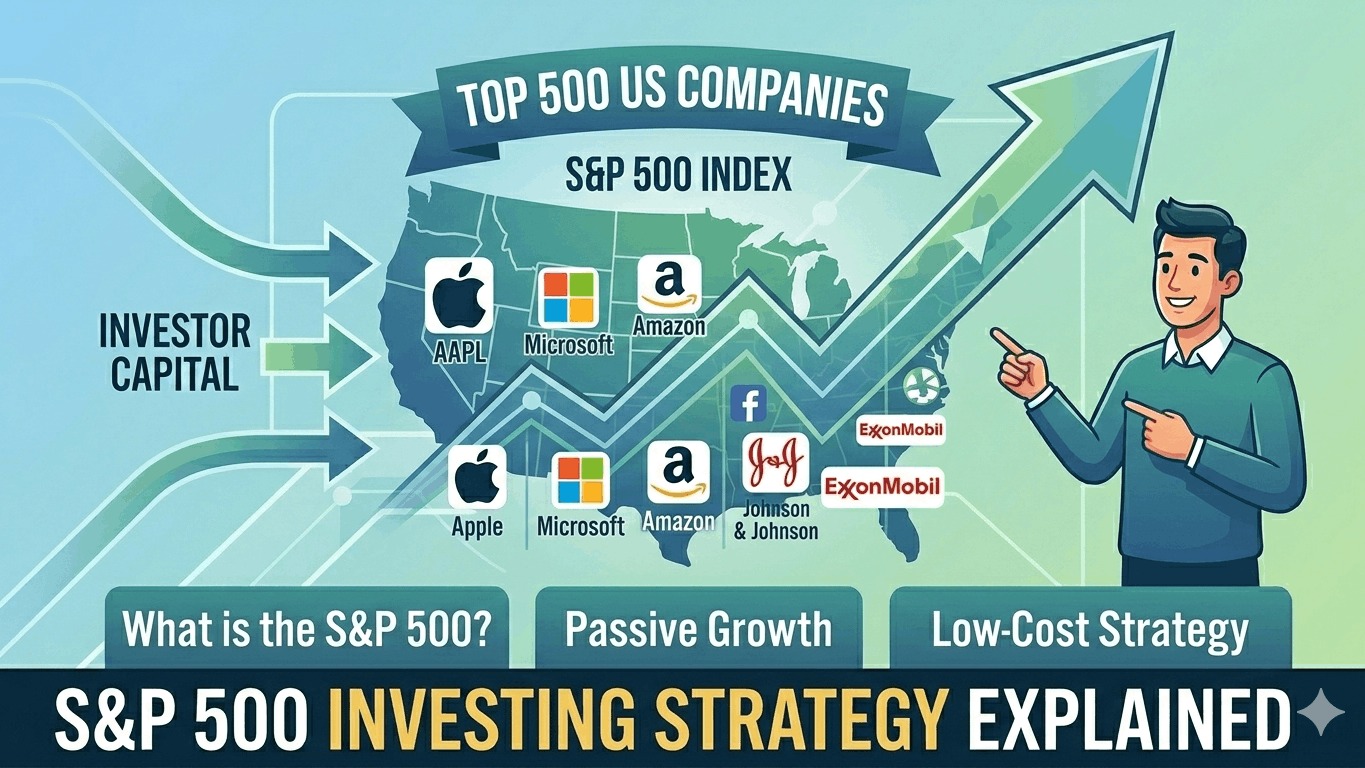
For many investors in the United States, the S&P 500 is one of the first places they look when learning how to build long-term wealth. It is widely seen as a benchmark for the U.S. stock market and a simple way to gain exposure to many of the country’s largest companies through a single investment. That is why the phrase S&P 500 investing strategy comes up so often in personal finance, retirement planning, and beginner investing guides.
But what does it really mean to invest using an S&P 500 strategy? Is it just buying one fund and holding it forever? Does it work for beginners only, or can experienced investors use it too? And how does it fit into a broader portfolio?
The truth is that an S&P 500 investing strategy is simple in structure but powerful in practice. It is built on the idea that instead of trying to beat the market by constantly picking individual stocks, many investors can benefit from owning a broad slice of leading U.S. companies and staying invested for the long term.
This article explains how an S&P 500 investing strategy works, why so many U.S. investors use it, the benefits and limitations of this approach, and how to apply it in a practical way.
What Is the S&P 500?
The S&P 500, or Standard & Poor’s 500, is a stock market index made up of 500 of the largest publicly traded companies in the United States. These companies come from a wide range of sectors, including technology, healthcare, finance, consumer goods, energy, industrials, and more.
Because it includes major American businesses across different industries, the S&P 500 is often used as a snapshot of the overall health and direction of the U.S. stock market.
When people talk about investing in the S&P 500, they usually mean buying a mutual fund or ETF that tracks the index. That fund holds stocks from the companies included in the index, giving investors broad market exposure without needing to buy each stock individually.
What an S&P 500 Investing Strategy Means
An S&P 500 investing strategy is a long-term investment approach centered around funds that track the S&P 500 index. Instead of selecting individual companies, the investor buys shares in a fund that mirrors the index and continues contributing over time.
The strategy is based on a few key ideas:
- Own a diversified group of large U.S. companies
- Keep investing costs low
- Avoid trying to time the market
- Invest consistently over time
- Focus on long-term growth rather than short-term price moves
This approach is popular because it removes much of the guesswork from investing. Rather than asking which stock will do best next year, the investor simply participates in the performance of the broader group of top U.S. businesses.
How an S&P 500 Fund Works
An S&P 500 fund is designed to track the performance of the index. The fund manager holds the same companies included in the S&P 500 and usually weights them similarly. Since the index is market-cap weighted, larger companies make up a bigger percentage of the fund.
That means companies with larger market values have more influence on the index’s performance than smaller members of the index.
For example, if a few of the largest companies perform extremely well, they can have a significant effect on the overall return of the fund. On the other hand, weaker performance from those same large holdings can also affect the index more heavily.
The investor does not need to manage these changes manually. The fund automatically adjusts as the index is updated.
Core Principles of an S&P 500 Investing Strategy
A successful S&P 500 investing strategy usually depends less on finding a secret formula and more on following a few timeless principles with discipline.
1. Buy broad exposure instead of chasing individual stocks
One of the biggest advantages of the S&P 500 strategy is that it shifts the focus away from trying to identify the next big winner. Instead of putting large amounts of money into one or two stocks, you spread your investment across hundreds of leading companies.
This can reduce company-specific risk and make the strategy more stable than relying on a concentrated stock portfolio.
2. Invest consistently
Consistency matters more than perfection for most long-term investors. Many people use dollar-cost averaging, which means investing a fixed amount at regular intervals, such as every paycheck or once a month.
This approach helps build investing discipline and reduces the temptation to wait for the “perfect” market entry point.
3. Stay invested through market volatility
No stock market strategy eliminates downturns. The S&P 500 can fall sharply during bear markets, recessions, or periods of economic stress. Investors using this strategy typically accept short-term volatility in exchange for long-term growth potential.
The ability to stay invested during market declines is one of the most important parts of making this strategy work.
4. Think in years, not weeks
The S&P 500 strategy is not designed for quick gains. It is most effective when viewed as a long-term plan. Investors who judge the strategy based on a few weeks or months may lose confidence during temporary downturns. Those who focus on years or decades are often better positioned to benefit from compounding.
5. Keep costs low
A low-cost S&P 500 index fund can help improve long-term returns because less of the investment is lost to fees. Over long periods, cost differences that seem small at first can have a large impact.
Example of How the Strategy May Work Over Time
Consider a simple example. Suppose an investor contributes $500 per month into an S&P 500 index fund inside a retirement or brokerage account. They continue doing this consistently for years, regardless of whether the market is up or down.
Some months the market is expensive, and other months it is cheaper. The investor keeps buying through both conditions. Over time, this can smooth out the average purchase cost and remove the emotional pressure of market timing.
Here is a basic example table showing a hypothetical investing pattern.
| Month | Monthly Investment | Market Condition | Estimated Shares Bought | Strategy Action |
|---|---|---|---|---|
| January | $500 | Market higher | Fewer shares | Keep investing |
| February | $500 | Market lower | More shares | Keep investing |
| March | $500 | Market volatile | Moderate shares | Keep investing |
| April | $500 | Market recovering | Moderate shares | Keep investing |
| May | $500 | Market rising | Fewer shares | Keep investing |
This table illustrates a key point: the strategy does not depend on predicting market direction each month. The focus is on steady participation.
Different Ways to Use an S&P 500 Strategy
Although the basic idea is simple, investors use the S&P 500 in different ways depending on their goals.
As a full stock allocation
Some investors use an S&P 500 fund as the main or only stock holding in their portfolio. This is common among beginners who want a simple entry into investing and do not want to manage multiple funds.
As a core holding
Others use it as the central piece of a broader portfolio. For example, an investor may combine an S&P 500 fund with:
- A total international stock fund
- A bond index fund
- A small-cap or mid-cap fund
- A dividend or value tilt fund
In this setup, the S&P 500 serves as the foundation while other funds add more diversification.
Inside retirement accounts
Many 401(k) plans and IRAs offer S&P 500 index funds because they are low-cost and easy for participants to understand. This makes the strategy especially common in retirement investing.
S&P 500 Strategy vs Picking Individual Stocks
Many new investors compare index investing with stock picking. Both approaches can be used, but they are very different in effort, risk, and predictability.
With stock picking, the investor has to research companies, evaluate valuations, track earnings, and decide when to buy or sell. This takes time and can lead to mistakes driven by emotion or overconfidence.
With an S&P 500 strategy, the investor avoids trying to identify winners one by one. They simply own a broad collection of major U.S. companies and let the market structure do the work.
Here is a simple comparison:
| Feature | S&P 500 Investing Strategy | Individual Stock Picking |
|---|---|---|
| Diversification | High | Often limited |
| Research needed | Low to moderate | High |
| Risk concentration | Lower | Higher |
| Time commitment | Low | High |
| Emotional trading risk | Lower | Higher |
| Potential to beat market | Limited by design | Possible, but difficult |
This does not mean stock picking is always wrong. It simply means the S&P 500 strategy is usually easier to maintain and often more practical for long-term investors.
Example Portfolio Approaches Using the S&P 500
Different investors may use the strategy in different ways depending on their comfort with risk and diversification goals.
| Investor Type | Possible Portfolio Approach | Main Goal |
|---|---|---|
| Beginner investor | 100% S&P 500 fund | Simplicity and growth |
| Retirement saver | S&P 500 fund + bond fund | Growth with some stability |
| Diversified investor | S&P 500 fund + international fund + bond fund | Broader global exposure |
| Hands-off investor | S&P 500 fund through recurring auto-investing | Long-term consistency |
These are only examples, but they show how flexible the strategy can be.
Common Mistakes to Avoid
Although the strategy is simple, investors can still make mistakes that reduce its effectiveness.
One common mistake is trying to time the market. Waiting for a perfect entry point often leads to missed opportunities or endless hesitation.
Another mistake is panic selling during downturns. Market declines are part of investing. Selling out of fear can turn temporary losses into permanent ones.
Some investors also make the mistake of checking performance too often. Daily or weekly price swings can create stress and lead to emotional decisions.
Another issue is assuming the S&P 500 is fully diversified for every purpose. While it is diversified across major U.S. companies, it is not the same as owning the entire global market or a balanced stock-and-bond portfolio.
Final Thoughts
The S&P 500 investing strategy is one of the most practical and widely used approaches in long-term investing. It is based on a simple idea: own a broad group of leading U.S. companies, invest consistently, keep costs low, and stay patient through market ups and downs.
Its strength is not complexity. Its strength is discipline.
For many investors, especially in the United States, this strategy provides a clear path toward long-term wealth building without the pressure of constantly picking stocks or predicting short-term market moves. It can work as a beginner-friendly strategy, a retirement investing foundation, or the core holding in a larger portfolio.
The key is to understand what it does well, where its limits are, and how it fits your personal financial goals. When used with patience and consistency, the S&P 500 strategy can be a powerful tool for building wealth over time.