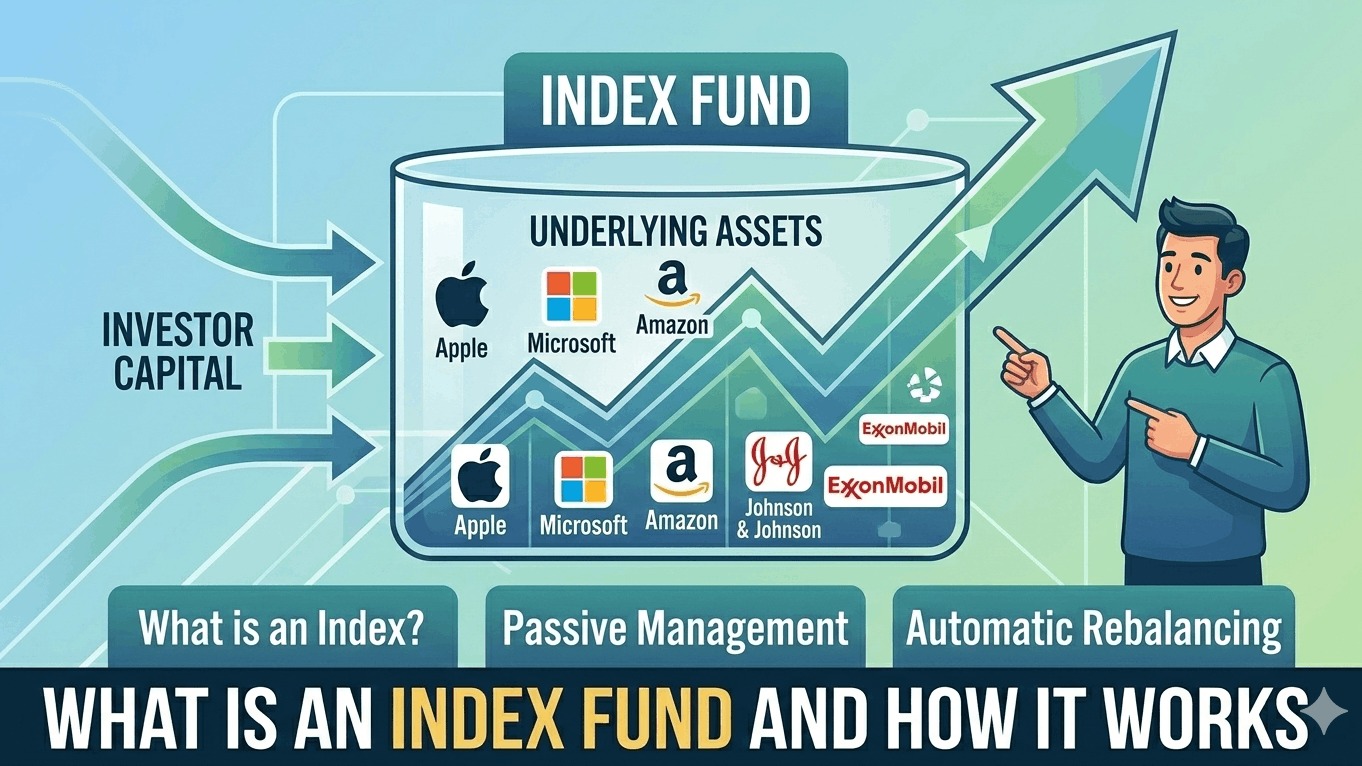
If you are new to investing, the term index fund might sound technical or complicated. In reality, it is one of the simplest and most popular ways to invest in the stock market. Many beginners in the United States start with index funds because they are easy to understand, widely available, and designed to give investors broad market exposure without needing to pick individual stocks.
An index fund is built to follow the performance of a specific market index, such as the S&P 500, the Dow Jones Industrial Average, or the Nasdaq-100. Instead of trying to beat the market by choosing “winning” stocks, an index fund aims to match the market or a segment of it. That idea may sound modest, but it has become one of the most powerful strategies in long-term investing.
This guide explains what an index fund is, how it works, why so many U.S. investors use it, and what beginners should know before putting money into one.
What Is an Index Fund?
An index fund is a type of investment fund that tracks a market index. A market index is simply a group of securities used to measure the performance of a section of the market.
For example:
- The S&P 500 tracks 500 of the largest publicly traded U.S. companies.
- The Nasdaq-100 tracks 100 large non-financial companies listed on the Nasdaq exchange.
- The Russell 2000 tracks smaller U.S. companies.
- A total stock market index can track thousands of U.S. stocks.
When you buy shares of an index fund, you are not investing in just one company. Instead, you are buying a fund that holds many stocks or bonds based on the index it follows. This means one investment can instantly give you diversification.
For instance, if you invest in an S&P 500 index fund, your money is spread across many major U.S. companies such as Apple, Microsoft, Amazon, and many others included in the index. You do not need to buy each stock separately. The fund does that for you.
How an Index Fund Works
To understand how an index fund works, it helps to break it down into a simple process.
First, a financial company creates a fund designed to mirror a specific index. The manager of the fund then buys the securities included in that index. If the fund tracks the S&P 500, it will hold the same companies in roughly the same proportion as the index.
When the index changes, the fund changes too. If a company is added to the index, the fund buys it. If a company is removed, the fund sells it. This process helps the fund stay aligned with the benchmark it is tracking.
Unlike actively managed funds, index funds do not rely on a manager making constant decisions about which investments to buy or sell in an attempt to outperform the market. The strategy is mostly passive. Because of that, index funds usually have lower operating costs.
A simple example
Imagine you have $500 to invest. Instead of buying shares of just one or two companies, you buy shares in a total market index fund. That fund may hold hundreds or even thousands of companies. Your $500 is spread across all of them based on the fund’s structure.
If the overall market rises over time, the value of your investment can grow. If the market falls, your investment can decline as well. The goal is not to avoid all ups and downs, but to participate in the long-term growth of the market.
Why Index Funds Are So Popular in the USA
Index funds have become extremely popular among American investors for several reasons. They fit well with retirement accounts, taxable brokerage accounts, and long-term wealth-building strategies.
1. Built-in diversification
Diversification means spreading your money across different investments instead of relying on a single stock or sector. One of the biggest advantages of index funds is that they offer diversification in a very simple way.
Buying one individual stock can be risky. If that company performs poorly, your investment could drop sharply. But if you own an index fund with hundreds of companies, the impact of one weak performer is smaller.
This is especially helpful for beginners who may not know how to analyze individual businesses.
2. Lower fees
Because index funds follow a passive strategy, they usually cost less than actively managed mutual funds. Lower fees matter more than many people realize. Even small expense ratios can reduce your long-term returns over the years.
With an index fund, you are generally paying for a rules-based approach rather than a team of managers trying to pick market winners.
3. Simplicity
Many people do not want to spend hours researching stocks, reading earnings reports, or trying to time the market. Index funds offer a much simpler path.
You choose a fund that matches your goal, invest consistently, and stay focused on the long term. This straightforward approach is one reason index investing is often recommended for beginners in the U.S.
4. Strong long-term investing appeal
A lot of investors discover that consistently investing in broad market index funds can be more reliable than chasing hot stocks or following short-term trends. Over long periods, broad U.S. market exposure has been a powerful way to build wealth.
5. Great fit for retirement accounts
Index funds are widely used in 401(k) plans, Traditional IRAs, and Roth IRAs. Since retirement investing often focuses on long-term growth, low costs, and diversification, index funds are a natural fit.
Types of Index Funds
Not all index funds are the same. Different funds track different parts of the market. Understanding the main categories can help you choose the right one for your investing goals.
U.S. stock index funds
These are among the most common choices for American investors. They focus on U.S. companies and may track:
- Large-cap stocks
- Mid-cap stocks
- Small-cap stocks
- The entire U.S. stock market
A large-cap index fund usually includes big, established companies. A small-cap index fund focuses on smaller businesses that may have more growth potential but also more volatility.
Index Mutual Funds vs. Index ETFs
In the United States, index funds are commonly available in two main forms: mutual funds and ETFs.
Index mutual funds
An index mutual fund is bought and sold at the end of the trading day at the fund’s net asset value. Some mutual funds may have minimum investment requirements, such as $500, $1,000, or more depending on the provider.
These funds are often popular for automatic investing because many platforms allow investors to set recurring contributions.
Index ETFs
An index ETF, or exchange-traded fund, also tracks an index, but it trades on the stock exchange like an individual stock. This means its price changes throughout the day.
ETFs are often attractive because they can have low expense ratios and may allow investors to buy a single share, or even fractional shares at some brokerages.
Which is better?
Neither is automatically better for everyone. The right choice depends on your investing style.
An index mutual fund may be better if you want:
- Automatic contributions
- Simple long-term investing
- End-of-day pricing
- Easy use in certain retirement plans
An index ETF may be better if you want:
- Intraday trading flexibility
- Potentially lower minimum investment
- Easy use in a standard brokerage account
For many long-term investors, either structure can work well.
How Index Funds Make Money
Index funds do not “make money” in the sense of creating profits out of nowhere. Your returns come from the underlying investments inside the fund.
There are two primary ways investors may benefit:
1. Price appreciation
If the stocks or bonds inside the index fund increase in value, the fund’s share price can rise. Over time, this is one of the main ways investors grow wealth through index funds.
2. Dividends or interest
If the fund holds dividend-paying stocks or interest-paying bonds, the income may be passed on to investors. Depending on the fund and account type, these payments may be taken as cash or automatically reinvested.
Reinvesting dividends is a common long-term strategy because it allows your returns to generate their own returns over time.
Who Should Invest in Index Funds?
Index funds can work well for many types of investors in the United States, especially those who:
- Are new to investing
- Want a low-cost strategy
- Prefer long-term investing
- Want retirement savings options
- Do not want to pick individual stocks
- Value diversification and simplicity
They are especially useful for people building wealth gradually through recurring monthly contributions. Someone investing a set amount every month into a broad index fund may benefit from dollar-cost averaging, which can reduce the emotional pressure of trying to invest at the “perfect” time.
How to Start Investing in Index Funds
Getting started is usually easier than many beginners expect.
Step 1: Define your goal
Ask yourself why you are investing. Is it for retirement, buying a home in the future, building long-term wealth, or simply learning how to invest? Your goal affects the type of index fund you choose.
Step 2: Choose the right account
U.S. investors commonly use:
- Employer-sponsored 401(k) plans
- Traditional IRAs
- Roth IRAs
- Taxable brokerage accounts
Retirement accounts often provide tax advantages, while taxable brokerage accounts offer more flexibility.
Step 3: Pick your fund type
You might choose:
- An S&P 500 index fund
- A total U.S. stock market index fund
- An international index fund
- A bond index fund
- A combination of these
Many beginners start with a broad U.S. stock index fund and expand later as they learn more.
Index Funds and Long-Term Wealth Building
One of the main reasons index funds are so often discussed in personal finance is because they align with habits that build wealth over time:
- Investing regularly
- Keeping costs low
- Staying diversified
- Avoiding emotional decisions
- Remaining invested for the long run
This approach may not feel exciting compared to chasing fast-growing stocks or trying to predict market moves. But for many investors, boring is actually effective. A steady plan followed consistently can be more powerful than a complicated strategy that is hard to maintain.
Index funds support this discipline by removing much of the guesswork from investing.
Final Thoughts
An index fund is one of the simplest and smartest tools available to many U.S. investors. It gives you a way to invest in a broad market index without needing to handpick stocks, monitor every market move, or pay high management fees.
By tracking a specific index, an index fund offers diversification, convenience, and a low-cost approach that fits both beginners and long-term investors. Whether you are saving for retirement, building a portfolio in a brokerage account, or just learning how investing works, index funds can play an important role in your financial journey.
The key is not just choosing an index fund. The real power comes from investing consistently, staying patient during market ups and downs, and letting time work in your favor.
For many people in the United States, that simple strategy is exactly why index funds remain such a popular choice.