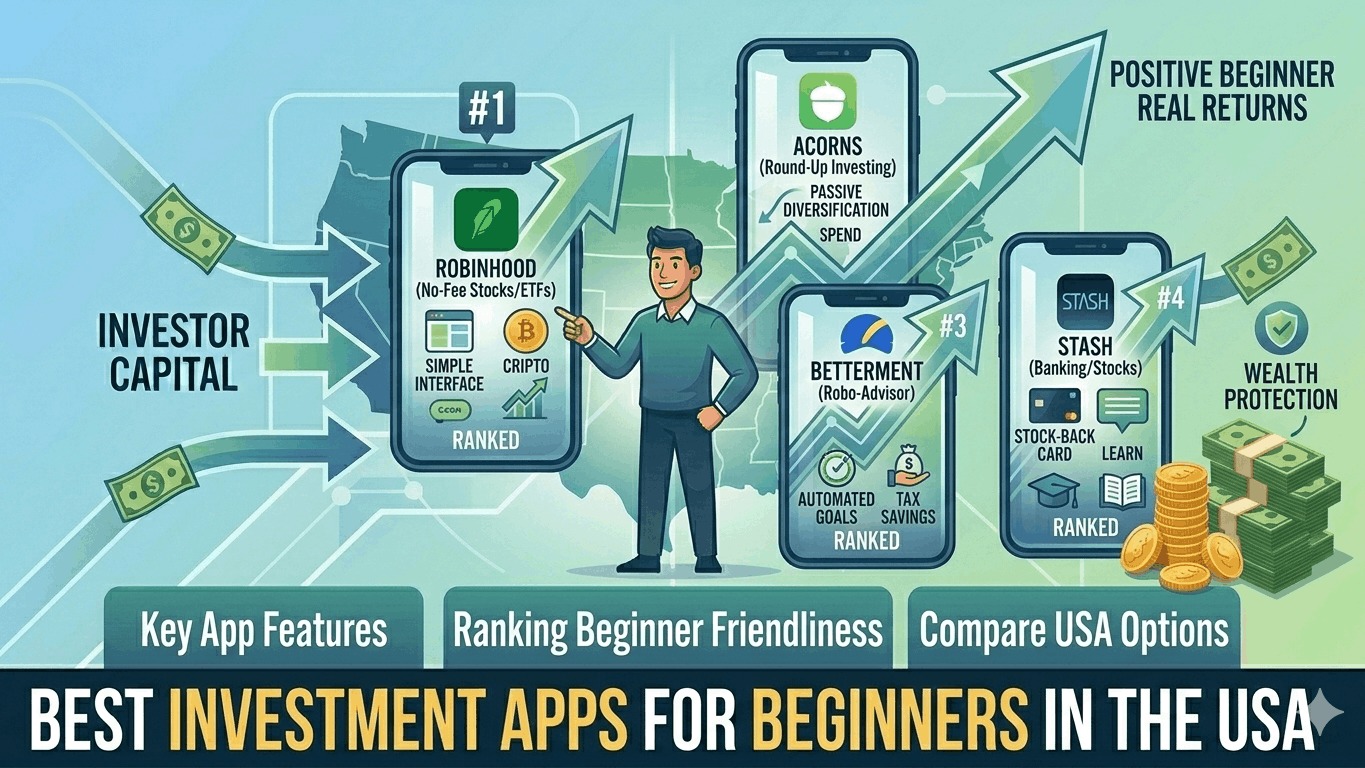
The financial landscape of 2026 has made "Wall Street" accessible from any smartphone in the country. For beginners, the challenge is no longer finding a way to invest, but choosing the right tool for their specific goals. In 2026, the best apps have moved beyond simple trading, offering features like automated tax-loss harvesting, IRA matching, and AI-driven portfolio insights.
Here is the definitive breakdown of the top investment apps for beginners in the USA as of March 2026.
1. Best Overall for Beginners: Fidelity Investments
Fidelity remains the "gold standard" in 2026 because it combines the power of a legacy institution with a modern, highly-rated mobile experience.
- Why it wins: They have completely removed the "nickel and diming" of the past. There are $0 account minimums and $0 commissions on U.S. stocks and ETFs.
- Standout Feature: Fidelity Spire. This specialized app helps beginners link their financial goals (like buying a house or retirement) directly to their investments.
- The "Starter Kit": For new investors, Fidelity often offers a "Starter Kit" bonus—typically a small cash deposit (around $50–$100) just for opening and funding a new account with a minimal amount.
2. Best for Automated Investing: Betterment
If you want to build wealth without picking individual stocks, Betterment is the premier "Robo-Advisor" of 2026.
- Why it wins: It uses advanced algorithms to build a diversified portfolio of low-cost ETFs based on your risk tolerance. It handles all the "boring" parts, like rebalancing your portfolio when the market shifts.
- Real-World Example: If the stock market has a great month and your portfolio becomes "too heavy" in tech, Betterment will automatically sell some tech and buy other assets to keep your risk level exactly where you want it.
- 2026 Tech: Betterment’s Tax-Loss Harvesting+ feature works daily to find "paper losses" in your account that can be used to lower your tax bill at the end of the year.
3. Best for Long-Term Building: Robinhood
While once known for "meme stocks," Robinhood has matured in 2026 into a powerful tool for long-term retirement building.
- Why it wins: The interface is arguably the most intuitive in the industry. It makes complex financial data look clean and easy to understand.
- The "Gold" Advantage: For a small monthly fee ($5), Robinhood Gold offers a 3% match on your IRA contributions in 2026.
- Real-World Example: If you contribute $7,000 to your Roth IRA, Robinhood will literally drop an extra $210 into your account for free. This is essentially an instant 3% return on your money before you even buy a single stock.
4. Best for "Hands-Off" Beginners: Acorns
Acorns is designed for people who find it hard to save money. It turns everyday spending into an investment strategy.
- Why it wins: It focuses on "Round-Ups." Every time you swipe your linked debit card, Acorns rounds the purchase up to the nearest dollar and invests the difference.
- Real-World Example: You buy a coffee for $4.25. Acorns rounds it to $5.00 and automatically puts that $0.75 into a diversified portfolio. Over a year, the average user invests hundreds of dollars without ever "feeling" the impact on their budget.
5. Best for Integrated Banking: SoFi Invest
SoFi is the "all-in-one" financial app of 2026, perfect for beginners who want their checking, savings, and investments in a single view.
- Why it wins: It offers fractional shares (called "Stock Bits"), meaning you can buy $5 worth of a company even if a single share costs $500.
- The Perk: SoFi members get free access to Certified Financial Planners (CFPs). For a beginner, being able to talk to a real human about your strategy for free is an incredible value that most other apps charge hundreds for.
2026 Comparison Table
| App | Best For | Minimum | Key Feature |
|---|---|---|---|
| Fidelity | Education & Trust | $0 | Goal-based "Spire" App |
| Betterment | Automation | $0 | Daily Tax-Loss Harvesting |
| Robinhood | IRA Building | $0 | 3% Match on Retirement |
| Acorns | Micro-Investing | $0 | Automatic Round-Ups |
| SoFi | All-in-One | $1 | Free Financial Advisor access |