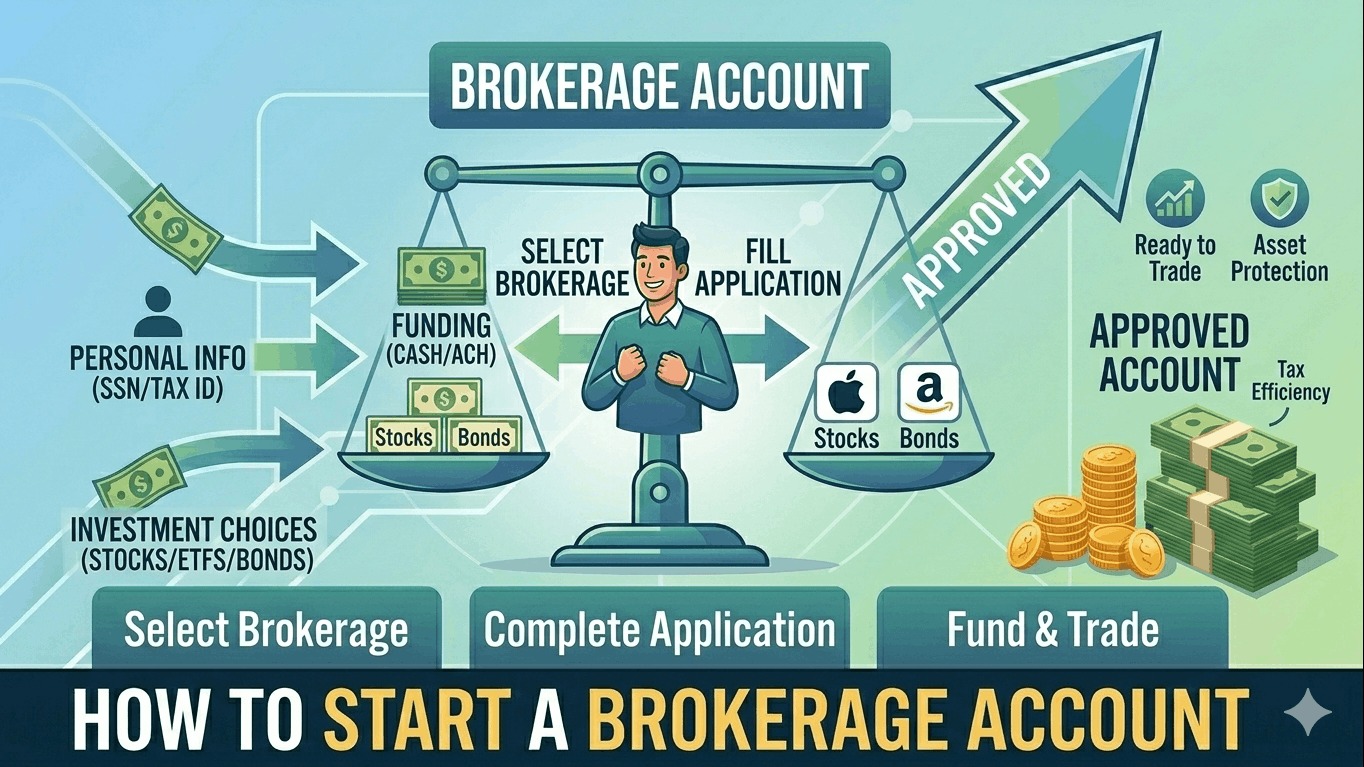
In 2026, the barrier to entry for the financial markets has never been lower. With the rise of zero-commission trading and fractional shares, starting a brokerage account is now a digital-first process that can often be completed in under 15 minutes. However, while the "how" is simple, the "what" requires a bit of strategy to ensure your account aligns with your long-term wealth goals.
Think of a brokerage account as a specialized "bridge" between your bank account and the global markets. It is the bucket where you hold assets like stocks, bonds, and ETFs (Exchange-Traded Funds).
Step 1: Choose Your "Flavor" of Brokerage
Before you sign up, you need to decide how much help you want. In 2026, brokers generally fall into three categories:
- Self-Directed (Discount) Brokers: These are platforms like Fidelity, Charles Schwab, or Robinhood. They provide the tools and the "buy" button, but you make all the decisions. These are the most popular because they typically charge $0 commissions on stocks and ETFs.
- Robo-Advisors: Platforms like Betterment or Wealthfront use algorithms to manage your money for you. You tell the app your risk tolerance, and it automatically buys a diversified mix of assets. These are great for a "set it and forget it" approach.
- Full-Service Brokers: These are traditional firms like Morgan Stanley or Merrill Lynch where you work with a human advisor. This is usually reserved for complex high-net-worth situations, as they often require a high minimum balance (e.g., $20,000+).
Step 2: Select the Right Account Type
This is where many beginners get tripped up. You aren't just opening "an account"; you are choosing a tax structure.
- Taxable Brokerage Account: This is the most flexible. You can put in as much money as you want and take it out whenever you want without penalties. The downside? You pay taxes on your dividends and capital gains every year.
- Retirement Accounts (IRAs): These are "tax-advantaged." In 2026, the contribution limit for a Roth or Traditional IRA is $7,500 (or $8,600 if you are 50+).
- Example: If you choose a Roth IRA, you pay taxes on the money now, but every penny you earn in the stock market is tax-free when you withdraw it after age 59½.
Step 3: Gather Your Documentation
Because of federal anti-money laundering laws (like the USA PATRIOT Act), brokers are required to verify your identity. Even in 2026, the requirements are standard. To open an account, you will need:
- Social Security Number (SSN) or Taxpayer Identification Number.
- Government-issued ID (Driver’s license or Passport).
- Employment Information (Employer name and address).
- Bank Account Details (To fund the account via ACH transfer).
Step 4: The Application Process (A Real Example)
Let’s walk through what the digital application actually looks like at a major firm like Fidelity or Schwab in 2026:
- Identity Check: You’ll enter your personal details. Many apps now allow you to simply "scan" your ID with your phone camera to auto-fill the forms.
- The "Risk" Questionnaire: The broker will ask about your "Investment Objective" (e.g., Speculation, Growth, or Income) and your “Net Worth.”
- Why? Regulators require brokers to ensure you aren't trading highly risky products (like advanced options) if you don't have the financial cushion to handle a total loss.
- Account Features: You will be asked if you want a Cash Account or a Margin Account.
- Recommendation for Beginners: Choose Cash. A margin account allows you to borrow money from the broker to buy stocks, which can lead to "margin calls" and magnified losses if the market drops.
Step 5: Funding and Your First "Trade"
Once approved—which often happens instantly or within one business day—you must link your bank account.
- The "Transfer" Stage: Most brokers allow for instant "provisional" funding. If you transfer $1,000, they might let you trade with it immediately while the actual bank transfer takes 2–3 days to clear.
- Fractional Shares: In 2026, most top-tier brokers offer fractional shares.
- Example: If a single share of an AI tech giant costs $450 but you only have $50, you can buy 0.11 shares. This allows you to stay fully invested regardless of how much cash you have on hand.
Step 6: Setting Up a Routine
Opening the account is just the beginning. The most successful investors in 2026 use Automated Investing.
By setting up a recurring transfer of $100 or $500 every payday, you employ a strategy called Dollar-Cost Averaging. This removes the stress of trying to "time" the market and ensures you are consistently building your position in the market's winning companies.