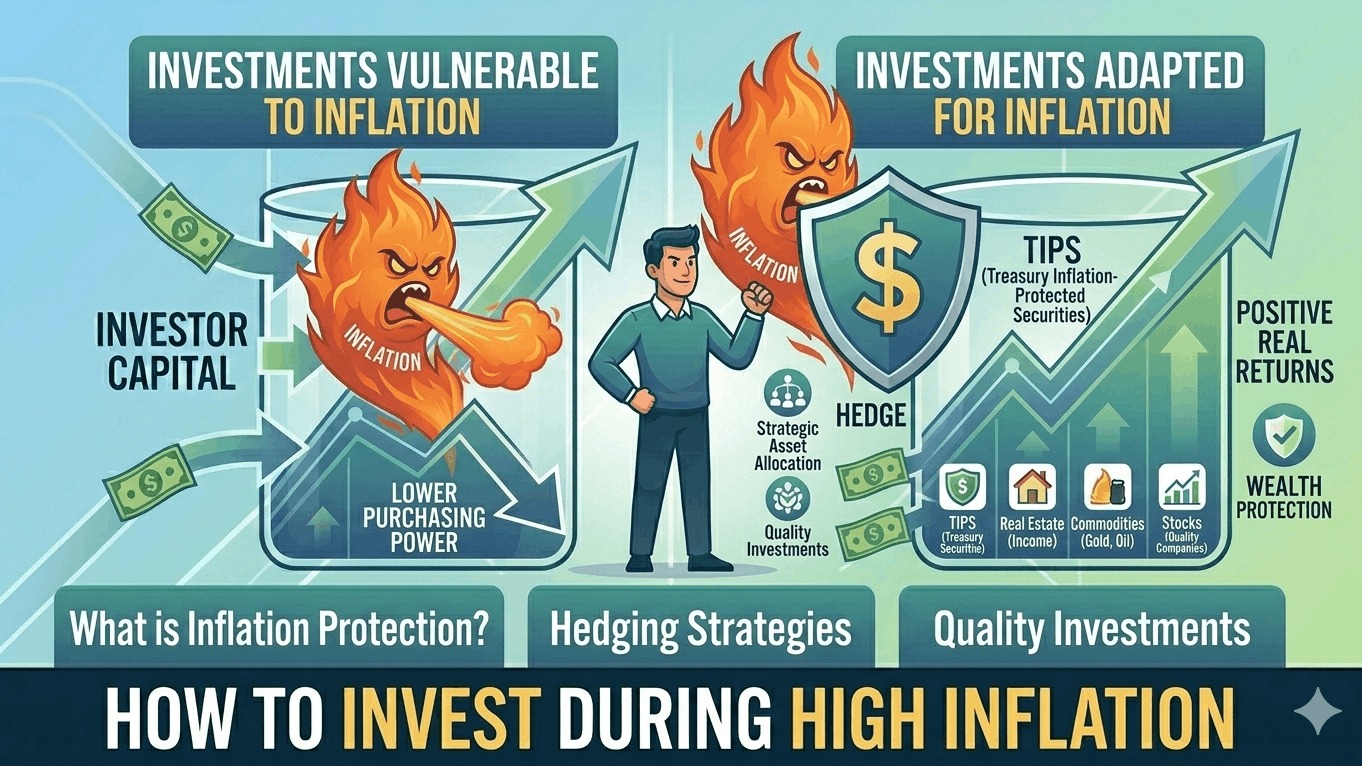
High inflation changes the way people think about money. It affects grocery bills, rent, transportation costs, savings, borrowing, and long-term financial plans. For investors, it can be especially frustrating because even when a portfolio appears to be growing, rising prices may quietly reduce the real value of those gains.
That is what makes high inflation so important in investing. It is not just about whether your money increases in dollar terms. It is about whether your investments continue to grow faster than the rising cost of living. If they do not, your purchasing power may shrink over time even when account balances look larger.
For investors in the United States, periods of high inflation often create uncertainty. Some assets become more volatile, some sectors respond better than others, interest rates may rise, bond prices may come under pressure, and cash may lose value faster than normal. In that kind of environment, many people start asking the same question: how should you invest during high inflation?
The answer is not about panic, guessing market headlines, or chasing whatever seems popular in the moment. A smart inflation strategy usually focuses on preserving purchasing power, staying diversified, and using investments that may be better positioned to handle rising prices over time.
This article explains how to think about investing during high inflation, what types of investments may respond differently, and how U.S. investors can build a strategy that is practical, balanced, and long-term focused.
What High Inflation Means for Investors
Inflation reduces the purchasing power of money. When inflation is high, the cost of goods and services rises faster than usual, and every dollar buys less than before.
For investors, this creates a few major challenges.
First, cash loses real value more quickly. If inflation is high and your money is sitting in a low-yield savings account, the money may feel safe, but its real spending power is falling.
Second, real returns become more important than nominal returns. A portfolio that grows by 6% might sound strong, but if inflation is running at 5%, the real gain is much smaller.
Third, different asset classes react differently. Some investments may struggle as inflation rises, while others may be better able to adapt.
Finally, interest rates often rise during high inflation, and that can affect stocks, bonds, borrowing costs, and real estate markets.
That is why investing during high inflation is not just about finding one “safe” asset. It is about understanding how inflation changes the investing environment.
Why High Inflation Can Hurt Traditional Investment Approaches
A lot of investing strategies work best in stable environments. High inflation makes things more complicated because it can pressure both consumers and businesses at the same time.
For example:
- Cash may lose value faster
- Fixed-income investments may become less attractive
- Stock market valuations may fall
- Borrowing costs may rise
- Profit margins may get squeezed
- Retirement planning assumptions may need updating
High inflation can also create emotional investing behavior. Some investors panic and move everything into cash. Others rush into trendy assets they barely understand because they are told those assets are “inflation-proof.” Both reactions can be risky.
The better approach is usually more balanced: understand what inflation does, then make thoughtful decisions based on your time horizon, risk tolerance, and portfolio structure.
Keep the Focus on Real Returns
One of the most important ideas during inflation is the difference between nominal return and real return.
- Nominal return is the return shown by the investment itself
- Real return is the return after inflation
Here is a simple example:
| Investment Return | Inflation Rate | Approximate Real Return |
|---|---|---|
| 8% | 2% | 6% |
| 8% | 6% | 2% |
| 5% | 5% | 0% |
| 4% | 7% | -3% |
This table shows why inflation matters so much. A positive investment return does not automatically mean you are moving ahead in real terms.
When inflation is high, investors need to ask not just, “Is my portfolio growing?” but also, “Is my portfolio outpacing inflation enough to preserve and build purchasing power?”
Do Not Hold Too Much Idle Cash
During uncertain times, many people feel safer holding cash. That instinct makes sense emotionally, but it can be costly during high inflation.
Cash has an important role in financial planning. It is useful for:
- Emergency savings
- Short-term expenses
- Liquidity
- Stability
But holding too much cash for long-term goals can be a problem when inflation is elevated. If your savings earn 2% and inflation is 6%, the real value of that money is declining.
That does not mean you should eliminate cash. It means you should be intentional about how much cash you hold and why you hold it.
For short-term needs, cash is still appropriate.
For long-term growth, too much idle cash may work against you.
Broad Stock Funds Can Be a Practical Option
For many investors, trying to handpick stocks during inflation is difficult. A practical alternative is using broad stock index funds or ETFs.
These may include:
- S&P 500 index funds
- Total U.S. stock market funds
- International stock index funds
- Dividend-focused funds
- Value-oriented stock funds
Broad funds can help reduce company-specific risk and simplify portfolio building. They also allow investors to stay exposed to long-term equity growth without relying too much on individual stock selection.
For beginners especially, broad diversification is often more useful than trying to build a complex inflation-trading strategy.
Be Careful With Traditional Bonds
Bonds can become more challenging during high inflation, especially if interest rates are rising.
When inflation rises, central banks often respond by increasing interest rates. That can hurt existing bond prices, particularly long-term bonds with fixed interest payments.
Why?
Because newer bonds may begin offering higher yields, which makes older lower-yield bonds less attractive.
Long-duration bonds may be more sensitive
Long-term bonds often experience larger price declines when rates rise.
Fixed payments lose purchasing power
If inflation stays high, the fixed income from traditional bonds becomes less valuable in real terms.
This does not mean all bonds should be avoided. Bonds still play a role in many portfolios, especially for stability and income. But investors may want to pay closer attention to bond type, duration, and inflation sensitivity.
Consider Inflation-Protected Securities
One area many investors look at during inflation is inflation-protected securities. In the U.S., these are often discussed as a way to help reduce inflation risk in the bond portion of a portfolio.
These investments are designed to adjust in a way that reflects inflation, making them more defensive than standard fixed-rate bonds in inflationary environments.
They are not perfect, and they still have risks, but they can play a useful role for investors who want some fixed-income exposure without relying entirely on traditional bonds.
For some portfolios, inflation-protected bond funds or similar securities can be a more thoughtful choice during periods of elevated inflation than long-duration conventional bonds.
Real Estate May Offer Some Inflation Support
Real estate is often mentioned in discussions about inflation because property values and rents can rise over time. In some cases, this can help real estate keep pace with inflation.
Investors may gain exposure to real estate through:
- Direct property ownership
- REITs
- Real estate funds
Potential inflation benefits include:
- Rising rental income
- Asset appreciation
- Exposure to real assets
However, high inflation also often leads to higher interest rates, and that can pressure real estate markets by making mortgages and financing more expensive.
So while real estate can sometimes help during inflation, it is not a guaranteed shield. It should be viewed as one part of a diversified strategy rather than a perfect solution.
Example of an Inflation-Aware Diversified Portfolio
There is no one-size-fits-all portfolio, but here is a simple example of how an investor might think about diversification during high inflation.
| Asset Type | Example Allocation | Possible Purpose |
|---|---|---|
| U.S. stocks | 40% | Core long-term growth |
| International stocks | 15% | Geographic diversification |
| Shorter-duration bonds | 15% | Stability with less rate sensitivity |
| Inflation-protected securities | 15% | Inflation-aware fixed income exposure |
| Real estate / REITs | 10% | Real asset exposure |
| Cash | 5% | Liquidity and short-term needs |
This is only an educational example, not a universal recommendation. The right mix depends on age, goals, income needs, and risk tolerance.
Continue Investing Consistently
One of the biggest mistakes during high inflation is trying to stop investing until conditions feel “normal” again.
Inflationary periods often come with volatility, uncertainty, and scary headlines. But long-term investing usually works best when contributions continue consistently rather than depending on perfect timing.
That may mean:
- Continuing monthly contributions
- Reinvesting dividends
- Staying diversified
- Reviewing allocation without overreacting
- Keeping long-term goals in mind
Consistency matters because inflation periods do not last forever, and markets often begin adjusting before the headlines improve.
Review Your Asset Allocation
High inflation is a good time to review your asset allocation and ask whether your portfolio still matches your goals.
Questions to consider include:
- Am I holding too much cash for long-term goals?
- Is my bond allocation too exposed to rising rates?
- Do I have enough diversification?
- Am I relying too much on one sector or one theme?
- Does my portfolio still match my risk tolerance?
Reviewing your allocation is different from panic-selling. It is about making sure your portfolio remains intentional.
Avoid Chasing “Inflation-Proof” Hype
Whenever inflation rises, the market starts promoting certain assets as guaranteed winners. That can be dangerous.
There is rarely a perfect inflation-proof investment. Even assets that may benefit from inflation can still be volatile, overpriced, or unsuitable for your situation.
Common mistakes include:
- Chasing the highest-yielding assets
- Buying speculative investments based only on headlines
- Abandoning diversification
- Moving too much into cash
- Making big decisions based on fear
A better strategy is to focus on fundamentals, diversification, and real purchasing power rather than market noise.
Think About Inflation in Retirement Planning
If you are investing for retirement, inflation deserves even more attention.
A retirement plan built on today’s living costs may fall short if inflation remains elevated over time. High inflation can affect:
- Future living expenses
- Withdrawal needs
- Bond income
- Social Security planning
- Healthcare cost assumptions
This does not mean retirement investing needs to become overly complicated. It means your plan should be realistic about rising costs and not rely too heavily on low-growth assets for long-term needs.
Simple Principles for Investing During High Inflation
Here is the basic mindset many investors can use during high inflation:
| Principle | Why It Matters |
|---|---|
| Focus on real returns | Nominal growth alone is not enough |
| Limit excessive cash | Idle cash loses purchasing power |
| Stay diversified | Different assets respond differently |
| Use quality investments | Strong businesses may handle inflation better |
| Review bond exposure | Rising rates can pressure fixed income |
| Consider inflation-aware assets | Useful for added resilience |
| Keep investing consistently | Timing inflation cycles is difficult |
Final Thoughts
Investing during high inflation is not about finding one perfect asset or making dramatic short-term moves. It is about protecting purchasing power, staying diversified, and making sure your portfolio is built for a changing economic environment.
High inflation can pressure cash, bonds, stock valuations, and long-term planning assumptions. But it also reminds investors why thoughtful portfolio construction matters. Strong businesses, broad stock exposure, inflation-aware fixed income, real assets, and disciplined diversification can all play a role.
For most U.S. investors, the smartest response to high inflation is not panic. It is adjustment with discipline.
That means keeping enough cash for short-term needs, avoiding excessive idle money for long-term goals, reviewing asset allocation, staying invested, and focusing on investments that have a reasonable chance of outpacing inflation over time. When the goal is long-term wealth building, protecting purchasing power is just as important as growing account balances.