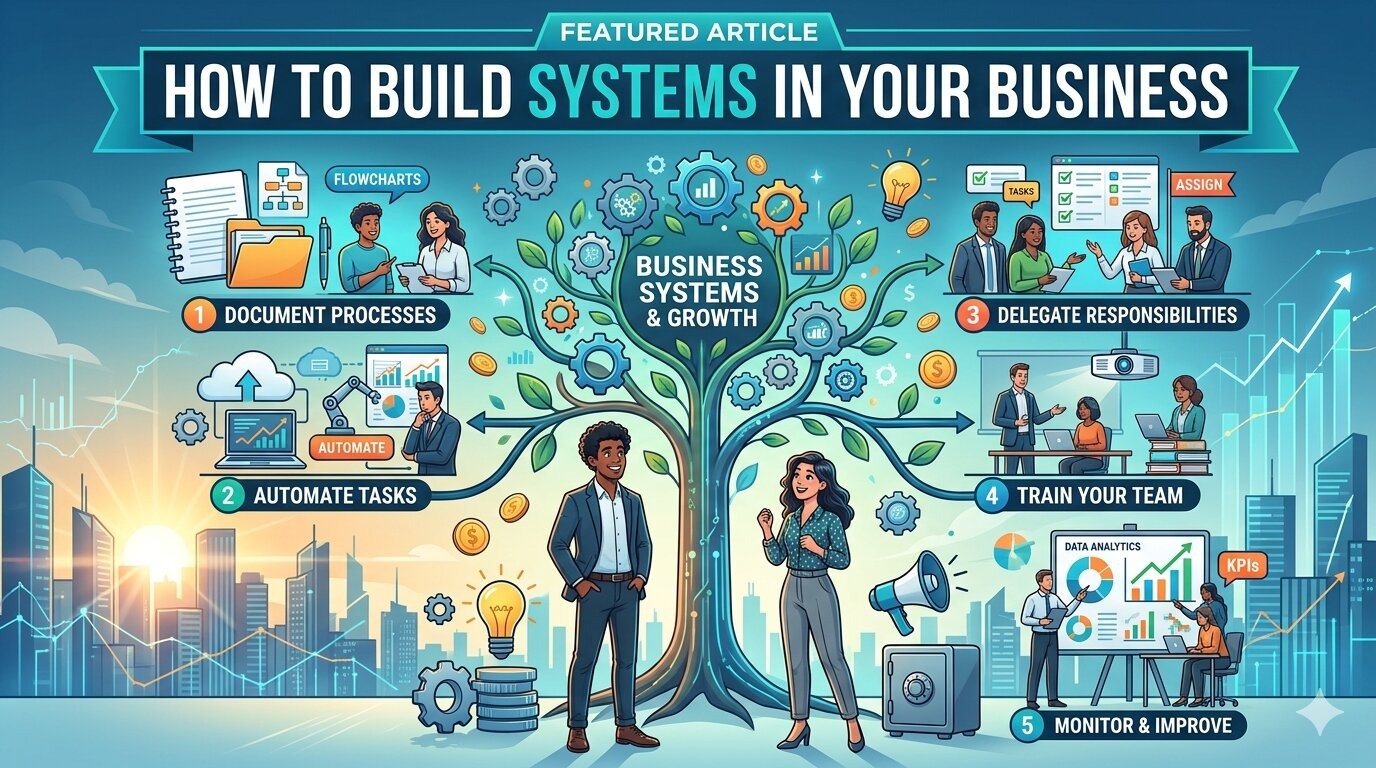
As your business grows, doing everything manually becomes unsustainable. You start feeling overwhelmed, tasks get delayed, and growth slows down.
This is where systems come in.
Building systems allows your business to run smoothly, consistently, and efficiently—without depending on you for every small task.
In this guide, we’ll break down how to build systems in your business step by step, using simple strategies and real-world examples.
What Are Business Systems?
A system is a repeatable process for completing a task.
Instead of:
- Doing things differently every time
You:
- Follow a clear, structured process
Example:
- Client onboarding checklist
- Content creation workflow
- Order processing steps
Why Systems Are Important
Systems help you:
- Save time
- Reduce errors
- Maintain consistency
- Scale your business
Simple truth:
Without systems, growth creates chaos. With systems, growth becomes manageable.
Step 1: Identify Repetitive Tasks
Start by listing tasks you do repeatedly.
Common areas:
- Customer onboarding
- Marketing
- Sales process
- Delivery or operations
Example:
| Task | Frequency |
|---|---|
| Responding to inquiries | Daily |
| Sending proposals | Weekly |
| Posting content | Regular |
These are perfect for systemization.
Step 2: Document Your Process
Write down how you complete each task.
Keep it simple:
- Step-by-step instructions
- Clear actions
- Easy to follow
Example: Client onboarding system
| Step | Action |
|---|---|
| 1 | Receive inquiry |
| 2 | Send details |
| 3 | Confirm payment |
| 4 | Start work |
This becomes your standard process.
Step 3: Create Templates and Checklists
Templates save time and improve consistency.
Examples:
- Email templates
- Proposal formats
- Content templates
Example:
| Task | Template |
|---|---|
| Client response | Pre-written message |
| Proposal | Standard format |
| Invoice | Fixed structure |
No need to start from scratch every time.
Step 4: Use Tools and Automation
Tools help you automate repetitive work.
Examples:
- Scheduling tools
- Payment systems
- Email automation
This reduces manual effort and increases efficiency.
Step 5: Standardize Communication
Communication can take a lot of time.
Standardize:
- Common replies
- FAQs
- Follow-ups
Example:
- Create responses for common customer questions
This improves speed and consistency.
Step 6: Build Systems Before Hiring
Before hiring, create systems.
Why?
- New team members can follow processes
- Training becomes easier
- Work remains consistent
If you’re planning to hire, read:
How to Hire Your First Employee → https://statush.com/entrepreneur/how-to-hire-your-first-employee
Step 7: Test and Improve Your Systems
Your first system won’t be perfect.
Improve by:
- Testing in real situations
- Getting feedback
- Adjusting steps
Over time, your systems become more efficient.
Step 8: Delegate Using Systems
Once systems are in place:
- You can delegate tasks easily
- Others can follow processes
- You focus on growth
This is key for scaling.
Step 9: Focus on High-Impact Systems
Not all systems are equally important.
Start with:
- Sales process
- Customer onboarding
- Delivery workflow
These directly affect your business growth.
Step 10: Keep Systems Simple
Don’t overcomplicate.
Good systems are:
- Easy to understand
- Easy to follow
- Easy to improve
Rule:
Simple systems are better than complex ones.
Business System Framework
| Step | Action | Result |
|---|---|---|
| Identify | Repetitive tasks | Clarity |
| Document | Create process | Structure |
| Template | Standardize work | Consistency |
| Automate | Use tools | Efficiency |
| Improve | Optimize system | Growth |
Real-World Example
Let’s say you run a service business:
Without systems:
- Every client handled differently
- Time wasted
- Errors increase
With systems:
- Standard onboarding
- Clear delivery steps
- Faster execution
Result:
- More clients handled
- Less stress
- Better growth
Avoid These Common Mistakes
- Not documenting processes
- Overcomplicating systems
- Ignoring improvement
- Doing everything manually
If you want to avoid mistakes, read:
Common Entrepreneur Mistakes to Avoid → https://statush.com/entrepreneur/common-entrepreneur-mistakes-to-avoid
Connect Systems with Scaling
Systems are the foundation of scaling.
Once systems are in place:
- You save time
- You manage more work
- You grow faster
To scale your business, read:
How to Scale a Small Business → https://statush.com/entrepreneur/how-to-scale-a-small-business
Final Thoughts
Building systems is not about complexity—it’s about clarity and consistency.
Focus on:
- Simplifying your work
- Creating repeatable processes
- Improving over time
You don’t need to do everything yourself.
You need systems that work for you.
Over time, strong systems will transform your business from manual effort into a scalable machine.