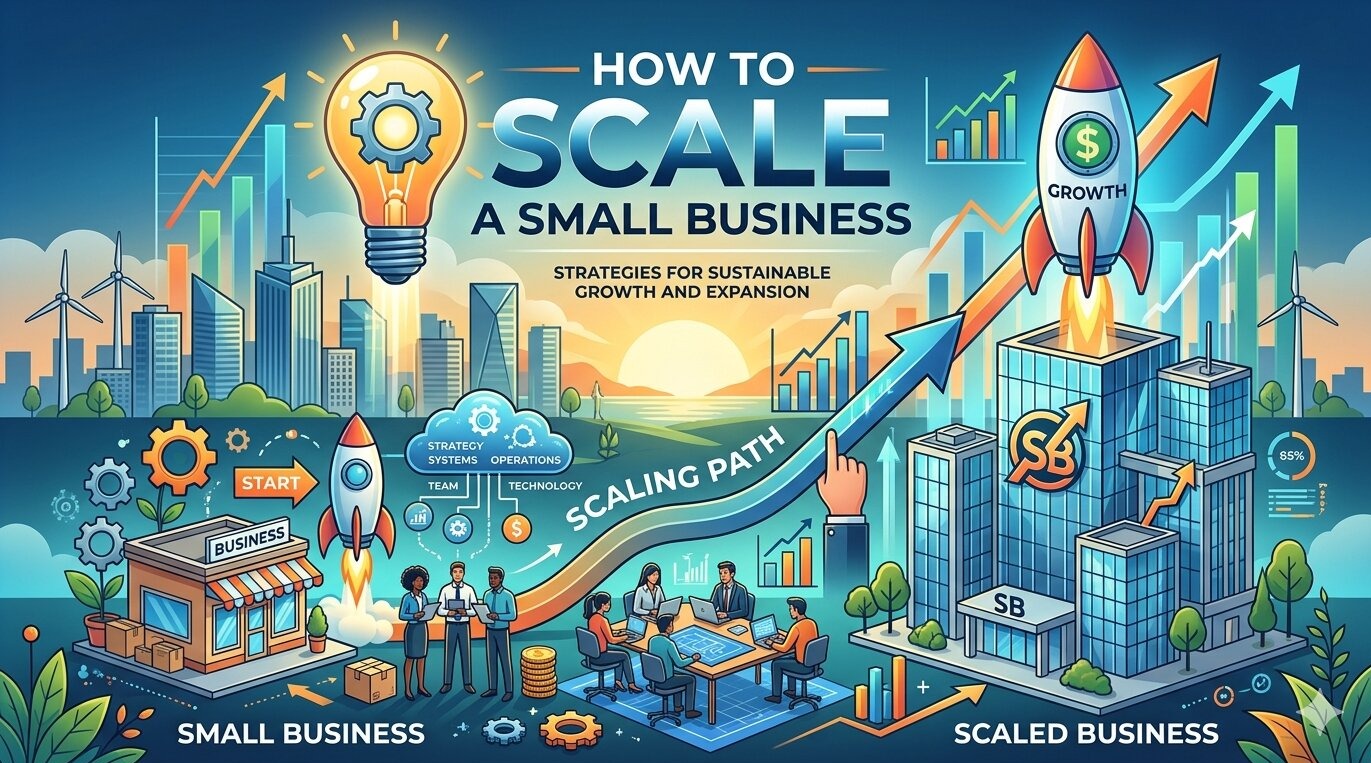
Starting a business is one challenge—scaling it is another. Many entrepreneurs reach a point where their business is working, but growth slows down. They get stuck managing everything manually, and income stops increasing.
Scaling is about growing your business without increasing your workload at the same rate. It’s about working smarter, building systems, and expanding strategically.
In this guide, we’ll break down how to scale a small business step by step, using practical strategies and real-world thinking.
What Does Scaling Really Mean?
Scaling is not just about increasing revenue.
It means:
- Growing income efficiently
- Handling more customers without chaos
- Building systems that reduce manual effort
Example:
| Situation | Result |
|---|---|
| More work = more hours | Not scalable |
| More work = same effort | Scalable |
Step 1: Build a Strong Foundation First
Before scaling, your business should be stable.
Make sure:
- You have consistent customers
- Your offer is clear and proven
- You are generating regular income
If you’re still at the beginning stage, read:
How to Start Your First Business Step-by-Step → https://statush.com/entrepreneur/how-to-start-your-first-business-step-by-step
Step 2: Improve Your Offer
Scaling becomes easier when your offer is strong.
Ask yourself:
- Can I increase value?
- Can I improve results for customers?
- Can I justify higher pricing?
Example:
- Instead of basic service → premium package
- Instead of one-time service → monthly plans
Better offers lead to higher revenue with less effort.
Step 3: Increase Pricing Strategically
One of the simplest ways to scale is pricing.
Instead of:
- Getting more customers
You can:
- Earn more per customer
Example:
| Price | Clients | Revenue |
|---|---|---|
| ₹1,000 | 50 | ₹50,000 |
| ₹5,000 | 10 | ₹50,000 |
Higher value → fewer clients → better scalability.
Step 4: Create Systems and Processes
Scaling is impossible without systems.
You need:
- Standard operating processes (SOPs)
- Clear workflows
- Repeatable steps
Examples:
- Client onboarding process
- Delivery checklist
- Customer communication templates
Systems save time and reduce errors.
Step 5: Automate Where Possible
Automation helps you grow without increasing effort.
You can automate:
- Emails
- Payments
- Marketing campaigns
- Scheduling
This allows your business to run more smoothly.
Step 6: Build a Team (Even Small)
At some point, you can’t do everything yourself.
Start small:
- Hire freelancers
- Outsource repetitive tasks
- Delegate non-core work
Example:
- You handle strategy
- Team handles execution
This frees your time for growth activities.
Step 7: Focus on High-Impact Activities
As you scale, your role changes.
Focus on:
- Strategy
- Sales
- Partnerships
- Growth planning
Avoid spending too much time on:
- Small tasks
- Repetitive work
Step 8: Add Scalable Income Streams
To scale effectively, include income streams that grow easily.
Examples:
- Digital products
- Courses
- Subscriptions
If you want to expand, read:
How to Build Multiple Income Streams → https://statush.com/entrepreneur/how-to-build-multiple-income-streams
Step 9: Strengthen Marketing and Sales
Scaling requires more customers—or better customers.
Focus on:
- Consistent content
- Paid ads (if ready)
- Strong messaging
Example:
- Clear value proposition
- Strong call-to-action
Better marketing → more growth opportunities.
Step 10: Track and Optimize Performance
Scaling without tracking leads to confusion.
Track:
- Revenue
- Customer acquisition
- Conversion rates
- Expenses
Example:
| Metric | Why It Matters |
|---|---|
| Revenue | Growth measurement |
| Conversion rate | Sales effectiveness |
| Cost | Profitability |
Scaling Journey (Simple View)
| Stage | Focus | Goal |
|---|---|---|
| Start | Get customers | Validation |
| Build | Improve offer | Stability |
| Systemize | Create processes | Efficiency |
| Scale | Expand and grow | Profit |
Real-World Example
Let’s say someone starts with:
- Freelancing → ₹30,000/month
Then:
- Builds a team → ₹1,00,000/month
- Adds digital products → ₹2,00,000+/month
Same business—scaled through systems and strategy.
Common Mistakes While Scaling
- Scaling too early
- Ignoring systems
- Hiring too fast
- Not tracking performance
If you want to avoid these, read:
Common Entrepreneur Mistakes to Avoid → https://statush.com/entrepreneur/common-entrepreneur-mistakes-to-avoid
Mindset for Scaling
Scaling requires a shift:
- From doing everything → to managing systems
- From working in the business → to working on the business
To build this thinking, read:
Entrepreneur Mindset: How to Think Like a Business Owner → https://statush.com/entrepreneur/entrepreneur-mindset-how-to-think-like-a-business-owner
Final Thoughts
Scaling a business is not about doing more work—it’s about doing better work.
Focus on:
- Systems and processes
- High-value activities
- Smart growth strategies
You don’t need to rush. Scale when your foundation is strong.
Over time, your small business can grow into something much bigger—without overwhelming you.