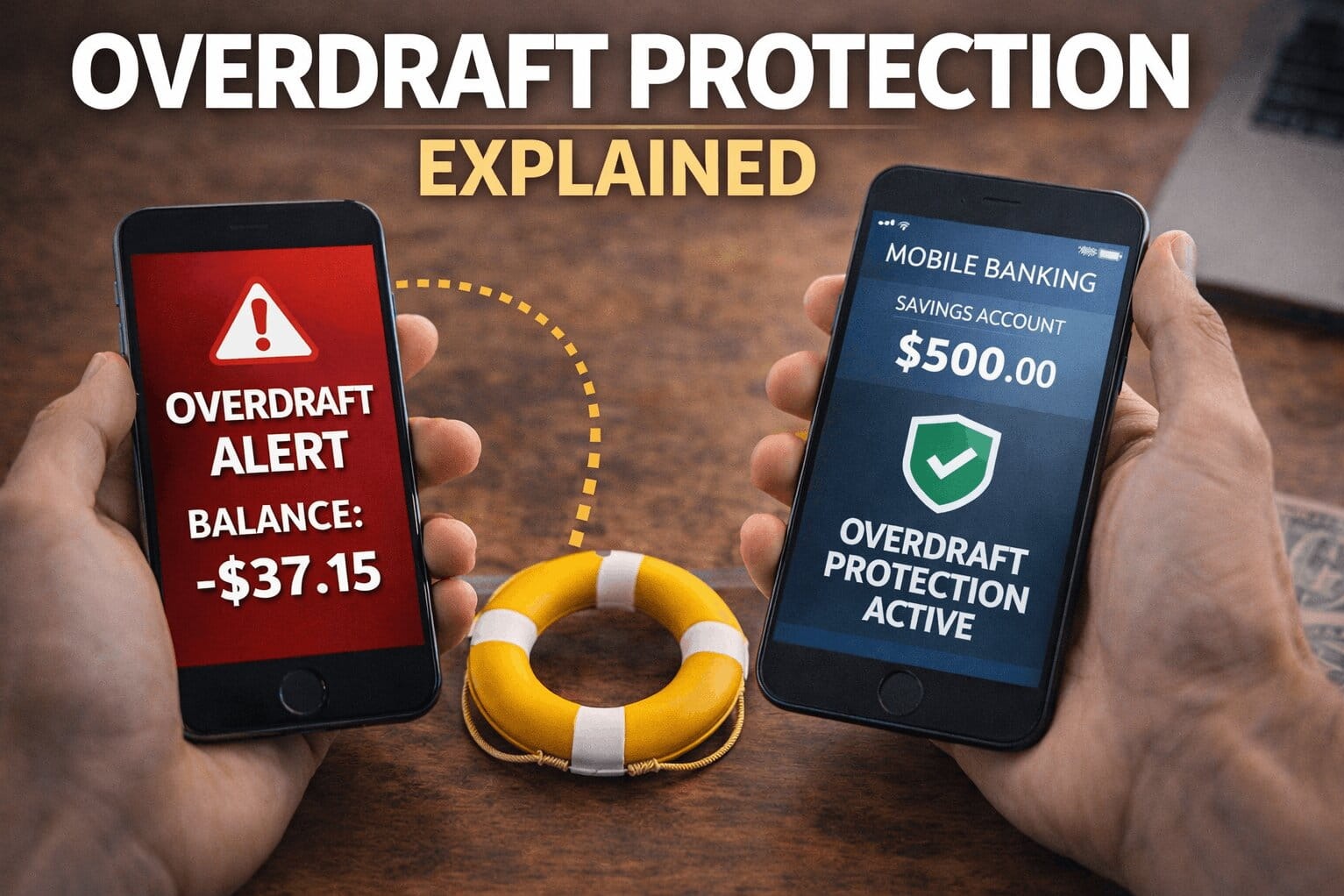
If you’ve ever swiped your debit card or scheduled a payment and later realized your account didn’t have enough money, you’ve brushed up against overdraft. That’s where overdraft protection comes in—a feature that can either save you from embarrassment or quietly cost you money if you’re not careful.
In the U.S., overdraft protection is common, but it’s often misunderstood. Some people think it’s a safety net, while others see it as a trap filled with fees. The truth sits somewhere in the middle.
Let’s break it down in a simple, real-world way so you can decide whether overdraft protection actually helps—or hurts—your finances.
What Is Overdraft Protection?
Overdraft protection is a service offered by banks that allows transactions to go through even when your checking account doesn’t have enough money.
Instead of declining the transaction, the bank covers the difference temporarily.
Here’s the simplest way to think about it:
| Situation | Without Overdraft Protection | With Overdraft Protection |
|---|---|---|
| You have $50 in your account and spend $70 | Transaction declined | Transaction approved |
| What happens next | No charge, but payment fails | Bank covers $20 difference |
| Cost | Usually none | Possible overdraft fee or transfer fee |
At first glance, it sounds helpful—and sometimes it is. But the details matter.
How Overdraft Protection Works in the USA
Banks in the U.S. typically offer a few different types of overdraft protection. Each works a bit differently and comes with its own costs.
1. Standard Overdraft Coverage
This is the most common type. If you opt in, the bank allows your debit card transactions or ATM withdrawals to go through even when your balance is insufficient.
- The bank covers the shortfall
- You’re charged an overdraft fee (often $30–$35 per transaction)
2. Linked Account Protection
Instead of charging a big fee, your bank transfers money from another account you own (like savings).
- Small transfer fee (around $5–$12)
- Much cheaper than standard overdraft fees
3. Overdraft Line of Credit
This works more like a small loan attached to your checking account.
- Bank lends you money to cover overdrafts
- You pay interest instead of flat fees
If you’re already familiar with borrowing concepts, this is similar to how credit works in banking products like those explained here: https://statush.com/credit-cards-banking/how-credit-cards-work-in-the-usa
A Real-World Example
Let’s say Jake lives in Texas and has $200 in his checking account.
He forgets about an automatic $220 car insurance payment.
Scenario 1: No Overdraft Protection
- Payment gets declined
- Insurance company may charge a late fee
- Policy could be at risk
Scenario 2: With Overdraft Protection
- Payment goes through
- Bank charges a $35 overdraft fee
- Jake now owes $255 total
In this case, overdraft protection prevented a bigger problem—but it wasn’t free.
That’s the trade-off in a nutshell.
Why Banks Offer Overdraft Protection
From a bank’s perspective, overdraft protection serves two purposes:
- Customer convenience – Transactions don’t fail at awkward moments
- Revenue generation – Fees can add up quickly
In fact, overdraft fees are one of the most criticized banking charges in the U.S., which is why many people actively try to avoid them.
If you’re interested in reducing unnecessary charges overall, you might also find this helpful: https://statush.com/credit-cards-banking/how-to-avoid-bank-fees
When Overdraft Protection Makes Sense
It’s not all bad. In certain situations, it’s actually useful.
You might want it if:
- You have irregular income
- You occasionally miscalculate expenses
- You want a backup for emergencies
It’s especially useful when:
- Linked to a savings account (low fees)
- Used rarely—not regularly
When You Should Avoid It
There are also clear cases where opting out is smarter.
Consider avoiding it if:
- You frequently run low on funds
- You struggle with budgeting
- You rely on overdraft as “extra money”
In those cases, overdraft protection becomes expensive debt disguised as convenience.
Smarter Alternatives to Overdraft Protection
If your goal is financial stability, there are better options.
1. Build a Small Emergency Buffer
Even $200–$500 can prevent most overdrafts.
You can estimate how much you need using tools like this:
https://statush.com/emergency-fund-calculator
2. Use Low Balance Alerts
Most banks let you set notifications when your balance drops below a certain level.
3. Link a Savings Account
This is one of the best middle-ground solutions.
4. Track Spending Regularly
Apps and mobile banking tools make this easier than ever:
https://statush.com/credit-cards-banking/mobile-banking-apps-explained
Practical Tips to Avoid Overdraft Fees
Let’s keep this actionable.
- Always keep a buffer (even $50 helps)
- Check your account before large purchases
- Watch for automatic payments
- Turn off overdraft for debit card purchases if possible
- Link a savings account instead of relying on fees
- Review your bank’s overdraft policy carefully
One underrated tip: treat your checking account like it has less money than it actually does. That mental cushion can save you real cash.
Overdraft Protection vs Declining Transactions
Here’s a quick comparison to help you decide:
| Feature | Overdraft Protection ON | Overdraft Protection OFF |
|---|---|---|
| Transactions | Go through | Declined if insufficient funds |
| Fees | High (per transaction) | Usually none |
| Risk | Debt + fees | Missed payments |
| Best for | Emergencies | Strict budget control |
There’s no universal “right” answer—it depends on your habits.
Final Thoughts
Overdraft protection is one of those financial tools that can either help or hurt depending on how you use it.
Used occasionally, it can prevent bigger problems like missed bills or service disruptions. But if it becomes routine, it’s a sign something deeper needs attention—usually spending habits or cash flow management.
A practical approach? Keep it as a backup, not a strategy.
And if you really want to stay ahead financially, focus less on avoiding overdraft and more on building stability—through budgeting, saving, and smart banking choices.
Because in the long run, the best overdraft protection isn’t a bank feature—it’s having enough money in your account to never need it.