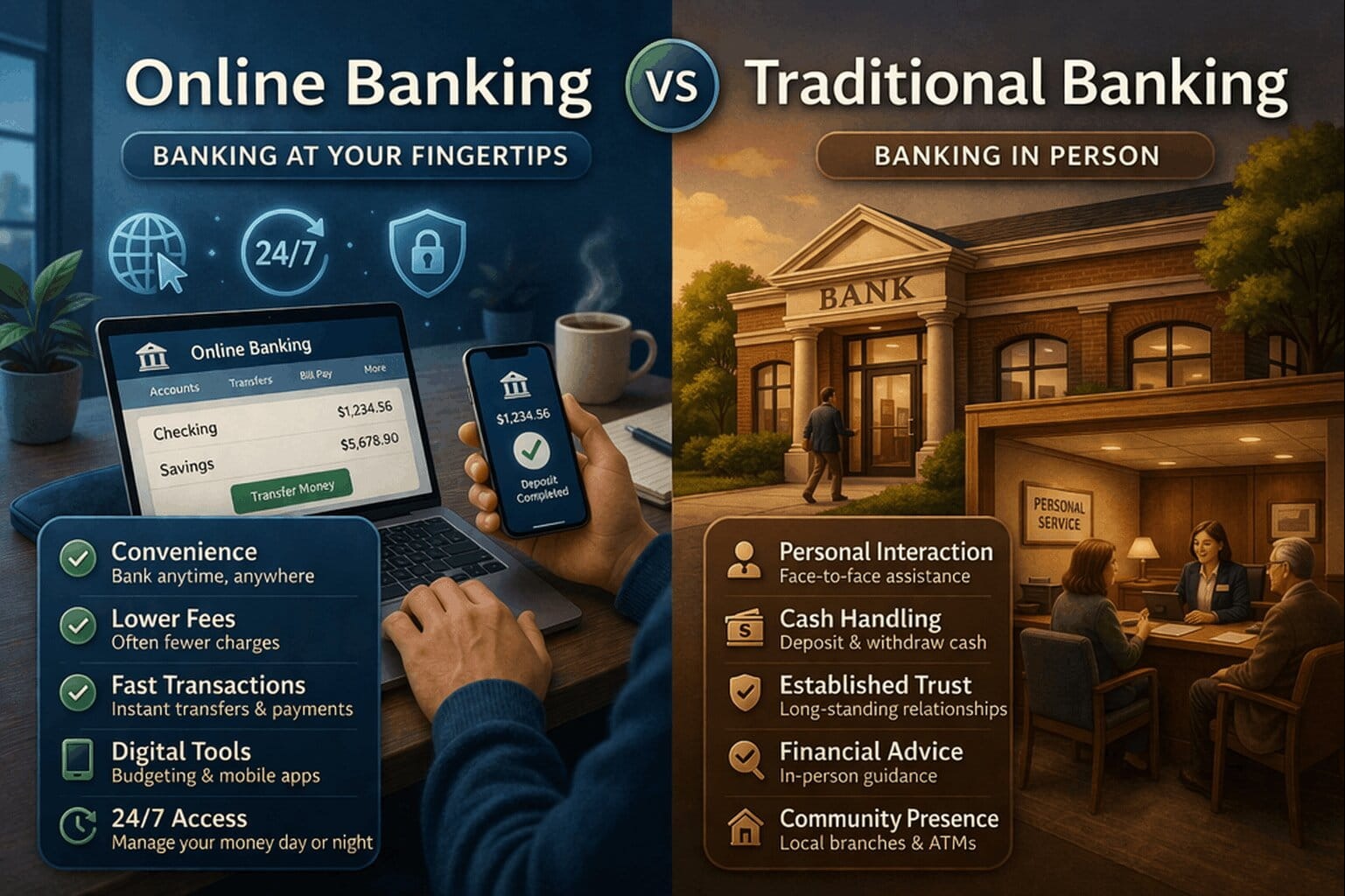
Banking has changed dramatically over the past decade. What once required visiting a physical branch can now be done in seconds on your phone. This shift has created two main options for consumers in the United States: online banking and traditional banking.
Both have their advantages and drawbacks, and choosing the right one depends on your lifestyle, preferences, and financial needs.
This guide breaks down the differences in a simple, practical way so you can decide which banking style works best for you.
What Is Online Banking?
Online banking refers to banks that operate primarily—or entirely—through digital platforms.
These banks don’t have physical branches. Instead, they offer services through:
- Mobile apps
- Websites
- Customer support (chat or phone)
Because they don’t maintain physical locations, online banks often pass those savings to customers in the form of better interest rates and lower fees.
What Is Traditional Banking?
Traditional banks operate through physical branches where you can interact with staff in person.
They offer:
- Face-to-face customer service
- In-branch services (like cash deposits and loan consultations)
- ATMs and physical locations
Many traditional banks also provide online services, but their core strength is still their physical presence.
Key Differences at a Glance
| Feature | Online Banking | Traditional Banking |
|---|---|---|
| Branch Access | None | Physical branches |
| Convenience | High (24/7 access) | Limited to branch hours |
| Fees | Usually lower | Often higher |
| Interest Rates | Higher savings rates | Lower savings rates |
| Customer Support | Digital | In-person + digital |
Convenience and Accessibility
Online banking clearly wins when it comes to convenience.
You can:
- Transfer money instantly
- Pay bills anytime
- Check your balance in seconds
All without leaving your home.
Traditional banking, on the other hand, requires visiting a branch for certain services. While this can be helpful, it’s less convenient—especially for people with busy schedules.
Real-World Example
Let’s compare two users.
Online Banking User
Ravi manages everything through his phone. He pays bills, transfers money, and tracks spending—all in a few taps.
Traditional Banking User
Meena prefers visiting her bank branch for major transactions. She values face-to-face interaction and personal assistance.
Both approaches work—it depends on personal preference.
Fees and Costs
One of the biggest advantages of online banks is lower fees.
Since they don’t operate physical branches, they often eliminate:
- Monthly maintenance fees
- Minimum balance requirements
- ATM fees (in some cases)
Traditional banks may charge these fees, although many offer ways to waive them.
To avoid unnecessary charges:
How to Avoid Bank Fees
https://statush.com/credit-cards-banking/how-to-avoid-bank-fees
Interest Rates and Savings
Online banks usually offer higher interest rates on savings accounts.
This is because they have lower operating costs and can pass those savings to customers.
Traditional banks tend to offer lower rates, especially on standard savings accounts.
To understand how savings interest works:
How Interest Works in Savings Accounts
https://statush.com/credit-cards-banking/how-interest-works-in-savings-accounts
Customer Support Experience
This is where traditional banks have a clear advantage.
If you prefer:
- Speaking to someone in person
- Getting help with complex issues
- Building a relationship with your bank
Then traditional banking may feel more comfortable.
Online banks rely on:
- Chat support
- Phone assistance
While efficient, it may not feel as personal.
Security and Safety
Both online and traditional banks use advanced security measures.
Online banks often provide:
- Two-factor authentication
- Real-time alerts
- Encryption
Traditional banks offer similar digital protections, along with physical security.
In practice, both are generally safe—as long as you follow basic security practices.
To stay protected:
Banking Security Tips Everyone Should Know
https://statush.com/credit-cards-banking/banking-security-tips-everyone-should-know
Cash Deposits and Physical Services
This is one area where traditional banks clearly stand out.
If you frequently deal with cash, traditional banks make it easy to:
- Deposit money
- Withdraw large amounts
- Access in-person services
Online banks may have limitations here, although some offer ATM networks or partner locations.
Technology and User Experience
Online banks are built around technology, so they often offer:
- Clean, user-friendly apps
- Advanced budgeting tools
- Instant notifications
Traditional banks have improved their apps over time, but some may still feel less modern compared to digital-first banks.
To understand digital tools better:
Mobile Banking Apps Explained
https://statush.com/credit-cards-banking/mobile-banking-apps-explained
Who Should Choose Online Banking?
Online banking is ideal if you:
- Prefer managing money digitally
- Want lower fees and higher interest rates
- Rarely need in-person services
- Value speed and convenience
It’s especially popular among younger users and tech-savvy individuals.
Who Should Choose Traditional Banking?
Traditional banking is better if you:
- Prefer face-to-face interactions
- Deal with cash frequently
- Need in-branch services
- Want personalized assistance
It’s often preferred by people who value human interaction and physical access.
Can You Use Both?
Yes—and many people do.
A common strategy is:
- Use an online bank for savings (higher interest)
- Use a traditional bank for checking (easy access to cash and branches)
This combination gives you the best of both worlds.
A Simple Way to Decide
If you want simplicity:
- Choose online banking
If you want personal service:
- Choose traditional banking
If you want both:
- Use a hybrid approach
Final Thoughts
Online banking and traditional banking are not competitors—they’re different tools for different needs.
Online banks offer speed, convenience, and better rates. Traditional banks offer personal service and physical access.
The best choice depends on how you manage your money and what you value most.
In many cases, the smartest approach is not choosing one over the other—but using both strategically to maximize benefits.