Minimum payments on credit cards can feel like a safety net. They keep your account in good standing, prevent late fees (if paid on time), and give you flexibility when money is tight. But there’s a catch—relying on minimum payments is one of the fastest ways to fall into long-term debt.
Many people don’t realize how costly this habit can be until they’ve spent months or even years trying to pay off a balance that barely seems to shrink. Understanding how minimum payments work—and how they affect your debt—is essential if you want to stay in control of your finances.
What Is a Minimum Payment?
A minimum payment is the smallest amount you must pay each month to keep your credit card account active and in good standing.
Typically, it’s calculated as:
- A percentage of your balance (usually 1%–3%)
- Plus any interest and fees
For example:
- Balance: $2,000
- Minimum payment: around $40–$60
It may seem manageable—and that’s exactly why it can be misleading.
Why Minimum Payments Exist
Credit card companies offer minimum payments to give borrowers flexibility. Life happens, and not everyone can pay their full balance every month.
From a lender’s perspective, minimum payments also ensure they continue earning interest over time. The longer you carry a balance, the more interest you pay.
So while minimum payments help you avoid immediate penalties, they often benefit the lender more than the borrower in the long run.
How Minimum Payments Affect Your Debt
At first glance, making the minimum payment might seem like responsible behavior. You’re paying on time, after all. But what’s happening behind the scenes tells a different story.
When you pay only the minimum:
- A large portion goes toward interest
- A small portion reduces your actual balance
This slows down your progress significantly.
To understand how interest builds:
How Credit Card Interest Works
https://statush.com/credit-cards-banking/how-credit-card-interest-works
Real-World Example
Let’s look at a realistic scenario.
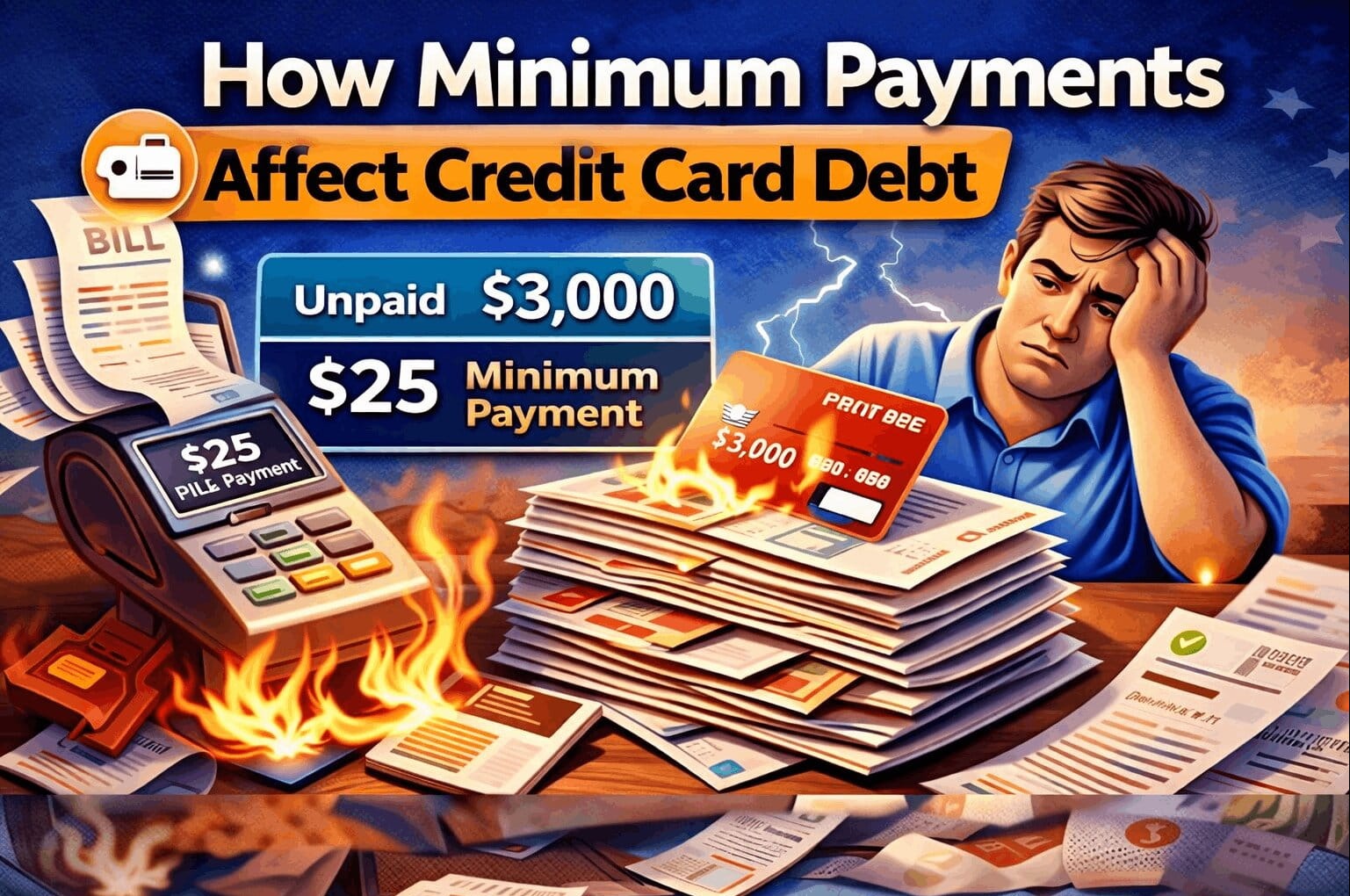
David has a $3,000 credit card balance with a 20% APR. His minimum payment is about $75.
If he only pays the minimum every month:
- It could take over 10 years to pay off the balance
- He could pay thousands of dollars in interest
Even though $75 feels manageable, it keeps him stuck in a long-term repayment cycle.
Why Debt Shrinks So Slowly
The main reason minimum payments slow down debt repayment is interest accumulation.
Each month:
- Interest is added to your remaining balance
- Your payment mostly covers that interest
- Only a small amount reduces the principal
This creates a cycle where your balance decreases very slowly.
Over time, it can feel like you’re making payments—but not making progress.
The Compounding Effect
Credit card interest compounds daily. This means interest is added not just to your original balance, but also to previously accumulated interest.
When combined with minimum payments, this creates a powerful effect:
- Your balance decreases slowly
- Interest continues to grow
- Total repayment cost increases significantly
This is why small balances can turn into long-term debt if not managed properly.
Simple Breakdown Table
| Factor | Effect of Minimum Payment |
|---|---|
| Monthly Payment | Low and manageable |
| Interest Paid | High over time |
| Debt Duration | Very long |
| Financial Progress | Slow |
Minimum Payments vs Full Payments
The difference between paying the minimum and paying the full balance is massive.
If you pay the full balance:
- You avoid interest completely
- Your debt doesn’t grow
- You maintain financial control
If you pay only the minimum:
- Interest continues to accumulate
- Debt lasts longer
- Total cost increases
For a full understanding of how credit cards operate:
How Credit Cards Work in the USA
https://statush.com/credit-cards-banking/how-credit-cards-work-in-the-usa
Psychological Trap of Minimum Payments
Minimum payments can create a false sense of security.
Because the required amount is small, it feels like you’re managing your finances well. But in reality, you may be falling deeper into debt.
This is especially risky when combined with continued spending. If you keep using your card while paying only the minimum, your balance may never decrease at all.
When Minimum Payments Make Sense
To be fair, minimum payments aren’t always bad. They can be useful in certain situations.
For example, if you’re facing a temporary financial challenge, making the minimum payment can help you avoid late fees and protect your credit score.
However, this should be a short-term strategy, not a long-term habit.
How to Break the Minimum Payment Cycle
Getting out of the minimum payment cycle requires a shift in approach.
Start by paying more than the minimum—even a small increase can make a big difference. For example, paying $150 instead of $75 can cut your repayment time significantly.
Another effective strategy is to stop adding new charges to your card while paying down the balance.
If your interest rate is high, you might consider transferring your balance to a lower-interest card.
Learn more:
Credit Card Balance Transfer Explained
https://statush.com/credit-cards-banking/credit-card-balance-transfer-explained
Practical Tips for Faster Debt Repayment
Improving your repayment strategy doesn’t require drastic changes—just consistent effort.
Focus on paying as much as you can above the minimum each month. Even an extra $50 or $100 can reduce your total interest significantly.
Track your progress regularly. Seeing your balance decrease can be motivating and help you stay consistent.
If possible, allocate extra income—such as bonuses or side earnings—toward paying off your debt faster.
If you’re trying to stay out of debt:
How to Avoid Credit Card Debt
https://statush.com/credit-cards-banking/how-to-avoid-credit-card-debt
Impact on Your Credit Score
Minimum payments do help maintain your credit score in one important way—they keep your payment history positive as long as you pay on time.
However, they can negatively affect your score in another way: high credit utilization.
If your balance remains high compared to your credit limit, your credit score may suffer over time.
A Better Way to Think About Minimum Payments
Instead of viewing minimum payments as a solution, think of them as a backup option.
They are there to prevent immediate damage—but they are not designed to help you get out of debt efficiently.
Your goal should always be to move beyond the minimum as quickly as possible.
Final Thoughts
Minimum payments may seem convenient, but they come at a cost—longer repayment periods, higher interest, and slower financial progress.
The key takeaway is simple:
- Minimum payments keep you afloat, but don’t move you forward
- Paying more reduces both time and cost
- Paying in full eliminates interest entirely
If you understand this early, you can avoid one of the most common credit card mistakes—and take full control of your financial future.