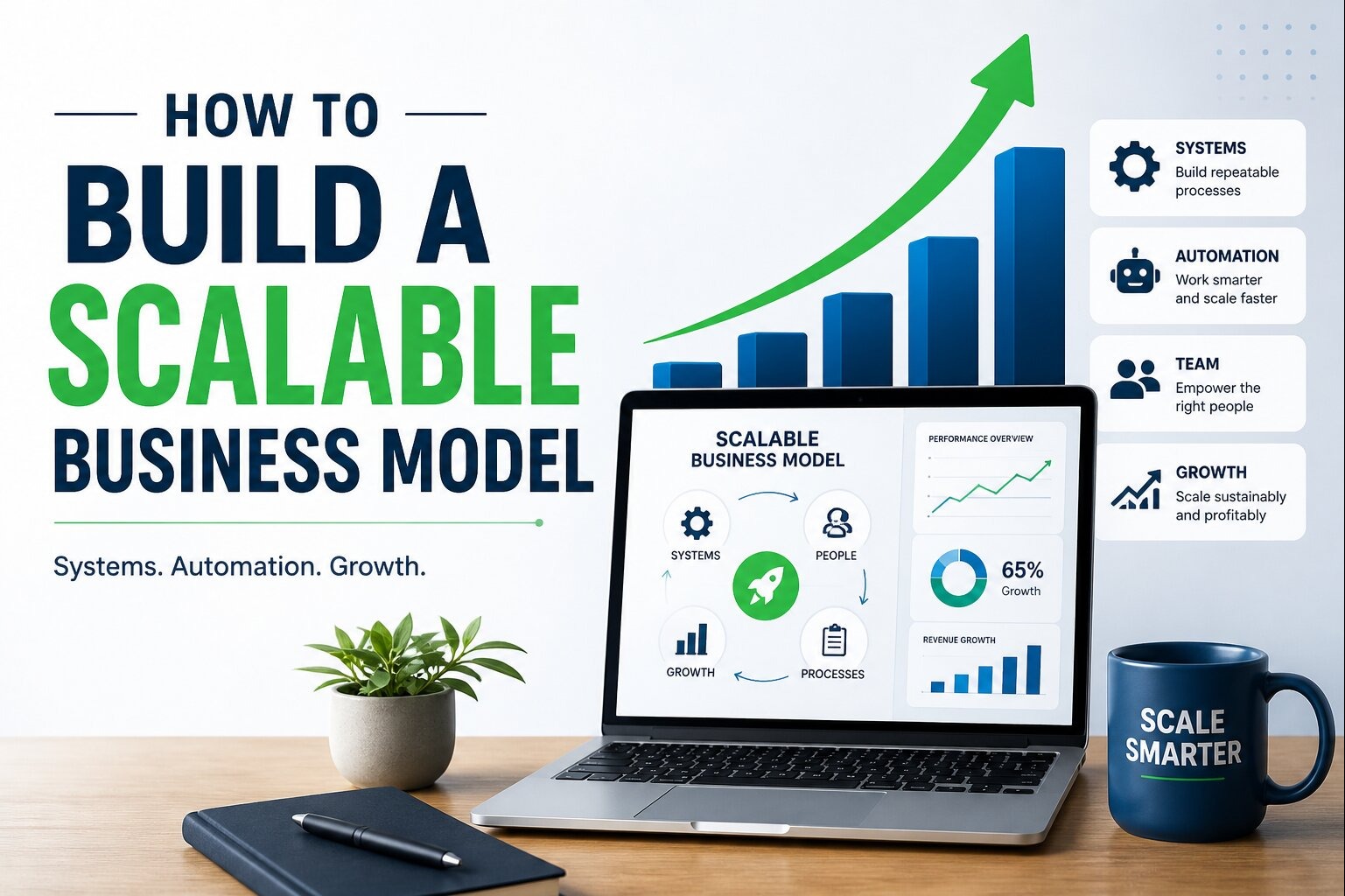
Building a business is one thing. Building a scalable business is something entirely different.
A lot of businesses grow… but only by adding more people, more effort, and more costs. That’s not true scalability. A scalable business model allows you to increase revenue without increasing costs at the same pace.
In simple terms:
👉 Growth = more input, more output
👉 Scaling = less input, more output
If you want long-term success (and less burnout), scalability is the goal.
Let’s break down how to actually build a scalable business model—step by step, in a practical way.
What Makes a Business Model Scalable?
Before building one, you need to understand what scalability looks like.
A scalable business model is:
- Repeatable
- Efficient
- System-driven
- Less dependent on manual effort
- Able to handle growth without breaking
Real-world contrast
- A freelancer trading time for money → not scalable
- A software product serving 1,000 users → highly scalable
If you're still at the foundation stage, start here:
How to Build a Business from Scratch – https://statush.com/business/how-to-build-a-business-from-scratch
1. Start with a Strong Core Offer
You can’t scale something that doesn’t work.
Ask yourself:
- Does your product solve a real problem?
- Do customers actually want it?
- Are people willing to pay consistently?
Practical tip
If you're still testing ideas, validate before scaling:
How to Validate a Business Idea Before Launch – https://statush.com/business/how-to-validate-a-business-idea-before-launch
2. Choose a Scalable Business Model Type
Not all business models are equally scalable.
Highly scalable models:
- SaaS (software subscriptions)
- Digital products (courses, templates)
- E-commerce (with systems)
- Marketplaces
Less scalable models:
- Service-based (without systems)
- Time-for-money businesses
Insight
You don’t need to change your business—but you do need to structure it for scalability.
3. Build Repeatable Systems
If your business depends on constant manual work, scaling will be difficult.
Create systems for:
- Sales
- Marketing
- Customer onboarding
- Delivery or fulfillment
Example
An agency that creates standard packages instead of custom offers can scale much faster.
Practical tip
Document everything. If someone else can follow it, it’s scalable.
4. Focus on Scalable Revenue Streams
Some revenue streams grow better than others.
Scalable options:
- Subscription models
- Automated online sales
- Licensing or franchising
- Digital distribution
Example
A gym adds an online fitness program—now revenue is not limited by physical space.
5. Automate Wherever Possible
Automation reduces effort while increasing output.
Areas to automate:
- Email marketing
- Customer support (basic queries)
- Billing and payments
- Order processing
Real insight
Automation doesn’t just save time—it makes your business consistent.
6. Build a Scalable Customer Acquisition System
You need a system that brings customers consistently.
Scalable channels:
- Paid ads (if profitable)
- SEO
- Content marketing
- Referral systems
Avoid relying only on:
- Manual outreach
- One-time campaigns
For deeper strategies:
Customer Acquisition Strategies for Small Businesses – https://statush.com/business/customer-acquisition-strategies-for-small-businesses
7. Improve Unit Economics
Scaling only works if your numbers make sense.
Key metrics:
- Customer Acquisition Cost (CAC)
- Lifetime Value (LTV)
- Profit margins
Simple rule
If you lose money per customer, scaling will increase losses.
8. Standardize Your Offer
Customization slows down scaling.
Instead:
- Create fixed packages
- Define clear pricing
- Limit variations
Example
Instead of custom marketing services, offer 3 fixed plans.
Practical tip
Clarity increases conversions—and makes operations easier.
9. Build a Team Around Systems (Not Chaos)
Hiring alone doesn’t make a business scalable—systems do.
Build roles like:
- Operations manager
- Sales team
- Customer support
Important
Hire after systems are in place—not before.
10. Track and Optimize Continuously
A scalable business is always improving.
Track:
- Revenue growth
- Conversion rates
- Customer retention
- Operational efficiency
Practical tip
Weekly reviews can help you catch problems early.
Scalable vs Non-Scalable Model Comparison
| Factor | Scalable Model | Non-Scalable Model |
|---|---|---|
| Revenue growth | Exponential | Linear |
| Cost increase | Slow | Fast |
| Dependency | Systems | Individual effort |
| Flexibility | High | Limited |
| Examples | SaaS, digital products | Freelancing, manual services |
Common Mistakes to Avoid
Let’s be honest—many businesses fail to scale because of avoidable mistakes.
Avoid:
- Scaling too early
- Ignoring systems
- Over-customization
- Hiring without structure
- Not tracking numbers
Connecting Scalability with Growth
Scalability is what allows growth to become sustainable.
If you're still growing your business:
How to Grow a Small Business Faster – https://statush.com/business/how-to-grow-a-small-business-faster
If you're ready to scale operations:
How to Scale a Startup Step-by-Step – https://statush.com/business/how-to-scale-a-startup-step-by-step
And to increase revenue efficiently:
How to Increase Business Revenue – https://statush.com/business/how-to-increase-business-revenue
Final Thoughts
Building a scalable business model isn’t about doing more—it’s about doing things smarter and more efficiently.
Focus on:
- Systems over effort
- Automation over manual work
- Consistency over complexity
Start small, refine what works, and then scale it.
Because the goal isn’t just to grow a business—it’s to build one that can grow without depending entirely on you.