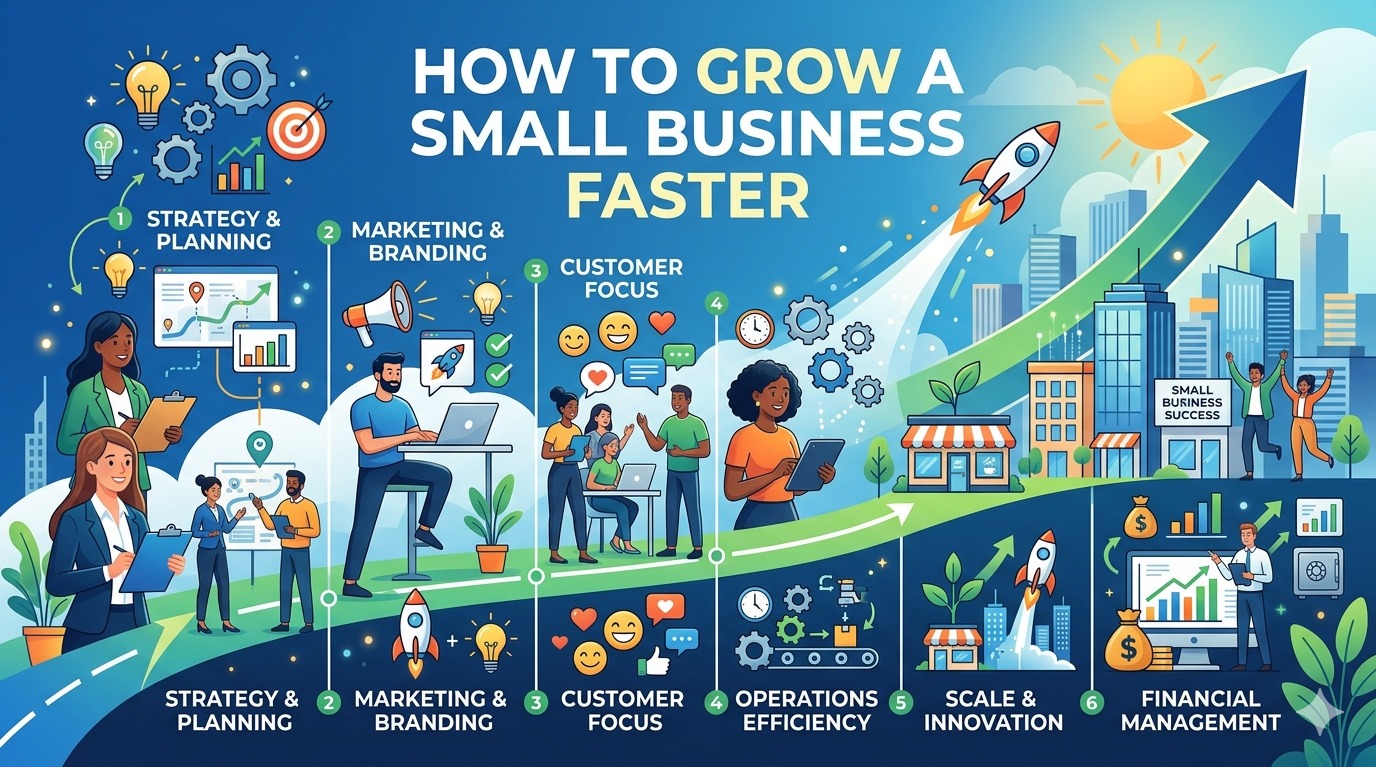
Growing a small business sounds exciting—and it is—but it’s also where most entrepreneurs get stuck. Starting is hard, no doubt. But growth? That’s where real strategy, patience, and smart decision-making come into play.
The biggest mistake people make is assuming growth will happen naturally if the product is good. In reality, growth is something you engineer. It requires clarity, consistency, and a willingness to test what works (and quickly drop what doesn’t).
Let’s break this down in a practical, no-nonsense way so you can actually apply it.
What “Growth” Really Means
Before chasing growth, define what it means for your business.
For some, growth means:
- More revenue
- More customers
- Expanding into new markets
- Building a team
- Increasing profit margins
If you don’t define it clearly, you’ll end up busy—but not necessarily successful.
A strong foundation matters here. If you haven’t structured your business properly yet, start with:
How to Build a Business from Scratch – https://statush.com/business/how-to-build-a-business-from-scratch
1. Focus on One Core Growth Channel
Trying to grow everywhere at once is a common trap.
Instead of:
- Running ads everywhere
- Posting on all social platforms
- Trying every marketing tactic
Pick one channel and go deep.
Examples:
- Local service → Google listings + referrals
- E-commerce → Instagram or paid ads
- B2B → LinkedIn + cold outreach
Real-world insight
Many successful businesses grow from just one strong channel before expanding. Think of it as building a “growth engine.”
2. Improve Your Existing Revenue First
Before chasing new customers, look at your current ones.
Simple ways to increase revenue:
- Upsell premium products
- Offer bundles
- Increase pricing strategically
- Improve repeat purchases
Example
A small clothing store increased profits by offering “buy 2 get 10% off” instead of chasing new customers with ads.
If you want to dive deeper:
How to Increase Business Revenue – https://statush.com/business/how-to-increase-business-revenue
3. Build a Strong Sales Process
Many businesses don’t have a sales problem—they have a conversion problem.
Fix this by:
- Improving your pitch
- Simplifying your offer
- Adding testimonials and proof
- Following up consistently
Practical tip
If people are interested but not buying, your messaging—not your product—is likely the issue.
4. Invest in Marketing That Actually Works
Marketing is not about doing more—it’s about doing what works.
Focus on:
- Channels that bring real leads
- Clear messaging (not fancy slogans)
- Consistency over perfection
Common mistake
Spending money on ads without testing the basics like:
- Target audience
- Offer clarity
- Landing page quality
5. Create Systems Before Scaling
Growth without systems leads to chaos.
Before scaling, make sure:
- Your operations are repeatable
- You can handle increased demand
- Your delivery quality stays consistent
Example
A food business that grows too fast without supply systems often fails due to inconsistency.
6. Hire at the Right Time (Not Too Early)
Hiring can accelerate growth—but only if done at the right time.
When to hire:
- You’re consistently overloaded
- Tasks are repeatable
- Revenue supports salaries
When NOT to hire:
- Just to “feel bigger”
- Without clear roles
7. Use Data to Make Decisions
Guesswork slows growth. Data speeds it up.
Track things like:
- Customer acquisition cost
- Conversion rates
- Profit margins
- Repeat customer rate
Practical tip
Even a simple Excel sheet tracking weekly performance can reveal patterns.
8. Expand Smartly (Not Emotionally)
Expansion is exciting—but risky.
Smart expansion includes:
- Launching related products
- Entering similar markets
- Scaling proven strategies
Risky expansion:
- Jumping into completely new industries
- Expanding without demand validation
Before expanding, validate your idea here:
How to Validate a Business Idea Before Launch – https://statush.com/business/how-to-validate-a-business-idea-before-launch
9. Strengthen Your Brand
People don’t just buy products—they buy trust.
Build your brand by:
- Being consistent
- Delivering quality
- Sharing your story
- Creating a recognizable identity
Example
Local brands often grow faster because of strong trust and word-of-mouth.
10. Think Long-Term, Act Short-Term
This is where many entrepreneurs struggle.
Balance both:
- Long-term vision → where you want to go
- Short-term actions → daily execution
Real talk
Growth is not one big move—it’s small wins repeated consistently.
Simple Growth Strategy Table
| Strategy | Impact Level | Difficulty | Time to See Results | Best For |
|---|---|---|---|---|
| Improve existing revenue | High | Low | Fast | All businesses |
| Focus on one channel | High | Medium | Medium | Early-stage businesses |
| Build sales process | High | Medium | Fast | Service & product businesses |
| Marketing optimization | Medium | Medium | Medium | Growth-stage businesses |
| System creation | High | High | Slow | Scaling businesses |
| Hiring | Medium | Medium | Medium | Growing teams |
| Expansion | High | High | Slow | Established businesses |
Common Growth Mistakes to Avoid
Let’s keep this real—most businesses don’t fail due to lack of effort. They fail due to wrong direction.
Avoid:
- Doing too many things at once
- Ignoring customer feedback
- Scaling without systems
- Spending too much on ads too early
- Not tracking performance
Connecting Growth with Strategy
If you want sustainable growth, you need a broader strategy—not just tactics.
You can explore structured strategies here:
Business Growth Strategies That Actually Work – https://statush.com/business/business-growth-strategies-that-actually-work
And if you're planning to scale aggressively:
How to Scale a Startup Step-by-Step – https://statush.com/business/how-to-scale-a-startup-step-by-step
Final Thoughts
Growing a small business faster isn’t about shortcuts—it’s about clarity, focus, and consistency.
Start with what’s working. Improve it. Then scale it.
Don’t chase growth just for the sake of it. Build something sustainable—and growth will follow naturally.
Because in the end, the businesses that win aren’t the fastest—they’re the ones that grow smart.