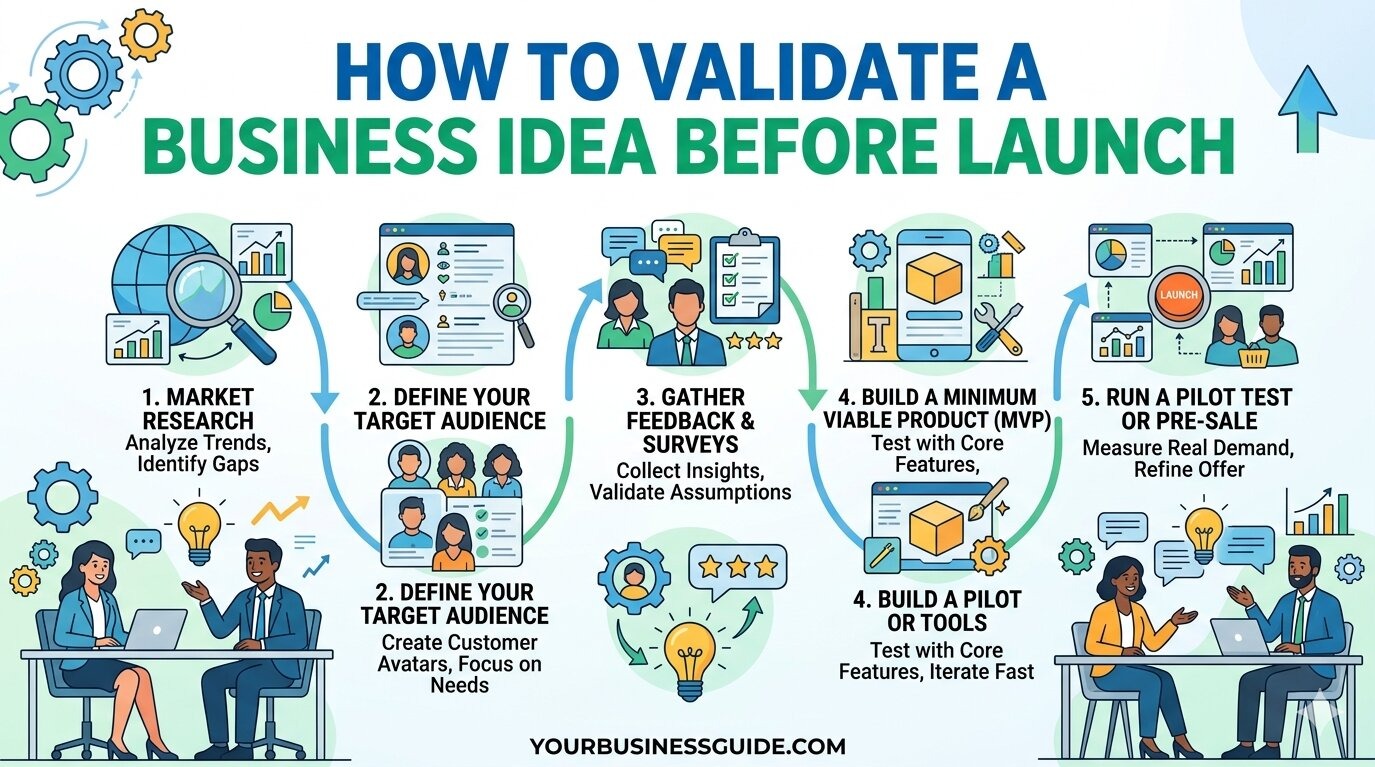
Coming up with a business idea is easy. The real challenge is figuring out whether it will actually work.
Many people skip validation and jump straight into building a product, investing money, or even quitting their job. That’s risky. Validation helps you test your idea before you commit fully—saving time, money, and frustration.
Let’s break this down in a practical, no-nonsense way.
What Does “Validation” Really Mean?
Validation simply means proving one thing:
Are people willing to pay for your idea?
Not “Do people like it?”
Not “Does it sound cool?”
But—will someone actually spend money on it?
This small shift in thinking changes everything.
Why Validation Is So Important
Skipping validation is one of the biggest reasons businesses fail.
Here’s what validation helps you avoid:
- Building something nobody wants
- Wasting months (or years) on the wrong idea
- Spending money without returns
Real-world example:
A startup spent months building a productivity app, only to realize users preferred simpler tools like spreadsheets. They never tested demand early—and paid the price.
Step 1: Define Your Target Customer Clearly
You can’t validate an idea if you don’t know who it’s for.
Instead of saying:
- “Everyone”
- “People who need this”
Be specific:
- Freelancers struggling with time management
- Busy parents looking for quick meal solutions
- Small business owners needing affordable marketing
The clearer your audience, the more accurate your validation will be.
Step 2: Identify the Problem You’re Solving
A strong business idea always solves a real problem.
Ask:
- What pain point exists?
- How serious is this problem?
- Are people already trying to fix it?
Tip:
If people are already spending money on a solution—even if it’s imperfect—that’s a strong signal of demand.
Step 3: Test Interest Before Building
This is where things get practical.
You don’t need a full product to test your idea.
Simple validation methods:
| Method | How It Works | What It Tells You |
|---|---|---|
| Landing Page | Describe your offer | Interest level |
| Pre-orders | Sell before building | Buying intent |
| Surveys | Ask target users | Pain points |
| Social Media | Post your idea | Engagement |
Example:
Someone planning to launch an online course created a simple page describing it and collected email signups. Within a week, 300 people signed up—that’s strong validation.
Step 4: Talk to Real People (Not Just Friends)
Feedback from friends and family can be misleading. They often want to support you, not criticize.
Instead:
- Talk to strangers in your target audience
- Join niche communities (Reddit, Facebook groups)
- Conduct short interviews
Ask questions like:
- “How do you currently solve this problem?”
- “What frustrates you about it?”
- “Would you pay for a better solution?”
Step 5: Validate With Real Money
Interest is good. Payment is better.
Even a small number of paying customers proves your idea has potential.
Ways to test this:
- Offer early-bird pricing
- Run a limited pre-sale
- Sell a basic version (MVP)
Real-world example:
A fitness coach sold a 4-week program before creating it. Once 20 people paid, they built the program—ensuring it was worth the effort.
Step 6: Analyze the Results Honestly
This step requires honesty—something many founders struggle with.
Ask yourself:
- Did people actually pay?
- Was interest consistent or just curiosity?
- Are customers excited or indifferent?
If the answer isn’t strong, don’t force it.
Honest opinion:
It’s better to pivot early than to push a weak idea.
Step 7: Refine or Pivot Your Idea
Validation doesn’t always mean “yes” or “no.” Sometimes it means “adjust.”
You might need to:
- Change your target audience
- Improve your offer
- Adjust pricing
- Simplify your solution
Example:
A meal prep startup initially targeted gym-goers but found more demand from busy office workers. A simple shift made the business work.
Step 8: Connect Validation With Your Bigger Plan
Once your idea shows promise, you can move forward with more confidence.
At this stage, you can:
- Build a structured roadmap
- Plan your finances
- Prepare for launch
If you’re ready for that step, read
How to Write a Business Plan That Works
https://statush.com/business/how-to-write-a-business-plan-that-works
And if you're still exploring ideas, check
Best Profitable Small Business Ideas in the USA
https://statush.com/business/best-profitable-small-business-ideas-in-the-usa
Common Validation Mistakes to Avoid
Let’s keep this practical—these mistakes can mislead you:
- Asking leading questions (“Would you buy this amazing product?”)
- Relying only on opinions, not actions
- Ignoring negative feedback
- Testing with the wrong audience
- Overcomplicating the process
Validation should be simple, quick, and focused.
Simple Validation Flow (Quick Recap)
Here’s a clear way to think about the process:
| Step | Action | Goal |
|---|---|---|
| 1 | Define audience | Target clarity |
| 2 | Identify problem | Real need |
| 3 | Test interest | Initial demand |
| 4 | Talk to users | Insights |
| 5 | Get payments | Proof |
| 6 | Analyze | Decision |
| 7 | Refine | Improvement |
Final Thoughts
Validating a business idea isn’t about perfection—it’s about reducing risk.
You don’t need expensive tools or complex strategies. Just focus on:
- Real problems
- Real people
- Real feedback
- Real payments
That’s it.
If your idea passes these tests, you’re already ahead of most beginners.
And when you're ready to move forward, you can follow
How to Start a Small Business in the USA (Step-by-Step)
https://statush.com/business/how-to-start-a-small-business-in-the-usa-step-by-step