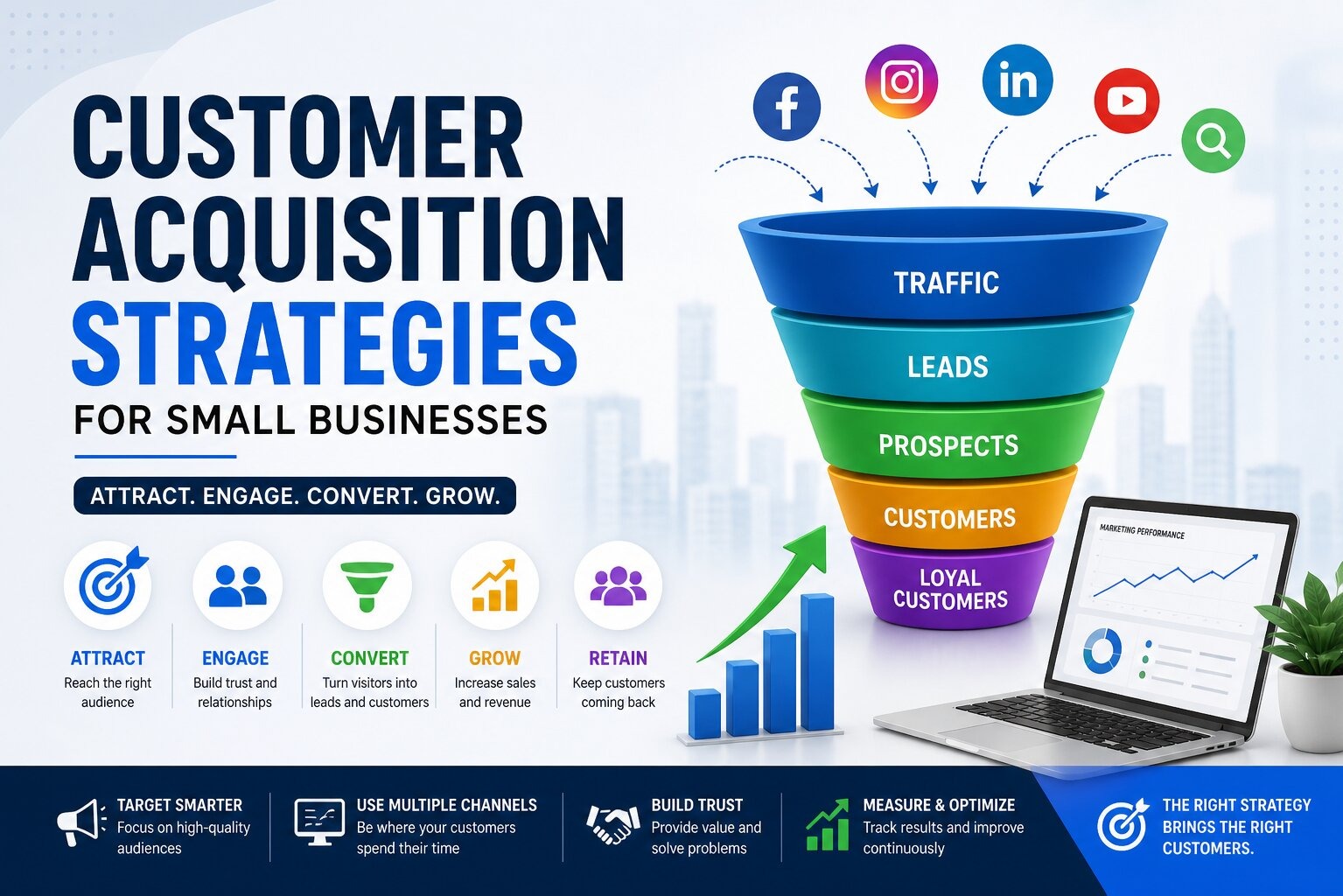
Getting customers is the lifeline of any business. Without customers, there’s no revenue. But here’s where many small businesses struggle—they either rely on random tactics or spend money on marketing that doesn’t convert.
Customer acquisition isn’t about doing everything. It’s about doing the right things consistently and building a system that brings in customers predictably.
Let’s break down practical, real-world strategies that actually work—especially for small businesses.
What is Customer Acquisition (Simple Explanation)
Customer acquisition is the process of turning strangers into paying customers.
It typically involves:
- Attracting attention
- Building interest
- Converting into a sale
If you don’t have a structured process, you’re likely relying on luck instead of strategy.
Before diving deeper, make sure your business foundation is solid:
How to Build a Business from Scratch – https://statush.com/business/how-to-build-a-business-from-scratch
1. Start with a Clear Target Audience
You can’t attract everyone—and trying to do so wastes time and money.
Define:
- Who your ideal customer is
- What problems they face
- Where they spend time
Example
A fitness coach targeting “everyone” struggles. One targeting “busy professionals who want quick workouts” grows faster.
Practical tip
The clearer your audience, the easier your marketing becomes.
2. Build a Strong Value Proposition
Why should someone choose you?
A strong value proposition:
- Solves a clear problem
- Is easy to understand
- Differentiates you from competitors
Weak example
“We offer digital marketing services”
Strong example
“We help local businesses get 50+ qualified leads in 30 days”
3. Use One Primary Acquisition Channel First
Trying multiple channels at once is a common mistake.
Choose based on your business:
- Local business → Google + local SEO
- E-commerce → Instagram or ads
- B2B → LinkedIn + email outreach
Why this works
Focus builds momentum. Once one channel works, you can expand.
4. Leverage Content Marketing
Content builds trust before the sale.
Types of content:
- Blog posts
- Social media content
- Videos
- Guides and tutorials
Example
A small skincare brand shares skincare tips → builds trust → converts followers into customers.
Practical tip
Focus on helping first, selling later.
5. Optimize Your Website or Landing Page
Your website is often your first impression.
Must-have elements:
- Clear headline
- Simple offer
- Testimonials or proof
- Easy navigation
Real insight
Even small improvements (like faster loading or better design) can increase conversions significantly.
6. Use Paid Advertising (Smartly)
Ads can bring fast results—but only if done right.
Best practices:
- Start with small budgets
- Test different creatives and audiences
- Track results closely
Common mistake
Running ads without a clear offer or funnel.
7. Build a Referral System
Happy customers can bring new customers—for free.
How to encourage referrals:
- Offer incentives
- Ask for referrals directly
- Deliver excellent service
Example
“Refer a friend and get 10% off your next purchase”
8. Partner with Other Businesses
Collaborations can expand your reach quickly.
Examples:
- Joint promotions
- Cross-marketing
- Affiliate partnerships
Real-world example
A café partners with a co-working space—both gain new customers.
9. Use Email Marketing
Email is still one of the most effective channels.
Why it works:
- Direct communication
- High ROI
- Builds long-term relationships
What to send:
- Offers
- Updates
- Helpful content
10. Track and Improve Your Acquisition Process
If you don’t track, you can’t improve.
Key metrics:
- Cost per customer
- Conversion rate
- Channel performance
Practical tip
Focus on improving what’s already working before trying new strategies.
Customer Acquisition Strategy Table
| Strategy | Cost Level | Speed | Difficulty | Best For |
|---|---|---|---|---|
| Target audience clarity | Low | Fast | Low | All businesses |
| Content marketing | Low | Slow | Medium | Long-term growth |
| Paid advertising | Medium | Fast | Medium | Quick results |
| Referral system | Low | Medium | Low | Service & local businesses |
| Partnerships | Low | Medium | Low | Small businesses |
| Email marketing | Low | Medium | Low | Retention & repeat sales |
| Website optimization | Medium | Fast | Medium | Online businesses |
Common Customer Acquisition Mistakes
Let’s be real—most businesses struggle because of avoidable mistakes.
Avoid:
- Targeting everyone
- Weak messaging
- Ignoring data
- Using too many channels at once
- Expecting instant results
Connecting Acquisition with Growth
Customer acquisition is just one part of growth. To build a strong business, you also need retention and scalability.
To improve overall growth:
How to Grow a Small Business Faster – https://statush.com/business/how-to-grow-a-small-business-faster
To build a scalable system:
How to Build a Scalable Business Model – https://statush.com/business/how-to-build-a-scalable-business-model
And to increase revenue from customers:
How to Increase Business Revenue – https://statush.com/business/how-to-increase-business-revenue
Final Thoughts
Customer acquisition isn’t about chasing customers—it’s about attracting the right ones consistently.
Start simple:
- Know your audience
- Use one strong channel
- Build trust through value
Then improve, optimize, and scale.
Because in the end, businesses don’t grow because of traffic—they grow because of customers who trust and buy.