If you're starting an e-commerce business in the U.S., one of the first big decisions you’ll face is this:
Should you go with dropshipping or build a private label brand?
Both models can work. Both can be profitable. But they are very different in terms of control, risk, margins, and long-term potential.
The key is not choosing what’s “popular”—it’s choosing what fits your goals, budget, and strategy.
Let’s break this down in a practical, no-nonsense way.
What is Dropshipping?
Dropshipping is a business model where you sell products without holding inventory.
How it works:
- You list products on your store
- Customer places an order
- Supplier ships directly to the customer
Simple example
You sell a product for $30 → supplier charges $15 → you keep the difference (before marketing costs).
What is Private Label?
Private label means you sell products under your own brand.
How it works:
- You source or manufacture products
- Add your branding (logo, packaging)
- Sell under your brand name
Example
Instead of selling a generic product, you create your own branded version and build a long-term business.
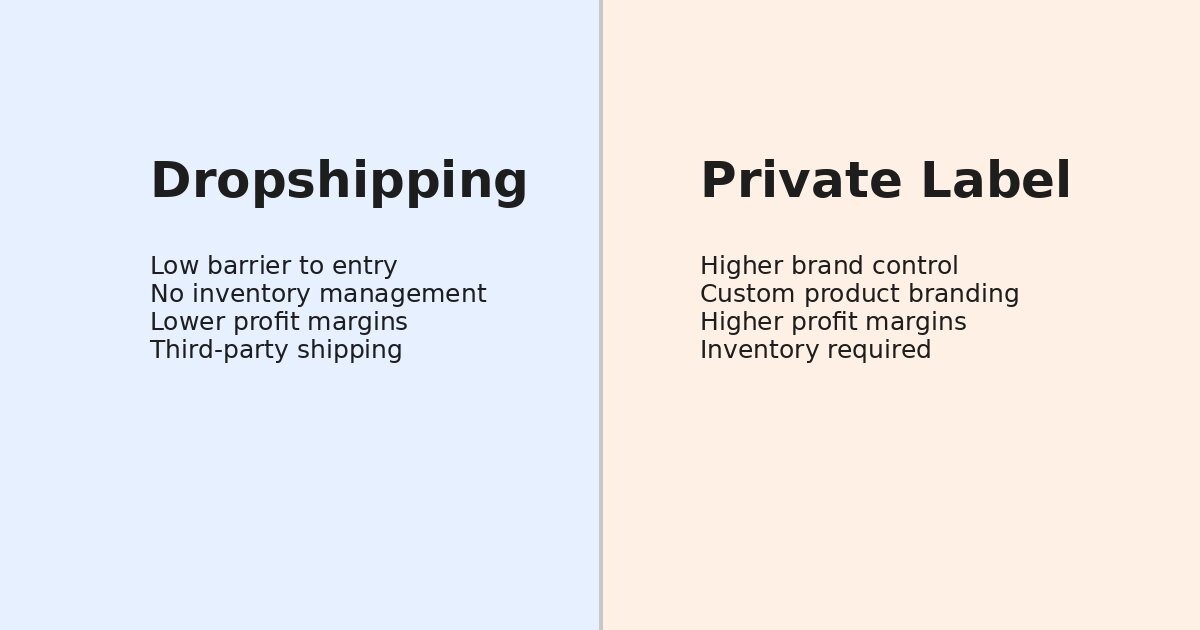
Key Differences at a Glance
| Factor | Dropshipping | Private Label |
|---|---|---|
| Inventory | No | Yes |
| Startup cost | Low | Medium to High |
| Control | Low | High |
| Profit margins | Low to Medium | Medium to High |
| Branding | Limited | Strong |
| Risk | Low upfront | Higher upfront |
| Scalability | Medium | High |
1. Startup Cost and Risk
Dropshipping:
- Low upfront investment
- No inventory cost
- Lower financial risk
Private Label:
- Requires inventory purchase
- Branding and packaging costs
- Higher initial investment
Practical insight
If you’re just starting and want to test quickly, dropshipping is easier.
2. Profit Margins
Dropshipping:
- Lower margins due to supplier pricing
- High competition reduces pricing power
Private Label:
- Higher margins
- More control over pricing
Real insight
Private label businesses tend to be more profitable long-term.
3. Branding and Customer Loyalty
Dropshipping:
- Hard to build a strong brand
- Customers often see it as a commodity
Private Label:
- Strong brand identity
- Better customer retention
- Higher perceived value
Example
Customers remember brands—not generic products.
To improve retention:
How to Retain Customers and Increase Lifetime Value – https://statush.com/business/how-to-retain-customers-and-increase-lifetime-value
4. Control Over Product and Quality
Dropshipping:
- Limited control over product quality
- Supplier issues affect your business
Private Label:
- Full control over product
- Ability to improve and customize
Practical tip
Control becomes critical as you scale.
5. Shipping and Customer Experience
Dropshipping:
- Longer shipping times (especially from overseas)
- Inconsistent customer experience
Private Label:
- Faster shipping (especially within the U.S.)
- Better packaging and branding
Real insight
Customer experience plays a huge role in repeat business.
6. Scalability
Dropshipping:
- Easy to start
- Harder to build a long-term brand
Private Label:
- Slower start
- Much more scalable
Practical tip
Dropshipping is often used to test products, then transition into private label.
7. Competition Level
Dropshipping:
- Highly competitive
- Easy to copy
Private Label:
- Less direct competition
- Differentiation through branding
8. Marketing Strategy
Dropshipping:
- Focus on quick sales
- Heavy reliance on ads
Private Label:
- Focus on brand building
- Long-term marketing strategies
For marketing strategies:
Customer Acquisition Strategies for Small Businesses – https://statush.com/business/customer-acquisition-strategies-for-small-businesses
9. Long-Term Business Value
Dropshipping:
- Short-term gains
- Harder to build a sellable business
Private Label:
- Long-term asset
- Higher business valuation
Real insight
Investors and buyers prefer branded businesses over generic stores.
10. Which One Should You Choose?
Choose Dropshipping if:
- You have a low budget
- You want to test products quickly
- You’re just starting
Choose Private Label if:
- You want to build a brand
- You’re focused on long-term growth
- You can invest upfront
Strategy Comparison Table
| Goal | Best Option | Reason |
|---|---|---|
| Low-risk start | Dropshipping | Minimal investment |
| Fast testing | Dropshipping | Quick product validation |
| High profit margins | Private Label | Better pricing control |
| Brand building | Private Label | Strong identity |
| Long-term scalability | Private Label | Sustainable growth |
Common Mistakes to Avoid
Let’s be honest—both models fail when done incorrectly.
Avoid:
- Choosing random products without validation
- Ignoring customer experience
- Poor marketing strategy
- Scaling too early
- Not understanding margins
Connecting Business Model with Growth
Your business model affects everything—growth, scaling, and profitability.
To start your online journey:
How to Start an Online Business in the USA – https://statush.com/business/how-to-start-an-online-business-in-the-usa
To scale effectively:
How to Scale a Startup Step-by-Step – https://statush.com/business/how-to-scale-a-startup-step-by-step
To build a scalable system:
How to Build a Scalable Business Model – https://statush.com/business/how-to-build-a-scalable-business-model
Final Thoughts
There’s no “best” model—only the one that fits your goals.
- Dropshipping is great for starting and testing
- Private label is better for building and scaling
A smart approach?
Start with dropshipping → validate products → move to private label.
Because in the end, success in e-commerce isn’t about the model—it’s about execution, consistency, and long-term thinking.