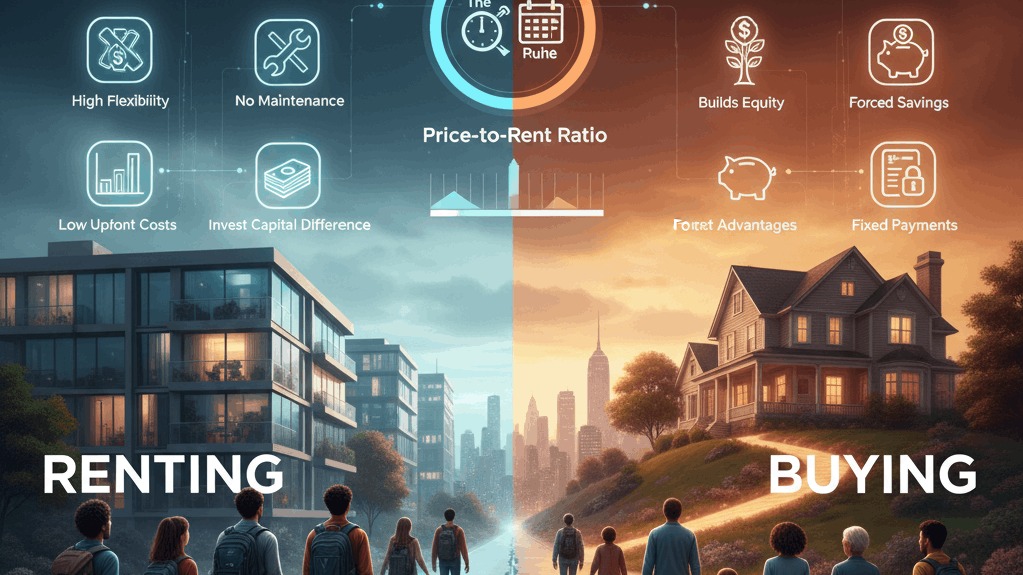
In 2026, the "Rent vs. Buy" debate has moved beyond simple math. With mortgage rates stabilizing around 6% and AI-driven rental markets becoming more efficient, the decision often hinges on your "Life Velocity."
Here is an expanded analysis of the hidden factors and modern financial realities.
1. The "Hidden" Costs of Homeownership
Many beginners compare a rent payment to a mortgage payment and assume that's the whole story. In reality, a mortgage is the minimum you will pay for housing, while rent is the maximum.
- The "Maintenance Tax": In 2026, homeowners should budget at least 1% of the home's value annually for repairs. On a $500,000 home, that’s $5,000 a year ($416/month) just to keep the house in its current condition.
- The Sunk Costs: * Property Taxes: Often increase as your home value rises.
- Homeowners Insurance: Rates have surged in 2026 due to climate-related risk adjustments.
- Closing Costs: You lose 2–5% when you buy and 5–6% in commissions when you sell. If you don't stay long enough to offset these costs with appreciation, you lose money.
2. The Wealth-Building Gap (Modern Math)
One of the biggest 2026 myths is that renting is "throwing money away."
- The Renter’s Strategy: If you rent for $2,500 but a mortgage would cost you $3,500, and you invest that $1,000 difference into a diversified index fund (averaging 7-9% returns), you could potentially build more liquid wealth than a homeowner over a 10-year period.
- The Owner’s Strategy: Homeownership is "forced savings." Most people aren't disciplined enough to invest the $1,000 difference every month. For them, a mortgage is a powerful tool because it requires wealth-building through principal paydown.
3. Psychological "Fit"
Your personality is a valid financial metric.
- The "Anchor" Mindset: You value stability, the ability to renovate (e.g., adding solar panels or a home office), and a sense of community. Buying is your psychological "win."
- The "Agile" Mindset: You prioritize career mobility. In 2026, moving for a 15% raise is often the fastest way to build wealth. Being "locked in" to a home sale process can prevent you from taking life-changing opportunities.
4. The Case for Renting in 2026
Renting is often dismissed as "throwing money away," but it is actually buying flexibility and time.
- Mobility: In the 2026 job market, the ability to move for a 20% salary increase in another city is a massive financial advantage.
- Capital Liquidity: Instead of tying up $100,000 in a house, you can invest that money in high-growth index funds or a business.
- Predictability: You know exactly what your housing cost is every month. No surprise $15,000 roof leaks.
5. The Case for Buying in 2026
Homeownership is a forced savings account that pays you back in the long run.
- The Equity Engine: Even with a 6.3% interest rate, a portion of every payment goes toward owning the asset. Over 10 years, this builds significant "hidden" wealth.
- Inflation Hedge: While rents in major cities are projected to rise by 3–5% annually through 2026, your fixed-rate mortgage stays the same, making your housing "cheaper" over time in real dollars.
- Tax Advantages: Depending on your country, mortgage interest and property taxes may be deductible, providing a year-end "bonus" from the government.
6. The "5-Year Rule"
The biggest mistake people make is buying a home they plan to leave in 2 years.
The Rule: If you don't plan to stay for at least 5 to 7 years, renting is almost always cheaper. This is because the high "transaction costs" (6% agent commissions, 3% closing costs) eat up all your equity gains in the short term.
2026 Pro Tip: The "Breakeven" Calculation
Before deciding, use the Price-to-Rent Ratio:
Ratio = Home Price / Annual Rent
- Below 15: Buying is significantly cheaper.
- 15 to 20: It's a toss-up; lifestyle factors should decide.
- Above 21: Renting is usually the smarter financial move in that specific market.
Here are some strong quote options for “Renting vs Buying a Home (Full Comparison)” — in different tones:
🔹 Educational
“Deciding whether to rent or buy isn’t just about today’s budget — it’s about your long-term financial goals, lifestyle, and flexibility.”
🔹 Strategic
“Renting offers freedom and lower upfront costs; buying builds equity and stability. The right choice depends on your priorities.”
🔹 Motivational
“Owning a home isn’t always the dream — sometimes renting wisely can be the smartest move.”
🔹 Practical
“Compare costs, consider mobility, and weigh investment potential — a well-informed choice always wins.”
🔹 Forward-Focused
“The best housing decision balances where you are now with where you want to be in five, ten, or twenty years.”
🔹 Concise & Impactful
“Rent or buy? Understand the trade-offs, and your home becomes an asset, not a burden.”