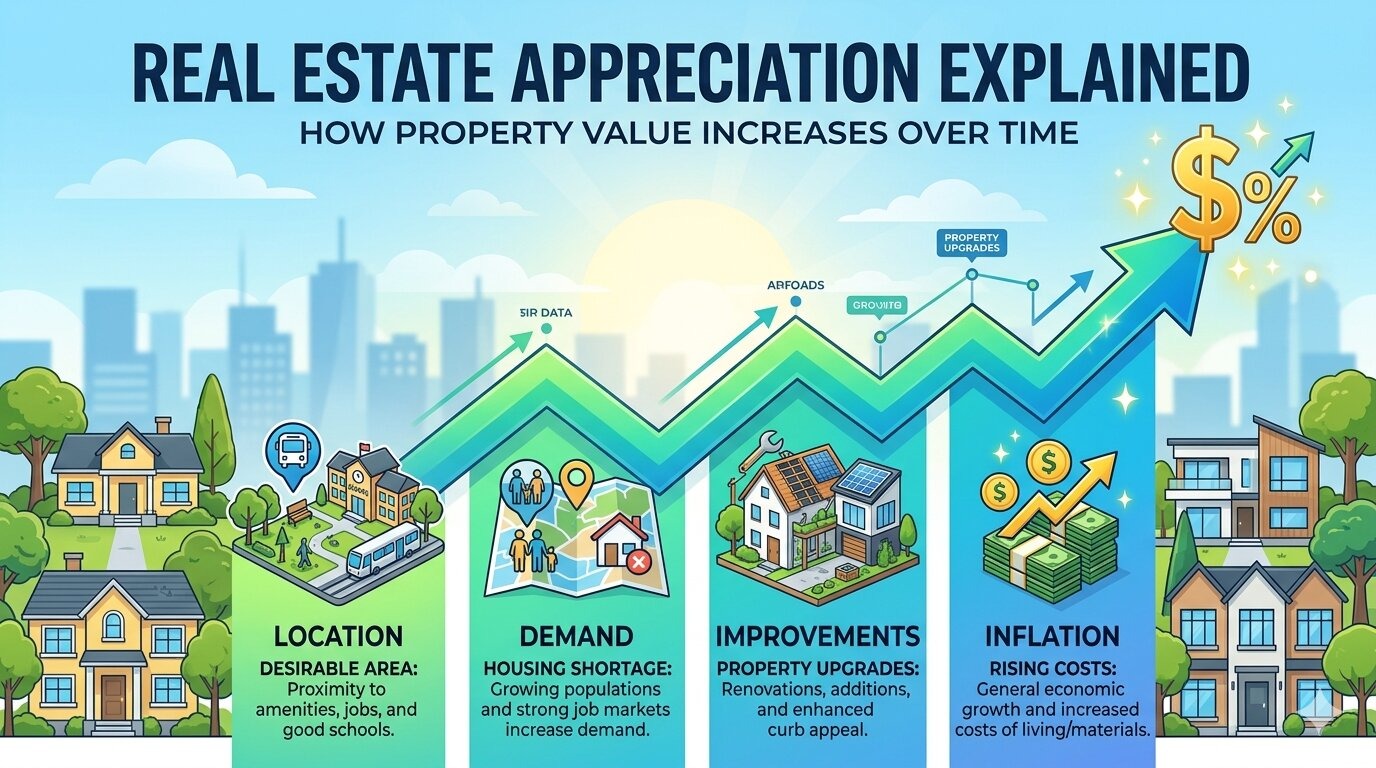
Real estate appreciation is one of the most powerful ways investors build wealth over time. While rental income provides steady cash flow, appreciation is what often creates significant long-term profits.
If you're new to the concept, start here:
How Real Estate Investing Works
https://statush.com/real-estate/how-real-estate-investing-works
In simple terms, appreciation means your property increases in value over time. But what actually drives that increase? And how can you benefit from it as an investor? Let’s break it down.
What Is Real Estate Appreciation?
Real estate appreciation is the increase in a property's market value over time. This can happen naturally due to economic growth or be forced through improvements and upgrades.
For example:
- You buy a property for $200,000
- Five years later, it’s worth $280,000
- That $80,000 increase is appreciation
Unlike cash flow, which you earn monthly, appreciation is usually realized when you sell or refinance.
Types of Real Estate Appreciation
Not all appreciation works the same way. Understanding the different types helps you plan better.
| Type | Explanation | Example |
|---|---|---|
| Natural Appreciation | Market-driven increase | City growth increases demand |
| Forced Appreciation | Value added through improvements | Renovating a kitchen |
| Inflation-Based | Prices rise due to inflation | Higher construction costs |
| Demand-Driven | Population/job growth | Tech companies moving in |
Each type plays a role depending on the market and your investment strategy.
What Drives Property Appreciation?
Several key factors influence how property values increase over time.
1. Location
This is the biggest driver. Properties in growing cities or desirable neighborhoods tend to appreciate faster.
2. Job Growth
More jobs mean more people moving into an area, increasing demand for housing.
3. Population Growth
As more people move in, housing demand rises, pushing prices up.
4. Infrastructure Development
New highways, schools, and public transport can significantly boost property values.
5. Supply and Demand
Limited housing supply with increasing demand leads to price growth.
To understand how these trends evolve over time, read:
Real Estate Market Cycles Explained
https://statush.com/real-estate/real-estate-market-cycles-explained
Appreciation vs Cash Flow
Many investors struggle to choose between appreciation and cash flow. Both are important, but they serve different purposes.
| Factor | Appreciation | Cash Flow |
|---|---|---|
| Income Timing | Long-term | Monthly |
| Risk Level | Medium | Lower |
| Best Markets | High-growth cities | Affordable cities |
| Goal | Wealth building | Passive income |
For a deeper comparison, read:
Cash Flow vs Appreciation in Real Estate
https://statush.com/real-estate/cash-flow-vs-appreciation-in-real-estate
Real-World Examples
Example 1: Natural Appreciation in a Growing City
An investor purchased a home in Phoenix for $250,000 in 2016. Over the next five years, strong population growth and job expansion pushed the property value to over $400,000. The investor didn’t make major upgrades—the appreciation came mainly from market growth.
Example 2: Forced Appreciation Through Renovation
Another investor bought a distressed property for $150,000 in Atlanta. After spending $40,000 on renovations, the property was revalued at $240,000. This created instant equity through forced appreciation.
How to Maximize Real Estate Appreciation
While you can’t control the market, you can take steps to increase your chances of higher appreciation.
1. Invest in Growth Markets
Look for cities with strong job and population growth.
2. Buy Below Market Value
Purchasing a property at a discount increases your upside potential.
3. Improve the Property
Renovations, upgrades, and better management can boost value.
4. Hold Long-Term
Appreciation typically takes time. Short-term gains are less predictable.
5. Analyze Trends, Not Hype
Avoid chasing “hot” markets without understanding fundamentals.
To explore different strategies, read:
Best Real Estate Investment Strategies
https://statush.com/real-estate/best-real-estate-investment-strategies
Risks of Relying on Appreciation
Appreciation is powerful, but it’s not guaranteed.
Market Cycles
Property values can rise and fall depending on economic conditions.
Overpaying
Buying at peak prices reduces your potential returns.
Low Cash Flow
Some appreciation-focused markets have weak rental income.
Economic Changes
Job losses or population decline can slow or reverse appreciation.
That’s why many investors balance appreciation with income-producing properties.
When Should You Focus on Appreciation?
Appreciation-based investing works best if:
- You’re investing for the long term
- You can handle market fluctuations
- You’re targeting high-growth cities
- You don’t rely solely on monthly rental income
If your goal is steady income, you may prefer cash flow-focused markets instead.
Practical Tips for Beginners
Start with Research
Understand local trends before investing in any market.
Use Data
Track property prices, rent trends, and job growth.
Diversify
Don’t rely on a single market or strategy.
Be Patient
Real estate wealth is built over years, not months.
Combine Strategies
Many successful investors use both appreciation and cash flow.
Final Thoughts
Real estate appreciation is one of the most effective ways to build long-term wealth. While it may not provide immediate income, it can create significant equity and financial growth over time.
The key is understanding what drives appreciation, choosing the right markets, and staying patient. Combine that with smart buying decisions and solid strategy, and appreciation can become a powerful tool in your investment journey.
Because in real estate, the biggest gains often come not from what you earn monthly—but from how much your property grows in value over time.