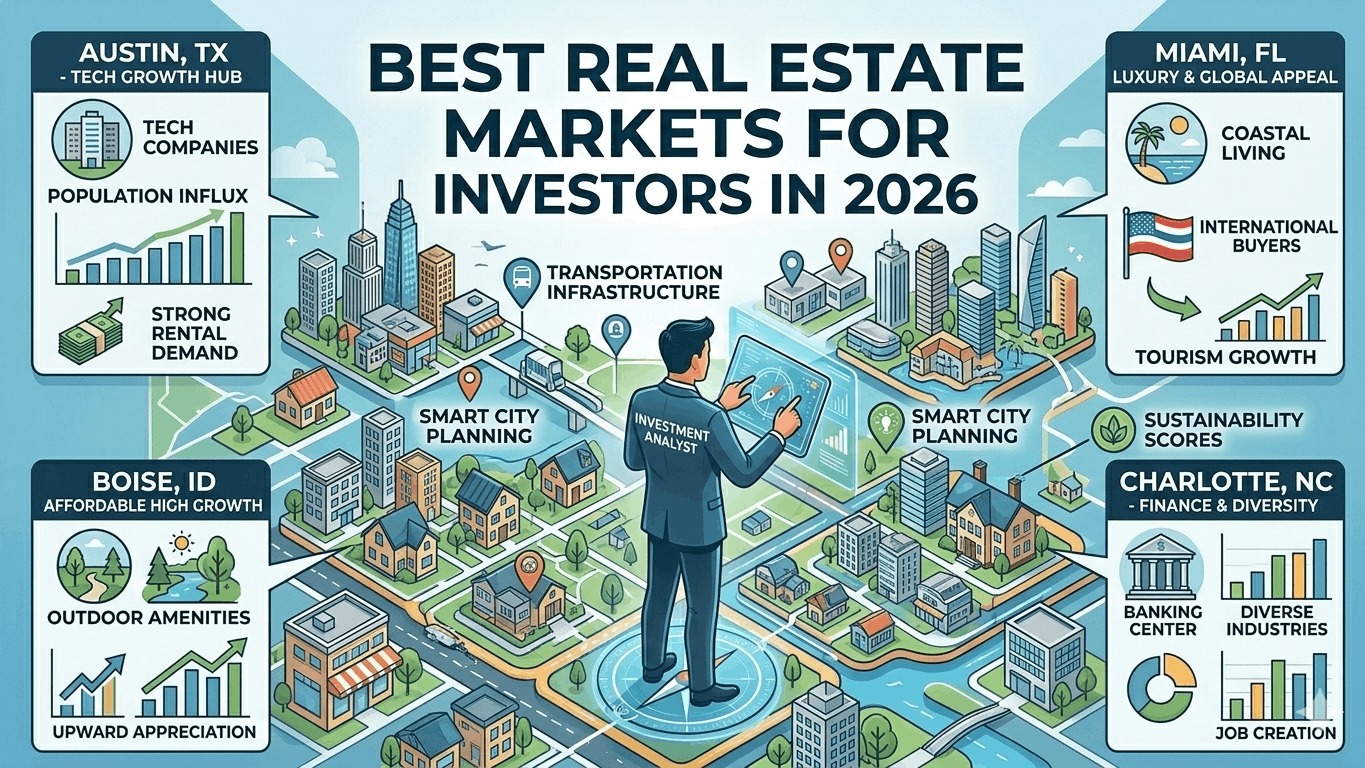
In March 2026, the "Gold Rush" era of real estate has transitioned into the "Fundamentals" era. National home prices are rising at a modest 2% to 4%, and mortgage rates have stabilized near 6%, making market selection more critical than ever.
To win in 2026, investors are looking beyond simple appreciation and focusing on three pillars: Job Growth, Population Migration, and Supply Constraints.
1. The 2026 Powerhouses: Top 5 Overall Markets
According to data from the National Association of Realtors (NAR) and PwC’s 2026 Emerging Trends report, these five cities offer the best balance of stability and growth.
#1 Dallas-Fort Worth, TX
For the second year running, DFW takes the top spot.
- The Draw: A massive, diversified economy (tech, healthcare, defense) and a population projected to hit 10 million by 2030.
- Investor Play: Multi-family assets and "Build-to-Rent" (BTR) communities in the northern suburbs like Frisco and Celina.
#2 Raleigh-Durham, NC
The "Research Triangle" continues to benefit from the high-tech and life sciences boom.
- The Draw: High educational attainment and constant migration of young professionals.
- Investor Play: Medium-term rentals (MTRs) for corporate relocations and healthcare workers.
#3 Nashville, TN
Nashville has moved from a "music city" to a major corporate hub (Amazon, Oracle, HCA Healthcare).
- The Draw: No state income tax and a supply-constrained urban core.
- Investor Play: High-end residential rentals and "co-living" spaces for young professionals.
#4 Tampa-St. Petersburg, FL
While some Florida markets face insurance headwinds, Tampa remains a buyer-friendly Sun Belt magnet.
- The Draw: Consistent 2–3% annual price growth and strong tourism-driven short-term rental demand.
- Investor Play: Single-family homes in "Path of Progress" areas like Pasco County.
#5 Kansas City, MO
Named a "NAR Hotspot" for 2026, KC offers the best affordability-to-growth ratio in the Midwest.
- The Draw: Improving infrastructure and a steady 6–8% appreciation rate over the last five years.
- Investor Play: Cash-flow-heavy long-term rentals in neighborhoods with strong school districts.
2. High-Yield "Cash Flow" Markets (The $200k Club)
If your goal is immediate monthly income (passive income) rather than waiting for a big sale, these "Tier 2" cities are the 2026 champions.
| City | Median Price (2026) | Est. Monthly Rent | Why Invest? |
|---|---|---|---|
| Birmingham, AL | $185,000 | $1,500 | Exceptional affordability; 7-9% CoC returns. |
| Cleveland, OH | $295,000 | $2,200 | Prices remain 18% below the national average. |
| Indianapolis, IN | $285,000 | $1,900 | High occupancy rates; stable corporate job base. |
| Jacksonville, FL | $310,000 | $2,300 | Price correction in 2025 created a buyer's entry point. |
3. Emerging "Niche" Trends to Watch in 2026
A. The Northeast Rebound
Zillow’s 2026 analysis highlights a surprising surge in "Hottest Markets" in the Northeast. Hartford, CT and Buffalo, NY are seeing high competition due to extreme supply shortages and relative affordability compared to NYC and Boston.
B. The AI Infrastructure Boom
Cities with massive data center expansions are seeing a "halo effect" on residential real estate. Markets along the Interstate 20 corridor in the Sun Belt are gaining traction as power-heavy data facilities move in, bringing high-paying tech jobs.
C. Industrial & Logistics Hubs
With the continued "reshoring" of manufacturing to the USA, markets like Columbus, OH and Phoenix, AZ are seeing high demand for workforce housing near new logistics and semiconductor plants.