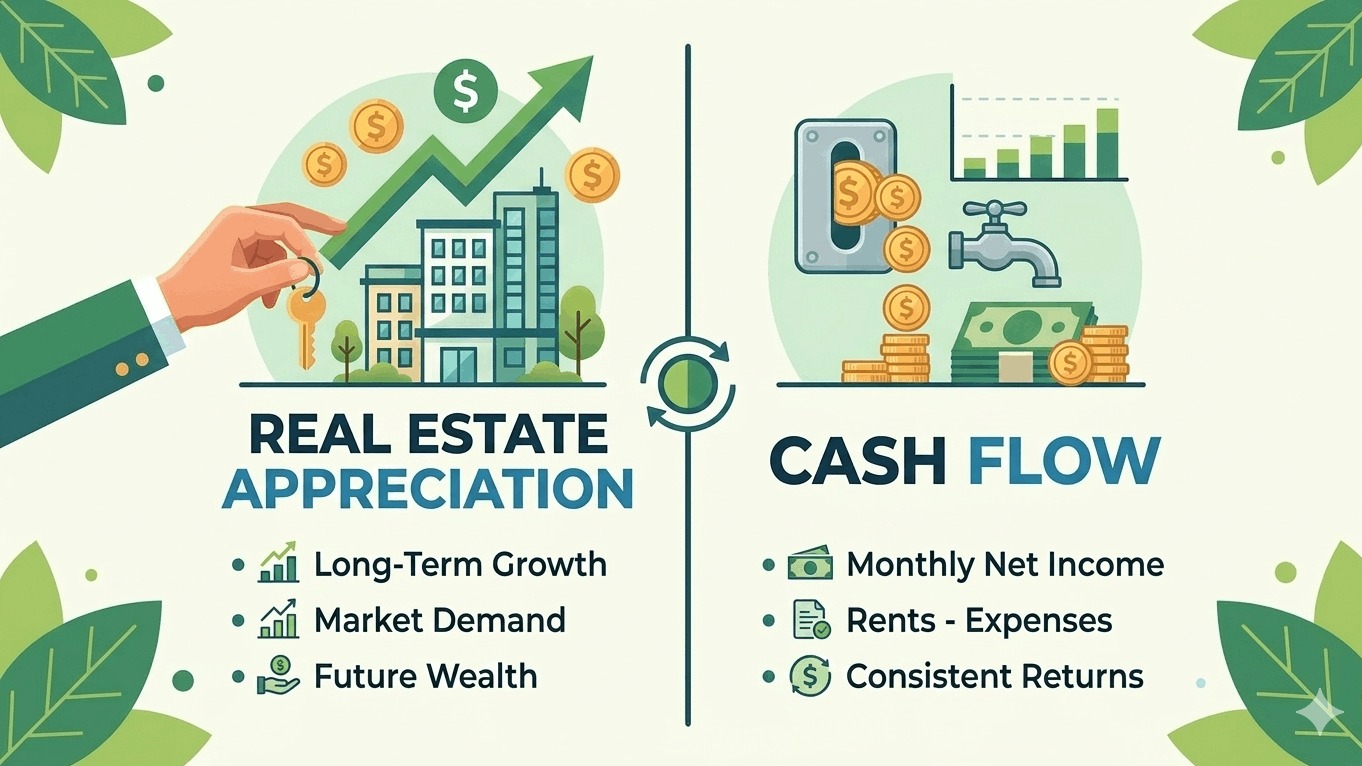
In the 2026 U.S. real estate market, the debate between Appreciation and Cash Flow has taken center stage. With national home prices stalling at 0% growth in many regions while rental demand remains at an all-time high, investors are forced to choose: Do you want a paycheck today, or a fortune tomorrow?
Understanding the tension between these two "wealth levers" is essential for building a portfolio that survives market cycles.
1. Defining the Two Levers
What is Cash Flow? (The "Now" Money)
Cash flow is the net profit you pocket every month after all expenses (mortgage, taxes, insurance, maintenance) are paid.
- Goal: Immediate passive income and financial stability.
- Metric: Cash-on-Cash Return.
What is Appreciation? (The "Later" Money)
Appreciation is the increase in the property's market value over time.
- Goal: Massive equity growth and long-term wealth.
- Metric: Internal Rate of Return (IRR).
2. Head-to-Head Comparison
| Feature | Cash Flow Strategy | Appreciation Strategy |
|---|---|---|
| Typical Market | Midwest / Southeast (e.g., Indianapolis, Birmingham) | Coastal / Tech Hubs (e.g., San Diego, Austin) |
| Risk Level | Lower (Income covers costs even if value dips) | Higher (Dependent on market timing and speculation) |
| Investor Profile | Retirees or those seeking to quit their 9-to-5 | High-earners looking for tax shelters and "big wins" |
| Maintenance | Often higher (Older homes in cash-flow markets) | Often lower (Newer builds in high-growth areas) |
| Tax Impact | Rental income is taxable annually | Capital gains are deferred until the sale |
3. The 2026 Reality Check: Why the Balance Shifted
In previous years, investors could "bet on the come," assuming 5–10% annual appreciation would bail out a property that didn't make money. In 2026, market dynamics have changed:
- Stagnant Price Growth: J.P. Morgan research suggests national home prices are stalling in 2026. If you buy a property that loses $200/month (negative cash flow), there is no guarantee that appreciation will save you this year.
- The "Cash Flow Cushion": 2026 investors are prioritizing cash flow as a "safety net." If the economy slows, the rent check keeps the mortgage paid, allowing you to wait out the cycle until prices rise again.
4. The "Hybrid" Approach: The Best of Both Worlds
Most successful 2026 portfolios don't pick just one. They use a 70/30 or 60/40 Split:
- Core (70%): Stable, cash-flowing properties in secondary markets to provide a base of income.
- Growth (30%): Speculative properties in "path of progress" areas where infrastructure (like new metro lines or tech HQs) is being built.
Forced Appreciation: The 2026 "Cheat Code"
Instead of waiting for the market to raise your property value, savvy investors use Forced Appreciation. By renovating a kitchen, adding an ADU, or improving management, you increase the property’s value and rent simultaneously.