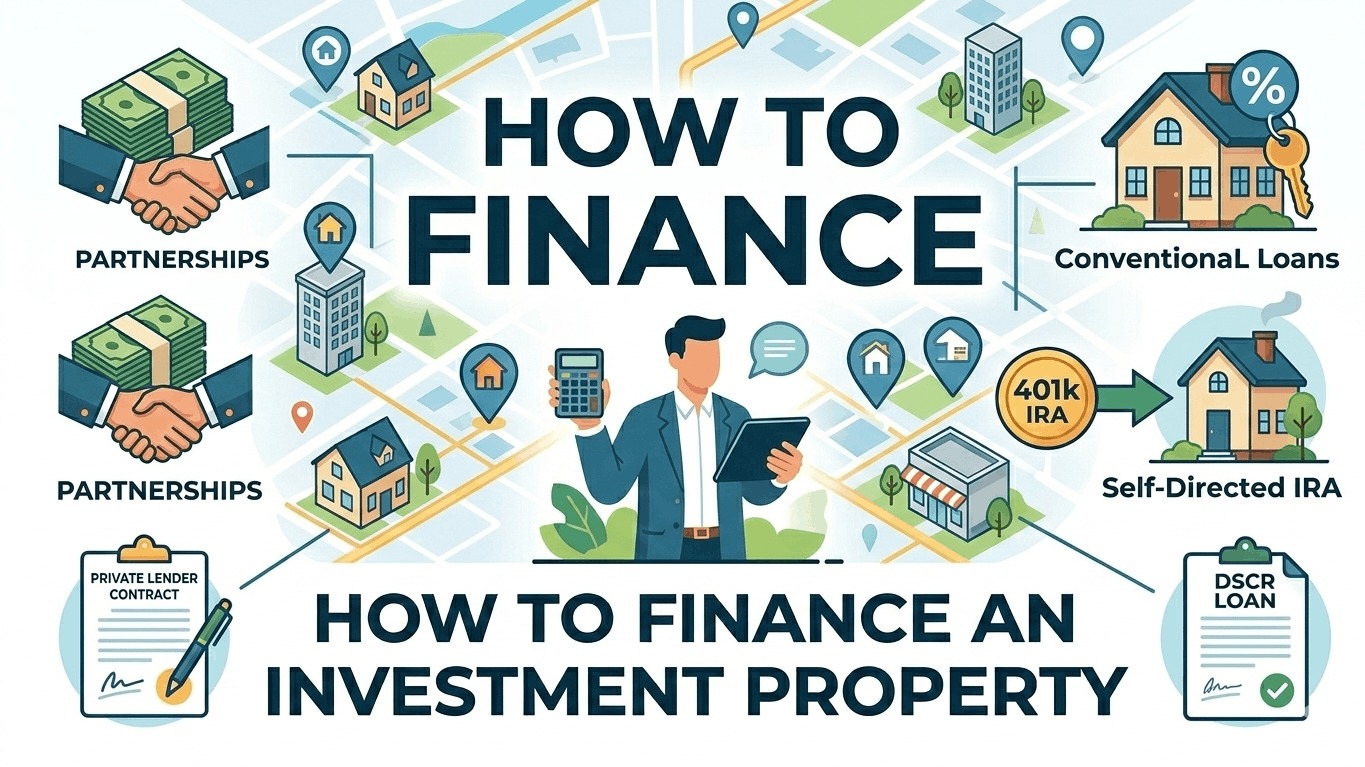
In March 2026, the strategy for financing a rental property is no longer just about finding the lowest rate; it’s about choosing the right structure. With average 30-year fixed mortgage rates for investment properties hovering around 6.1% to 6.3%, investors are prioritizing loan products that offer speed, scalability, and flexibility over traditional bank financing.
1. Traditional Financing: Conforming Loans
Conventional loans—backed by Fannie Mae or Freddie Mac—remain the most popular choice for single-family and 2–4 unit properties.
- Down Payment: Typically 15% to 25%. In 2026, many lenders require 25% for multi-unit properties to mitigate risk.
- Credit Score: While the minimum is usually 620, a score of 740+ is required to secure the best pricing.
- Cash Reserves: Lenders often demand 6 to 12 months of PITI (Principal, Interest, Taxes, Insurance) in reserves for each property you own.
- The 75% Rule: You can use 75% of the property's projected rental income (verified by a lease or appraisal) to help you qualify for the mortgage.
2. The DSCR Loan: The 2026 Investor Favorite
Debt Service Coverage Ratio (DSCR) loans have become a staple for scaling portfolios in 2026. These loans don't care about your personal income, W-2s, or tax returns.
- How it works: Qualification is based entirely on whether the property's rental income covers its debt.
- The Ratio: Most lenders look for a DSCR of 1.0 to 1.25. For example, if the mortgage is $2,000, the rent should be at least $2,000–$2,500.
- Benefits: No debt-to-income (DTI) calculation, faster closing (often 2-3 weeks), and the ability to close in an LLC name.
- Trade-off: Rates are typically 0.5% to 1.5% higher than conventional loans, and they often carry a 3–5 year prepayment penalty.
3. Creative & Asset-Based Financing
A. Hard Money (For Fix-and-Flips)
If you’re buying a property that needs major work, traditional banks won't touch it.
- Terms: High interest (8%–12%) and short terms (6–18 months).
- Strategy: Use hard money to buy and renovate, then refinance into a long-term DSCR or conventional loan (the BRRRR method).
B. HELOC or Home Equity Loan
Many 2026 investors are tapping into the record equity in their primary residence.
- How: You take a line of credit against your current home to use as the down payment for your first rental. This allows you to enter the market without saving up six figures in cash.
C. Seller Financing
In a higher-interest environment, some sellers who own their homes outright are willing to "be the bank." You pay the seller a monthly installment rather than a bank.
4. Comparing the 2026 Financing Options
| Feature | Conventional Loan | DSCR Loan | Hard Money |
|---|---|---|---|
| Qualification | Personal Income (DTI) | Property Income (DSCR) | Asset Value (ARV) |
| Down Payment | 15% – 25% | 20% – 25% | 10% – 15% |
| Documentation | Full (Tax returns/W2) | Light (No income docs) | Very Light |
| Speed | 30–45 Days | 14–21 Days | 5–10 Days |
| Ideal For | Buy-and-Hold (1st deal) | Scaling a Portfolio | Renovations/Flips |