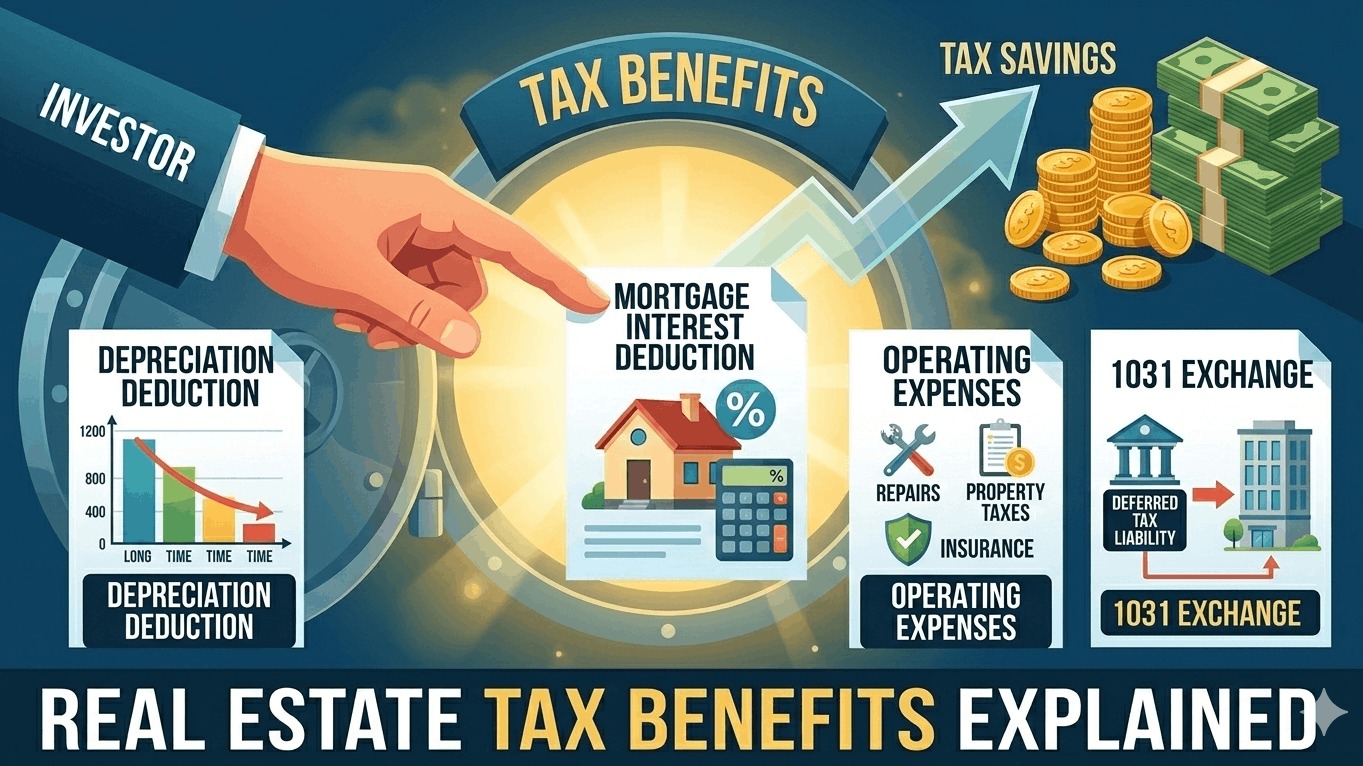
In the 2026 fiscal landscape, real estate remains one of the most tax-advantaged asset classes in the United States. Following the landmark "One Big Beautiful Bill Act" (OBBBA) of 2025, several key tax provisions have been made permanent or significantly enhanced, providing investors with unprecedented stability and "paper losses" to shield their wealth.
While most people view taxes as an expense, savvy investors view the tax code as a partner that pays them to provide housing.
1. The Power of Depreciation: Your "Non-Cash" Expense
Depreciation is often called the "Holy Grail" of real estate taxes. It allows you to deduct the cost of the building (not the land) over its IRS-defined useful life, even if the property is actually increasing in value.
- Residential Rental Property: Depreciated over 27.5 years. You can deduct approximately 3.6% of the building's value every single year.
- 100% Bonus Depreciation (2026 Update): Under the OBBBA, 100% bonus depreciation has been restored and made permanent for property placed in service after January 19, 2025.
- Cost Segregation: By performing a cost segregation study, you can identify components of your building (like appliances, carpeting, and landscaping) that can be depreciated over 5, 7, or 15 years instead of 27.5. In 2026, you can take 100% of those deductions in Year 1.
2. Standard Operating Deductions
Every dollar you spend to maintain and operate your investment is a "write-off" that reduces your taxable rental income.
- Mortgage Interest: Usually the largest deduction. While you cannot deduct the principal portion of your payment, the interest is fully deductible.
- Property Taxes: In 2026, the SALT (State and Local Tax) cap has been increased to $40,400, providing significant relief for investors in high-tax states.
- Professional Services: Fees paid to property managers, lawyers, and accountants (like the one who prepares your 2026 return) are fully deductible.
- Repairs vs. Improvements: Routine repairs (fixing a leak) are deducted in the current year. Improvements (replacing the whole roof) are typically capitalized and depreciated.
3. Advanced Wealth Preservation Tools
The 1031 Exchange (Tax Deferral)
The 1031 Exchange remains fully intact in 2026. It allows you to sell a property and reinvest 100% of the proceeds into a new "like-kind" property without paying a dime in capital gains tax.
- The Rule: You have 45 days to identify a new property and 180 days to close.
- The Goal: "Swap 'til you drop." Investors use this to trade up from a single-family home to a 20-unit apartment building without losing 20-30% of their equity to the IRS.
Section 121 Exclusion (The Homeowner's Gift)
If you sell your primary residence in 2026, you can exclude up to $250,000 (single) or $500,000 (married) of profit from taxes entirely.
- The Requirement: You must have lived in the home for at least 2 of the last 5 years.
Real Estate Professional Status (REPS)
Normally, rental losses are "passive" and can only offset rental income. However, if you qualify as a Real Estate Professional (750+ hours/year in the industry), you can use your real estate losses (generated by that 100% bonus depreciation) to offset your W-2 or business income.
4. Summary of 2026 Tax Benefits
| Benefit | 2026 Status | Impact |
|---|---|---|
| Bonus Depreciation | 100% (Permanent) | Huge Year 1 tax shield for renovations/parts. |
| SALT Deduction Cap | $40,400 | Higher deduction for state/local taxes. |
| QBI (Section 199A) | Permanent | 20% deduction on "pass-through" rental income. |
| 1031 Exchange | Unchanged | Defer 100% of capital gains indefinitely. |
| Interest Deduction | EBITDA-based | More favorable interest write-offs for large deals. |