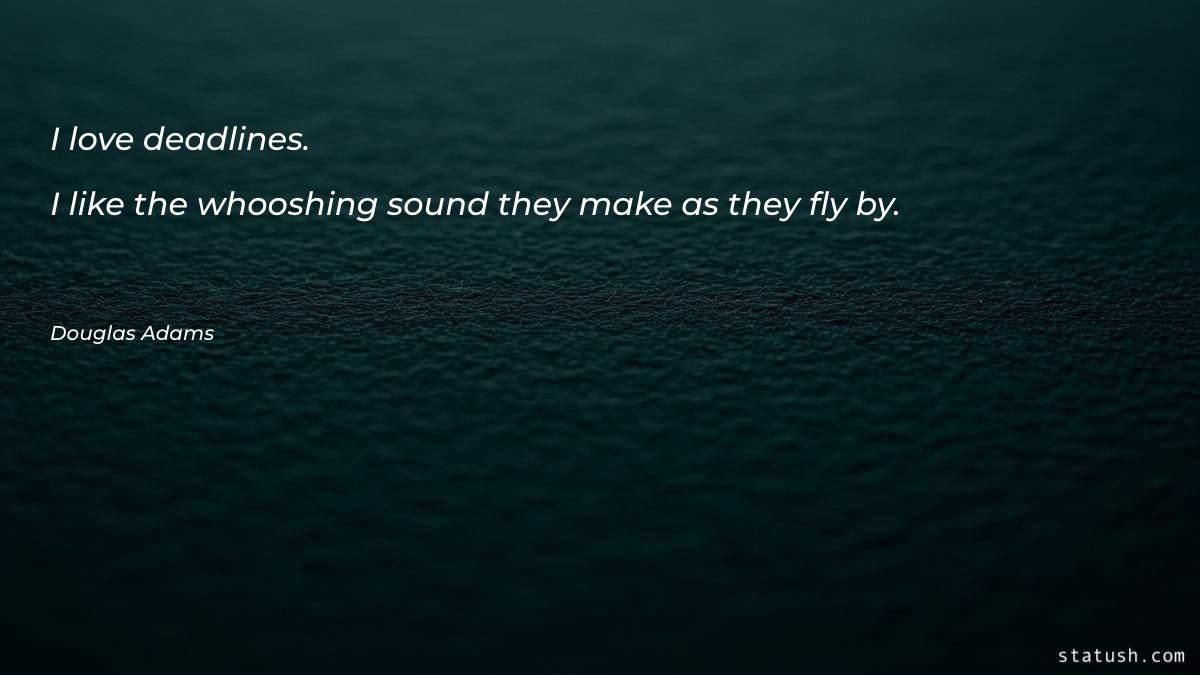
Here are 10 of the most insightful quotes attributed to Douglas Adams, and the logic behind them.
1. On Thought and Judgment
I think a nerd is a person who uses the telephone to talk to other people about telephones. And a computer nerd therefore is somebody who uses a computer in order to use a computer.
The Meaning: This line from Douglas Adams compresses a lived tension into a single readable moment. Read it slowly: it is not asking you to agree, but to notice where the same pattern shows up in your own life. If you take it seriously, it becomes a test—what would you change if this were reliably true for you?
2. On Clarity
Dennis Hutch had stepped up into the top seat when its founder had died of a lethal overdose of brick wall, taken while under the influence of a Ferrari and a bottle of tequila.
The Meaning: This line from Douglas Adams compresses a lived tension into a single readable moment. Read it slowly: it is not asking you to agree, but to notice where the same pattern shows up in your own life. If you take it seriously, it becomes a test—what would you change if this were reliably true for you?
3. On Thought and Judgment
She was particularly fond of the alleged car for many reasons. If one of its doors, for instance, fell off she could put it back on herself, which is more than you could say for a BMW.
The Meaning: This line from Douglas Adams compresses a lived tension into a single readable moment. Read it slowly: it is not asking you to agree, but to notice where the same pattern shows up in your own life. If you take it seriously, it becomes a test—what would you change if this were reliably true for you?
4. On Perspective
We don't have to save the world. The world is big enough to look after itself. What we have to be concerned about is whether or not the world we live in will be capable of sustaining us in it.
The Meaning: This line from Douglas Adams compresses a lived tension into a single readable moment. Read it slowly: it is not asking you to agree, but to notice where the same pattern shows up in your own life. If you take it seriously, it becomes a test—what would you change if this were reliably true for you?
5. On Discipline
If it looks like a duck, and quacks like a duck, we have at least to consider the possibility that we have a small aquatic bird of the family Anatidae on our hands.
The Meaning: This line from Douglas Adams compresses a lived tension into a single readable moment. Read it slowly: it is not asking you to agree, but to notice where the same pattern shows up in your own life. If you take it seriously, it becomes a test—what would you change if this were reliably true for you?
6. On People and Relationships
Human beings, who are almost unique in having the ability to learn from the experience of others, are also remarkable for their apparent disinclination to do so.
The Meaning: Knowledge is framed as something that changes behavior, not something you collect like trophies. If a sentence is true but does not shift what you notice or do, it has not finished its work.
7. On Time
The door was the way to... to... The Door was The Way. Good. Capital letters were always the best way of dealing with things you didn't have a good answer to.
The Meaning: This line from Douglas Adams compresses a lived tension into a single readable moment. Read it slowly: it is not asking you to agree, but to notice where the same pattern shows up in your own life. If you take it seriously, it becomes a test—what would you change if this were reliably true for you?
8. On Success and Effort
The explosion was now officially designated an Act of God. But, thought Dirk, what god? And why? What god would be hanging around Terminal Two of Heathrow Airport trying to catch the 15:37 flight to Oslo?
The Meaning: This reframes outcomes as feedback rather than verdicts. Success can hide weak processes; failure can reveal strong ones—if you study it. The meaning is to keep your identity separate from any single result.
9. On Truth
Radio did not kill books and television did not kill radio or movies — what television did kill was cinema newsreel. TV does it much better because it can deliver it instantly. Who wants last week's news?
The Meaning: This line from Douglas Adams compresses a lived tension into a single readable moment. Read it slowly: it is not asking you to agree, but to notice where the same pattern shows up in your own life. If you take it seriously, it becomes a test—what would you change if this were reliably true for you?
10. On Learning
The teacher usually learns more than the pupils. Isn't that true? It would be hard to learn much less than my pupils, came a low growl from somewhere on the table, without undergoing a pre-frontal lobotomy.
The Meaning: Knowledge is framed as something that changes behavior, not something you collect like trophies. If a sentence is true but does not shift what you notice or do, it has not finished its work.