The Master of the Craft: Sir Anthony Hopkins Quotes and Their Meaning
Sir Anthony Hopkins is more than an Oscar-winning actor; he is a survivor and a stoic philosopher of the modern age. Known for his legendary portrayal of Hannibal Lecter, his off-screen wisdom is equally piercing. Hopkins often speaks about the liberation that comes with aging, the necessity of self-reliance, and the beauty of a life lived without the burden of others' expectations.
Here are 10 of his most powerful quotes and the deep truths they hold.
1. On Letting Go of the Unwilling
"Let go of the people who aren't ready to love you. This is the hardest thing you’ll ever have to do, and it will also be the most important thing."
The Meaning: Hopkins advocates for emotional self-preservation. We often waste years trying to "earn" the affection of people who aren't capable of giving it. He suggests that your time is too valuable to spend it begging for a seat at someone else's table.
2. On the Freedom of Age
"My life is none of my business."
The Meaning: This is Hopkins' ultimate mantra for peace. It means detaching from the "story" of your life—the worries, the reputation, and the constant analysis. By deciding that your life isn't something you need to constantly manage or "figure out," you find the freedom to simply exist.
3. On Public Opinion
"What people say about me, what they think of me, is none of my business. I am who I am and I do what I do. I expect nothing and accept everything."
The Meaning: This is pure stoicism. Hopkins suggests that you cannot control the minds of others, so worrying about their judgment is a mathematical waste of energy. When you "expect nothing," you can never be disappointed; when you "accept everything," you become unshakeable.
4. On the Illusion of Success
"We are all dying. That's the first thing you should learn. So there's nothing to lose. You're already naked."
The Meaning: Borrowing a bit of the same energy as Steve Jobs, Hopkins uses mortality as a tool for boldness. If the end result for everyone is the same, there is no reason to play it safe or be afraid of embarrassment. Mortality is the ultimate permission slip to take risks.
5. On Staying Active
"I'm a bit of a loner. I don't have many friends, but I like people. I like to watch them."
The Meaning: This highlights his observant nature as an actor. He values solitude over social noise. He teaches that you don't need a massive social circle to be "connected" to humanity; sometimes, being a quiet observer of life is more fulfilling than being the center of the party.
6. On Personal Responsibility
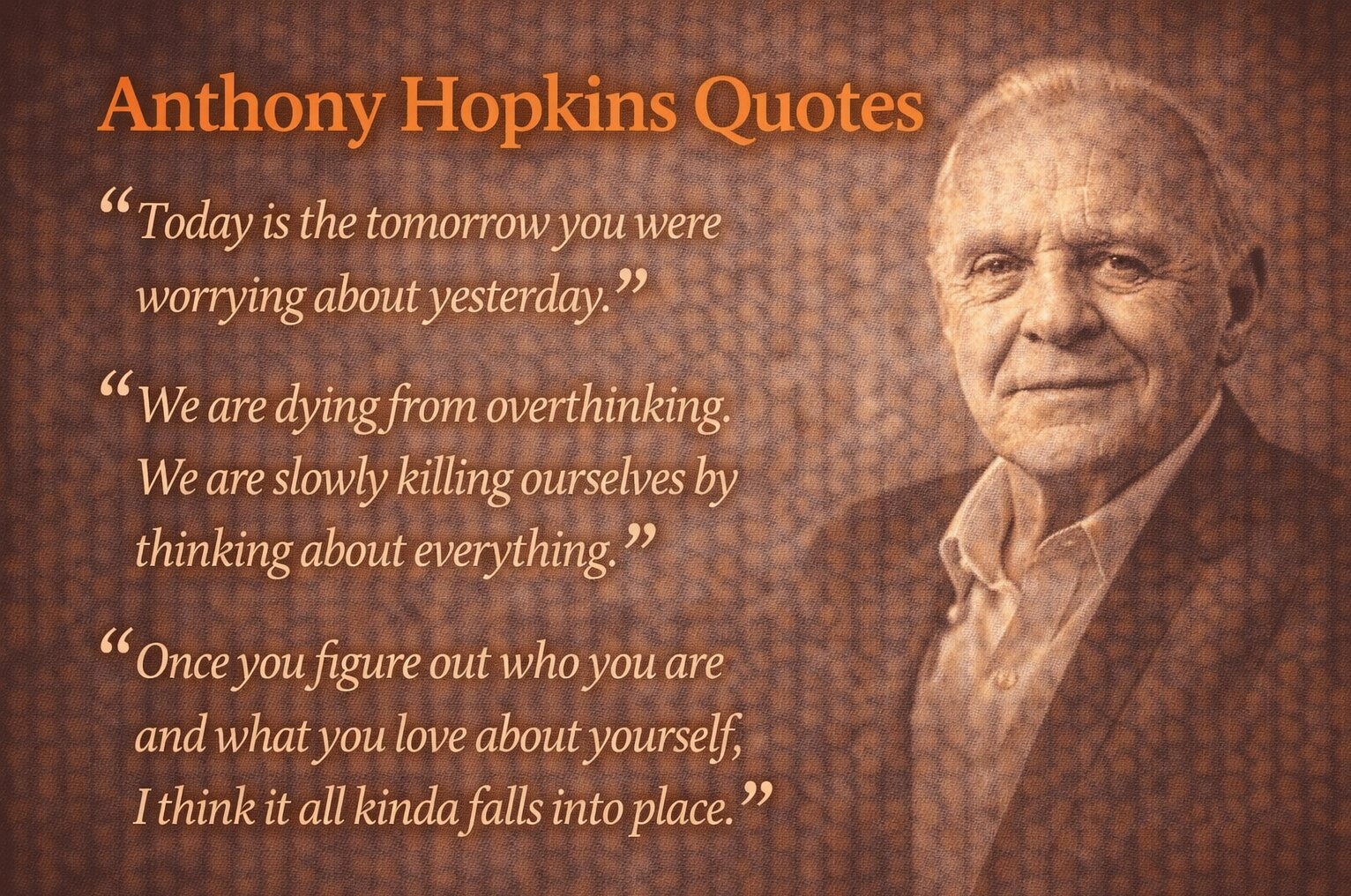
"Today is the tomorrow you worried about yesterday."
The Meaning: A classic reminder to stay in the present. We spend our lives dreading future scenarios that rarely happen. Hopkins encourages us to realize that we are currently living in the "future" we once feared, and we are handling it just fine.
7. On the Magic of "Doing"
"I have no expectations. I just do. I'm a worker."
The Meaning: Despite his fame, Hopkins views himself as a craftsman. He doesn't wait for "inspiration" or "the right mood." He believes in the blue-collar ethic of showing up and doing the work. Results come from the act of doing, not the act of dreaming.
8. On Forgiving Yourself
"We are all flawed. Every one of us. We are all 'damaged goods' in a way."
The Meaning: This is a call for radical self-compassion. By accepting that everyone is struggling with their own internal shadows, we can stop judging ourselves and others so harshly. Perfection is a lie; "damaged goods" is just another way of saying "human."
9. On Loneliness vs. Solitude
"I've always been a bit of a recluse. I've always felt like an outsider."
The Meaning: Hopkins embraces his "outsider" status. Instead of trying to fit in, he used that feeling of detachment to fuel his art. He teaches that being different isn't a social failure; it’s a creative superpower.
10. On the Simplicity of Happiness
"I've got a great life. I'm lucky. I've got no complaints."
The Meaning: After decades of struggle, including a battle with alcoholism in his younger years, Hopkins has landed on a foundation of gratitude. He proves that the ultimate goal of a long life is to reach a point where "no complaints" is your natural state of being.
The Hopkins Philosophy At-A-Glance
| Core Theme | The Takeaway |
|---|---|
| Detachment | Stop caring what others think; it’s a trap. |
| Stoicism | Accept reality as it is, not as you want it to be. |
| Humility | View yourself as a worker, not a "star." |
| Presence | The only time that matters is right now. |
Anthony Hopkins’ life and words remind us that the most powerful thing you can be is yourself—unapologetically, quietly, and completely.