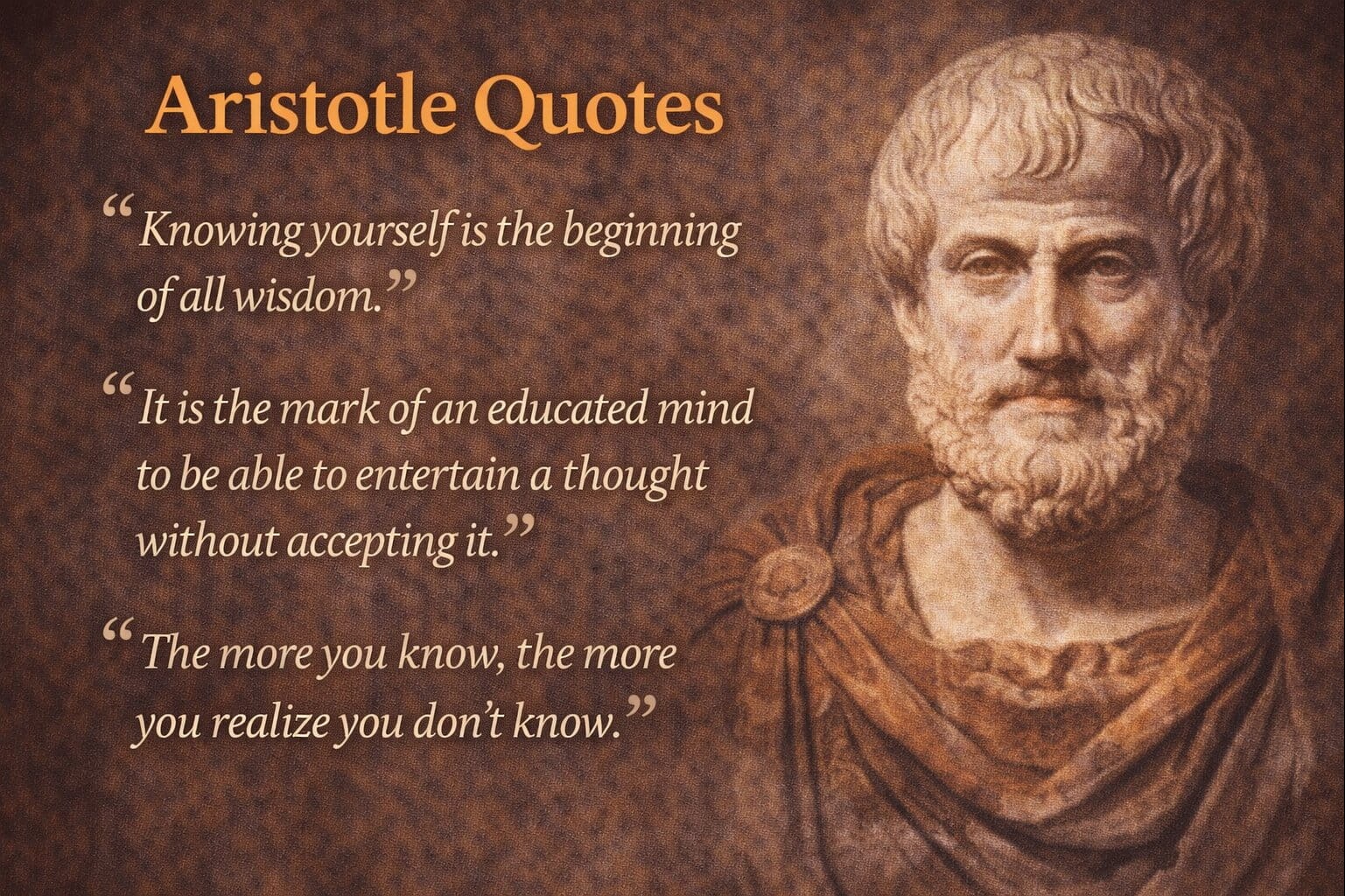
The Architect of Reason: Aristotle Quotes and Their Meaning
Aristotle was the ultimate polymath of ancient Greece. A student of Plato and the tutor to Alexander the Great, he shifted philosophy from the "world of ideas" down to the earth of logic, science, and ethics. He believed that excellence wasn't a gift from the gods, but a muscle we build through daily practice.
Here are 10 of his most foundational quotes and the timeless logic they offer for a modern life.
1. On the Power of Habit
"We are what we repeatedly do. Excellence, then, is not an act, but a habit."
The Meaning:
Success isn't about one "big break" or a single heroic moment. Aristotle argued that your character is simply the sum of your daily routines. If you want to be a writer, you write every day; if you want to be virtuous, you practice small acts of honesty every day. You don't "become" excellent; you practice excellence until it becomes automatic.
2. On Intellectual Maturity
"It is the mark of an educated mind to be able to entertain a thought without accepting it."
The Meaning:
True intelligence isn't about how much you know; it’s about how you handle information you disagree with. Aristotle suggests that you should be able to explore an idea, look at its logic, and understand its perspective without immediately "subscribing" to it. It is the antidote to modern echo chambers and polarized thinking.
3. On the Goal of Life
"Happiness is the meaning and the purpose of life, the whole aim and end of human existence."
The Meaning:
Aristotle used the word Eudaimonia, which is deeper than "feeling good." To him, happiness meant "human flourishing"—living up to your full potential and exercising your unique talents. It’s not a fleeting emotion; it is the result of a life lived with purpose and virtue.
4. On Knowing Yourself
"Knowing yourself is the beginning of all wisdom."
The Meaning:
You cannot navigate the world effectively if you don't understand the "equipment" you are using. Aristotle believed that before you try to master politics, science, or art, you must master your own biases, strengths, and weaknesses. Self-awareness is the foundation upon which all other knowledge is built.
5. On the "Golden Mean"
"He who has overcome his fears will truly be free."
The Meaning:
Aristotle was the father of the "Golden Mean"—the idea that virtue lies in the middle of two extremes. For example, courage is the mean between cowardice (too much fear) and recklessness (too little fear). To be "free" is to have your emotions under the control of your reason, rather than being a slave to your impulses.
6. On Friendship
"What is a friend? A single soul dwelling in two bodies."
The Meaning:
Aristotle categorized friendships into three types: utility (using each other), pleasure (having fun together), and virtue (admiring each other’s character). The highest form of friendship is the "virtuous" one, where two people are so aligned in their values and goals that they become extensions of one another.
7. On the Nature of Work
"Pleasure in the job puts perfection in the work."
The Meaning:
When you find work that aligns with your natural talents and interests, "effort" ceases to feel like a burden. Aristotle observed that the highest quality results don't come from grit alone, but from the enthusiasm and "flow" that happen when a person actually enjoys the process of creation.
8. On Logic and Emotion
"Educating the mind without educating the heart is no education at all."
The Meaning:
A brilliant person without empathy or ethics is dangerous. Aristotle believed that a true education must include "character building." Learning how to think is useless if you don't also learn how to feel for others and how to act with integrity.
9. On Overcoming Criticism
"There is only one way to avoid criticism: do nothing, say nothing, and be nothing."
The Meaning:
If you are doing anything of substance, you will be criticized. Aristotle presents this as a mathematical certainty. Therefore, if you find yourself being judged, it’s actually a sign that you are active, vocal, and significant. The only way to stay "safe" is to be invisible—and that is no way to live.
10. On the Roots of Success
"The roots of education are bitter, but the fruit is sweet."
The Meaning:
Learning is often frustrating, boring, and difficult. Aristotle acknowledges the "bitterness" of the discipline required to master a skill or a subject. However, he promises that the payoff—the "fruit"—is the most rewarding thing a human can experience: the freedom and power that come with mastery.
The Aristotelian Framework
| Concept | The Logic |
|---|---|
| The Mean | Find the balance between extremes. |
| Habit | You are what you do every single day. |
| Logic | Use your mind to govern your emotions. |
| Purpose | Your "Why" determines the quality of your "How." |
Aristotle didn't just want us to think better; he wanted us to live better. He reminds us that while the world is complex, the path to a good life is built on the simple foundations of habit, balance, and self-knowledge.
