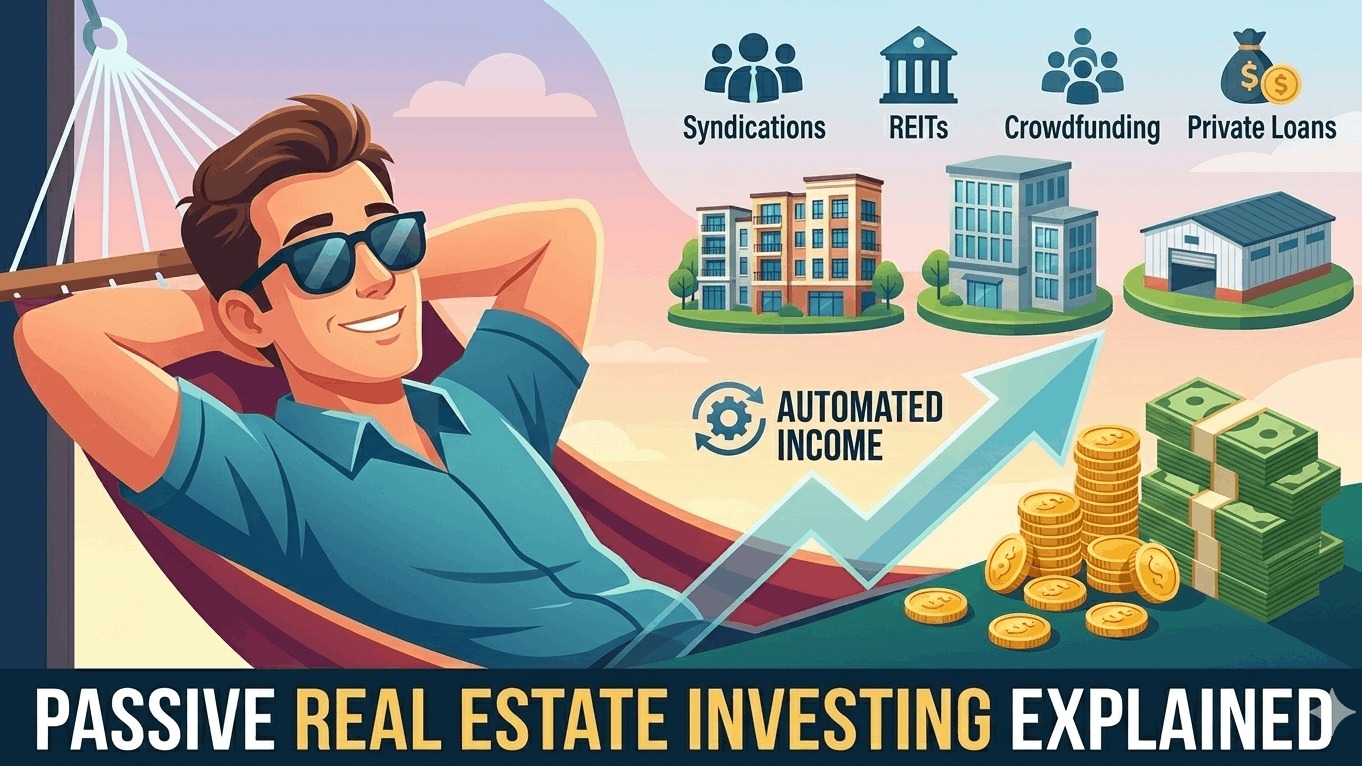
For many in 2026, the dream of real estate wealth doesn't involve "Toilets, Tenants, and Trash." As the U.S. economy shifts toward more specialized investment vehicles, Passive Real Estate Investing has become the preferred path for high-earning professionals and retirees who want the tax benefits and returns of property without the operational headaches.
Passive investing allows you to act as the "bank" or the "silent partner," putting your capital to work while experts handle the daily management.
1. What Is Passive Real Estate Investing?
Passive investing is the process of committing capital to real estate assets where you have no day-to-day management responsibilities. You provide the funds; a professional sponsor or a corporate entity provides the expertise, time, and labor.
In 2026, this is primarily achieved through three main "hands-off" buckets:
- Publicly Traded Securities: Buying shares in real estate companies.
- Private Syndications: Pooling money with others to buy large assets (like 200-unit apartments).
- Debt Investing: Lending money to other real estate pros.
2. Top Passive Strategies for 2026
A. Real Estate Investment Trusts (REITs)
REITs are the easiest entry point. They are companies that own and operate income-producing real estate.
- How it works: You buy shares on the stock market (like $O or $AMT).
- The 2026 Draw: Highly liquid. You can sell your "property" in seconds if you need cash.
B. Real Estate Syndications
A syndication is a partnership between General Partners (GPs) who manage the deal and Limited Partners (LPs) who provide the cash.
- How it works: You invest a lump sum (often $25,000 - $50,000) into a specific project, such as a self-storage facility or an apartment complex.
- The 2026 Draw: You get a share of the monthly cash flow AND a "kicker" profit when the building is sold in 3–7 years.
C. Real Estate Crowdfunding
Online platforms (like Fundrise or RealtyMojo) allow you to spread small amounts of money across dozens of different projects.
- How it works: You browse a digital marketplace and pick the "eREITs" or individual projects that fit your risk profile.
- The 2026 Draw: Low barrier to entry; some platforms allow you to start with as little as $100.
D. Private Money Lending
You become the bank for a local "fix-and-flip" investor.
- How it works: You lend $200,000 for a renovation project, secured by a deed of trust on the house.
- The 2026 Draw: High fixed interest rates (often 8–12% in today's market) with a clear exit date.
3. Active vs. Passive: The Trade-off
| Feature | Active (Landlord) | Passive (Investor) |
|---|---|---|
| Control | Total Control | Little to No Control |
| Time Commitment | High (24/7 Responsibility) | Zero (Reviewing reports only) |
| Potential Returns | Highest (You keep 100% of profit) | Moderate (You share profit with a manager) |
| Liability | Personal Liability | Limited to the amount invested |
| Tax Benefits | Direct Depreciation | Pass-through Depreciation (K-1s) |
4. The 2026 "Passive" Checklist
Before putting your money into a passive deal this year, you must vet the Three S's:
- Sponsor: What is their track record? Have they ever lost investor money during a downturn?
- Strategy: Does the asset class make sense for 2026? (e.g., Industrial and Data Centers are "Hot"; older Office buildings are "Not").
- Structure: How are the profits split? Look for a "Preferred Return" where you get paid your first 6–8% before the manager takes a dime.