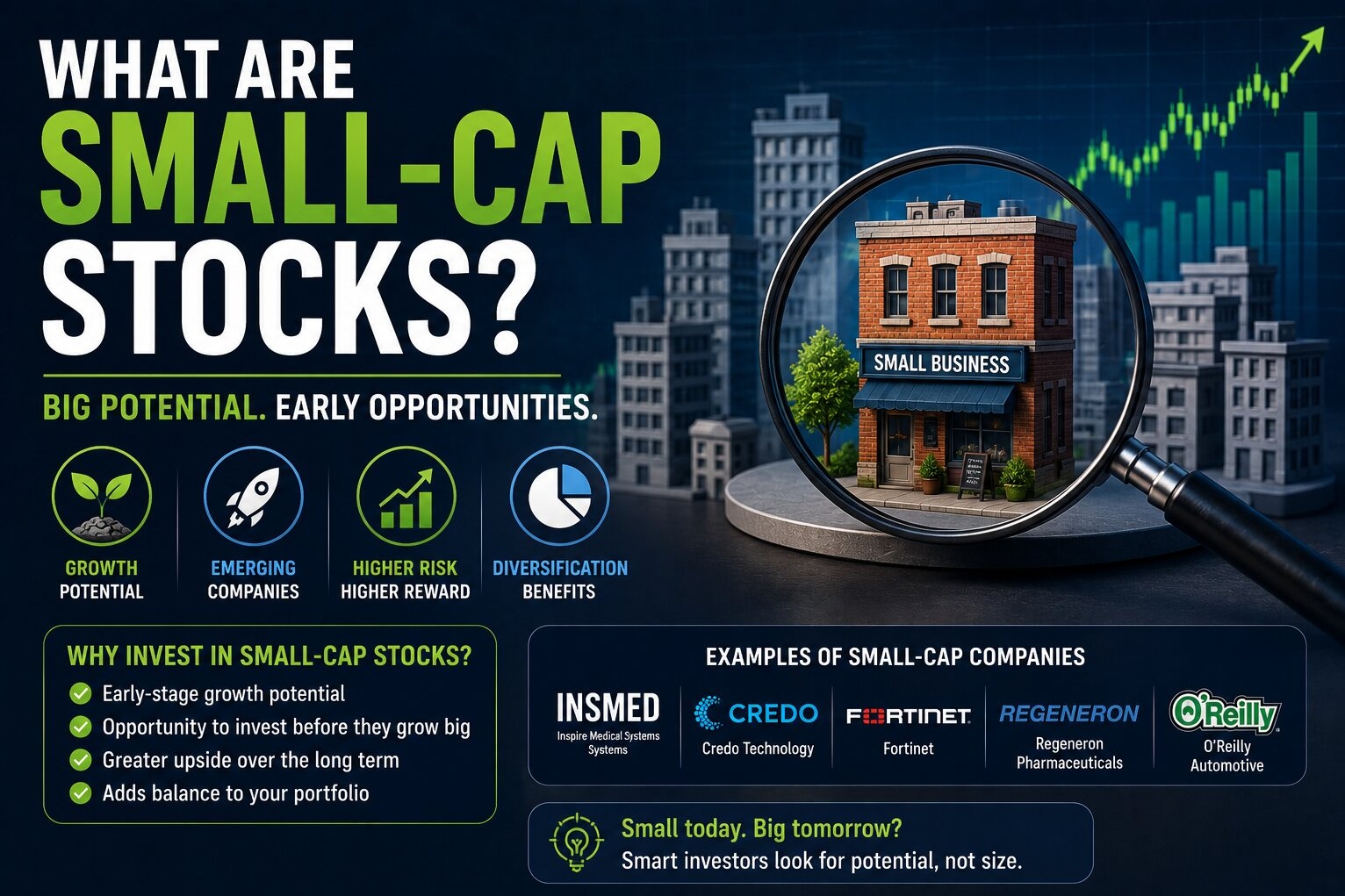
When most beginners start investing, they usually hear about giant companies like Apple, Microsoft, or Amazon. These massive businesses dominate headlines and stock market indexes, so naturally, they receive most of the attention.
But the stock market also contains thousands of smaller companies that many investors overlook.
These are often called small-cap stocks.
Small-cap investing can be exciting because smaller businesses sometimes grow much faster than large established companies. At the same time, small-cap stocks also tend to carry higher risk and volatility.
Understanding how small-cap stocks work can help investors decide whether they belong in a diversified long-term portfolio.
What Does “Small-Cap” Mean?
“Cap” refers to market capitalization, which measures the total value of a company’s outstanding shares.
The formula looks like this:
\text{Market Capitalization} = \text{Share Price} \times \text{Outstanding Shares}
Example
| Share Price | Shares Outstanding | Market Cap |
|---|---|---|
| $50 | 20 Million | $1 Billion |
A small-cap stock is generally a company with a relatively smaller market capitalization compared to large corporations.
While definitions vary slightly, small-cap companies are often valued between:
- Roughly $300 million
- Up to around $2 billion
You may also want to read What Is Market Capitalization? for a deeper explanation of company size categories.
Characteristics of Small-Cap Stocks
Small-cap companies often share several common traits.
| Characteristic | Description |
|---|---|
| Smaller business size | Limited market presence |
| Higher growth potential | Expansion opportunities |
| Higher volatility | Prices can move sharply |
| Lower analyst coverage | Less Wall Street attention |
| Greater business risk | Less financial stability |
Many small-cap businesses are still in expansion stages rather than fully mature companies.
Why Investors Like Small-Cap Stocks
There are several reasons investors include small-cap stocks in their portfolios.
Higher Growth Potential
This is probably the biggest attraction.
Small companies generally have more room to grow compared to giant corporations.
For example:
- A $500 million company growing into a $5 billion company
- Expansion into new markets
- Rapid product adoption
Large corporations often grow more slowly because they are already massive businesses.
Some of the world’s largest companies today were once small-cap stocks years ago.
Market Inefficiencies
Small-cap stocks often receive less attention from analysts and institutional investors.
This creates opportunities where:
- Undervalued companies may exist
- Strong businesses remain overlooked
- Investors may discover growth opportunities earlier
Some investors enjoy researching smaller companies before they become widely recognized.
Economic Expansion Benefits
Small-cap companies sometimes perform especially well during:
- Strong economic growth
- Bull markets
- Lower interest rate environments
This is partly because smaller businesses may expand more aggressively when economic conditions improve.
Risks of Small-Cap Stocks
Higher potential returns usually come with higher risk.
Small-cap investing is no exception.
Higher Volatility
Small-cap stocks often experience larger price swings than large-cap companies.
For example:
- Sharp rallies during optimism
- Steep declines during market fear
This volatility can become emotionally difficult for beginners.
Financial Risk
Smaller companies may have:
- Limited cash reserves
- Higher debt burdens
- Less diversified revenue streams
Economic downturns can impact smaller businesses more severely.
You can learn more about managing investment risk in How to Reduce Investment Risk.
Lower Liquidity
Some small-cap stocks trade with lower daily volume.
This can create:
- Wider bid-ask spreads
- More price fluctuations
- Difficulty entering or exiting positions quickly
Liquidity risk becomes especially important during market stress.
Less Predictable Earnings
Small businesses often face:
- Rapid operational changes
- Competitive pressures
- Scaling challenges
This can make future earnings harder to predict compared to mature blue-chip companies.
Small-Cap vs Large-Cap Stocks
Understanding the difference between small-cap and large-cap stocks is important for portfolio building.
| Feature | Small-Cap Stocks | Large-Cap Stocks |
|---|---|---|
| Company Size | Smaller | Larger |
| Growth Potential | Higher | Moderate |
| Volatility | Higher | Lower |
| Financial Stability | Lower | Higher |
| Dividend Payments | Less common | More common |
| Risk Level | Higher | Lower |
Small-cap stocks may produce stronger returns during certain market cycles, while large-cap companies often provide greater stability.
You may also enjoy reading How to Invest in Blue-Chip Stocks.
Small-Cap Growth vs Small-Cap Value
Small-cap investing itself has multiple categories.
Small-Cap Growth Stocks
These companies focus heavily on expansion and future growth potential.
Characteristics include:
- Rapid revenue growth
- Higher valuations
- More aggressive expansion
Small-Cap Value Stocks
These are smaller companies trading at relatively lower valuations.
Investors may believe the market is undervaluing them.
Characteristics include:
- Lower price-to-earnings ratios
- Potential recovery opportunities
- More conservative valuations
You can learn more in Growth Stocks vs Value Stocks.
Small-Cap ETFs and Index Funds
Many beginners prefer small-cap ETFs or index funds rather than picking individual small companies.
This approach provides:
- Diversification
- Reduced company-specific risk
- Easier portfolio management
Small-cap funds may track:
- Broad small-cap indexes
- Small-cap growth indexes
- Small-cap value indexes
For beginners, diversified small-cap funds are often safer than concentrated individual stock investing.
You may also want to read Index Fund vs ETF: Key Differences Explained.
How to Analyze Small-Cap Stocks
Research becomes especially important with small-cap investing.
Important factors include:
- Revenue growth
- Profitability
- Debt levels
- Competitive advantages
- Management quality
- Industry trends
Smaller companies often carry more uncertainty, so strong analysis matters greatly.
You can improve your research skills in Fundamental Analysis for Beginner Investors.
Diversification Matters Even More
Because small-cap stocks are riskier, diversification becomes extremely important.
Some investors make the mistake of putting too much money into a few speculative small companies.
That can become dangerous.
A diversified portfolio may combine:
- Small-cap stocks
- Large-cap stocks
- Dividend stocks
- International investments
- Bonds
Balanced portfolios often reduce emotional stress during volatile markets.
You can read more in Portfolio Diversification Strategies.
Long-Term Investing and Small Caps
Small-cap investing usually works best with long-term thinking.
Why?
Because smaller companies often experience:
- Temporary setbacks
- Volatile earnings
- Market overreactions
Short-term price swings can become dramatic.
Long-term investors who stay patient may benefit more from:
- Business growth
- Revenue expansion
- Market recognition over time
Trying to trade small-cap stocks emotionally often creates unnecessary risk.
You may also enjoy reading How to Build a Long-Term Investment Strategy.
Common Beginner Mistakes
Chasing Hype Stocks
Many speculative small-cap stocks gain attention through social media excitement.
Some beginners invest without researching fundamentals properly.
Ignoring Financial Health
Smaller companies with weak balance sheets can struggle badly during downturns.
Overconcentration
Putting too much money into one small-cap company increases risk significantly.
Expecting Quick Riches
Some investors expect every small-cap stock to become the next giant technology company.
In reality, many smaller businesses fail or stagnate.
Final Thoughts
Small-cap stocks offer investors exposure to smaller businesses with potentially higher long-term growth opportunities.
They can provide:
- Strong expansion potential
- Greater upside opportunities
- Diversification benefits
- Exposure to emerging businesses
However, they also carry:
- Higher volatility
- Greater business risk
- Less predictable performance
For many investors, small-cap exposure works best as part of a diversified long-term portfolio rather than a concentrated speculative strategy.
In many ways, successful small-cap investing requires patience, research, diversification, and emotional discipline far more than excitement or hype-driven decision-making.