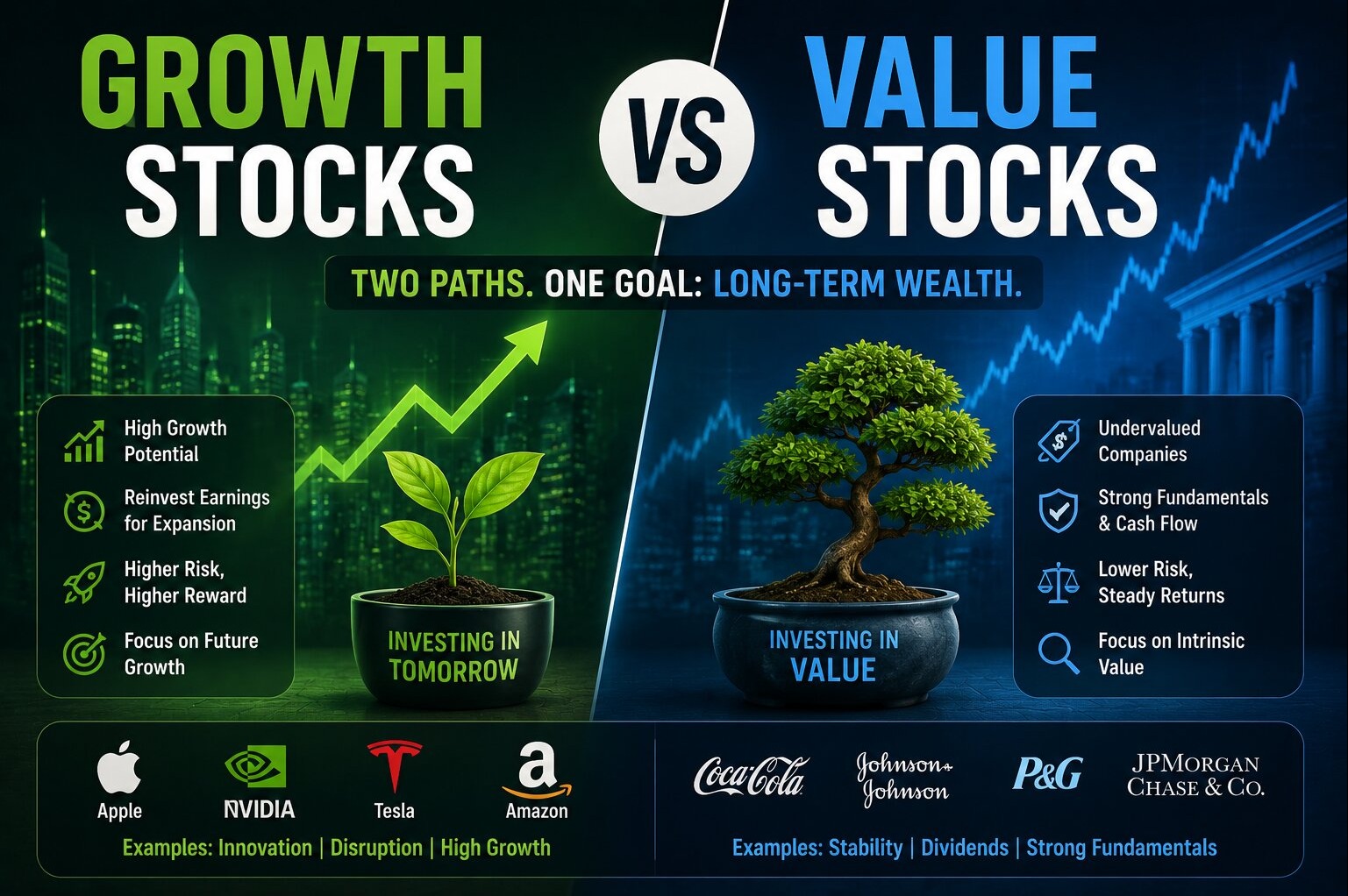
One of the most common debates in investing is whether growth stocks or value stocks are the better investment. You will hear investors strongly defend both sides, and honestly, both strategies have produced successful long-term results in different market conditions.
Some investors prefer fast-growing companies with massive future potential. Others prefer stable businesses trading at lower valuations with more predictable performance.
The important thing for beginners is understanding that growth and value investing are not just labels. They represent two very different approaches to building wealth in the stock market.
Learning how these strategies work can help you build a portfolio that matches your financial goals, risk tolerance, and investing style.
What Are Growth Stocks?
Growth stocks are companies expected to grow revenue, earnings, or market share faster than the broader market.
These companies often:
- Reinvest profits back into expansion
- Focus heavily on innovation
- Operate in rapidly growing industries
- Prioritize future growth over current income
Examples often come from sectors like:
- Technology
- Artificial intelligence
- E-commerce
- Cloud computing
- Biotechnology
Growth companies usually aim to expand aggressively rather than pay large dividends.
Characteristics of Growth Stocks
Growth stocks often share several common traits.
| Characteristic | Description |
|---|---|
| High revenue growth | Sales increase rapidly |
| Higher valuations | Investors pay premium prices |
| Lower dividends | Profits often reinvested |
| Strong future expectations | Investors expect long-term expansion |
| Higher volatility | Prices can move sharply |
Many growth investors focus more on future potential than current profitability.
If you are still learning stock analysis basics, you may also want to read How to Analyze Stocks Before Investing.
Advantages of Growth Stocks
Higher Potential Returns
One major attraction is long-term upside potential.
Some growth companies eventually become massive global businesses.
For example:
- Early technology companies
- Fast-growing software firms
- Innovative consumer brands
Investors who identify successful growth companies early can sometimes generate enormous long-term returns.
Innovation and Industry Leadership
Growth companies often lead innovation in emerging industries.
These businesses may benefit from:
- Expanding markets
- Technological disruption
- Changing consumer behavior
This creates excitement around future earnings potential.
Strong Revenue Expansion
Growth companies frequently report rapid sales increases.
Example Revenue Growth
| Year | Revenue |
|---|---|
| 2022 | $2 Billion |
| 2023 | $3.5 Billion |
| 2024 | $5 Billion |
Rapid expansion can attract investors willing to pay premium valuations.
Risks of Growth Stocks
Growth investing also carries significant risks.
Higher Valuations
Growth stocks often trade at expensive price levels relative to earnings.
This means expectations become extremely important.
If growth slows:
- Stock prices can decline sharply
- Investors may panic quickly
You can learn more in Price-to-Earnings Ratio Explained.
Higher Volatility
Growth stocks tend to experience larger price swings.
For example:
- Rapid rallies during optimistic markets
- Sharp declines during uncertainty
This volatility can become emotionally difficult for some investors.
Interest Rate Sensitivity
Growth companies are often more sensitive to rising interest rates because investors value them heavily based on future earnings expectations.
When rates rise:
- Future profits become less attractive
- Growth stock valuations may fall
What Are Value Stocks?
Value stocks are companies trading at relatively lower valuations compared to their fundamentals.
These businesses are often:
- Established companies
- Financially stable
- Temporarily overlooked by the market
- Trading below perceived intrinsic value
Value investors aim to buy stocks they believe are undervalued relative to:
- Earnings
- Assets
- Cash flow
- Business strength
Characteristics of Value Stocks
| Characteristic | Description |
|---|---|
| Lower valuations | Often lower P/E ratios |
| More mature businesses | Stable operations |
| Dividend payments | Common among value stocks |
| Slower growth | Less aggressive expansion |
| Potential undervaluation | Market may underestimate company |
Value stocks often appear less exciting than growth stocks, but many investors appreciate their stability.
Advantages of Value Stocks
Lower Valuation Risk
Because value stocks often trade at cheaper prices relative to earnings, some investors believe downside risk may be lower.
This does not eliminate risk entirely, but lower expectations sometimes create more stability.
Dividend Income
Many value companies pay dividends.
This can provide:
- Passive income
- Portfolio stability
- Reinvestment opportunities
You may also enjoy reading How to Start Dividend Investing.
Stronger Defensive Characteristics
Value stocks often perform better during:
- Economic slowdowns
- Rising interest rate environments
- Market uncertainty
This is partly because mature companies tend to have:
- Stable cash flow
- Established customer bases
- Strong balance sheets
Risks of Value Stocks
Slower Growth
Value companies may grow much more slowly than aggressive growth businesses.
This can limit long-term upside potential.
Value Traps
Some stocks appear “cheap” for legitimate reasons.
For example:
- Declining industries
- Weak management
- Poor future outlook
A low valuation alone does not automatically make a stock a good investment.
This is why proper research matters.
Read more in Fundamental Analysis for Beginner Investors.
Market Can Ignore Value for Long Periods
Undervalued stocks may remain undervalued for years before markets recognize their potential.
Patience becomes very important for value investors.
Growth vs Value: Side-by-Side Comparison
| Feature | Growth Stocks | Value Stocks |
|---|---|---|
| Main Focus | Future expansion | Undervalued opportunities |
| Revenue Growth | Higher | Moderate |
| Valuation | Often expensive | Often cheaper |
| Dividend Yield | Usually low | Often higher |
| Volatility | Higher | Lower |
| Best Market Environment | Bull markets | Defensive periods |
| Investor Style | Aggressive growth | Conservative/value-oriented |
Which Strategy Performs Better?
There is no permanent winner.
Different market environments favor different styles.
Growth Stocks Often Perform Better During:
- Strong economic growth
- Low interest rates
- Bull markets
- Technology expansion
Value Stocks Often Perform Better During:
- Economic uncertainty
- Rising interest rates
- Inflationary environments
- Defensive market periods
This cycle changes over time.
That is why many diversified investors include both styles in their portfolios.
Can Investors Combine Both?
Absolutely.
Many investors combine:
- Growth stocks for long-term upside
- Value stocks for stability and income
This balanced approach can help reduce portfolio concentration risk.
For example:
- Growth companies drive future expansion
- Value companies provide steadier performance
Diversification often creates smoother long-term investing experiences.
You can read more here:
Portfolio Diversification Strategies
ETFs for Growth and Value Investing
Many investors use ETFs to gain exposure to growth or value stocks.
Growth ETFs may focus on:
- Technology companies
- Innovation-driven businesses
- High earnings growth
Value ETFs may focus on:
- Lower valuation companies
- Dividend-paying stocks
- Stable mature businesses
ETFs simplify diversification and reduce company-specific risk.
You may also enjoy reading Index Fund vs ETF: Key Differences Explained.
Emotional Investing Challenges
Growth investing and value investing both create emotional challenges.
Growth Investors May:
- Chase hype stocks
- Overpay during market excitement
- Panic during sharp declines
Value Investors May:
- Hold weak companies too long
- Become impatient waiting for recovery
- Buy “cheap” businesses with poor fundamentals
This is why emotional discipline matters regardless of strategy.
You may also want to read How to Build a Long-Term Investment Strategy.
Final Thoughts
Growth stocks and value stocks are both important investing styles with different strengths and risks.
Growth investing focuses on future expansion and long-term upside potential. Value investing focuses more on buying financially solid companies at reasonable prices.
The right approach depends largely on:
- Risk tolerance
- Investment timeline
- Financial goals
- Emotional comfort with volatility
Many successful investors combine both strategies to create balance within their portfolios.
At the end of the day, successful investing is usually less about choosing one “perfect” strategy and more about staying disciplined, diversified, and patient through changing market conditions.