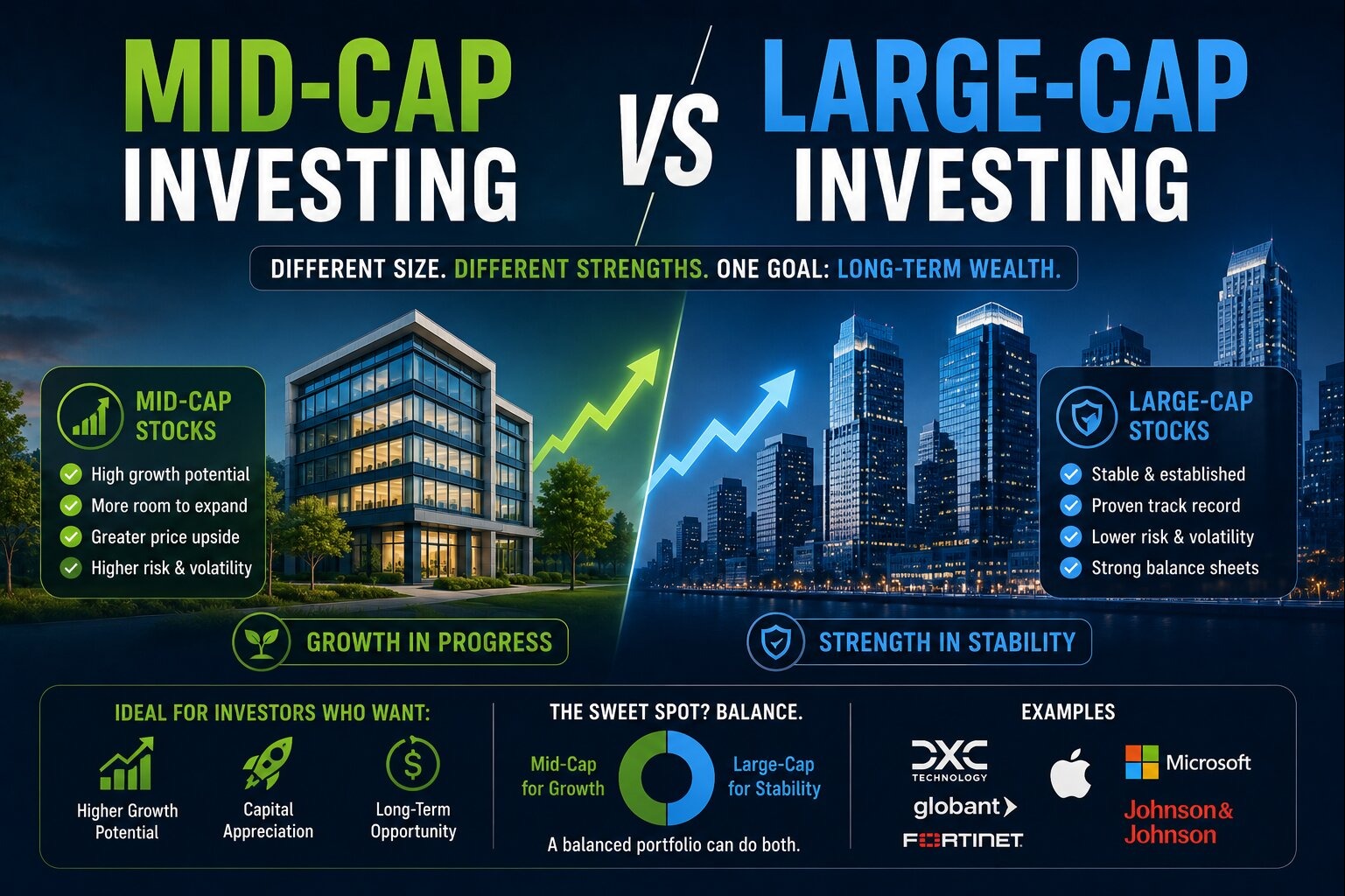
When investors talk about stocks, company size matters more than many beginners realize. A company’s size can influence:
- Growth potential
- Risk levels
- Stability
- Dividend opportunities
- Market behavior during economic cycles
Two important categories investors often compare are mid-cap stocks and large-cap stocks.
Some investors prefer the stability of large, established companies. Others like the growth potential that mid-sized businesses can offer. Both approaches have strengths and weaknesses, and understanding the differences can help investors build more balanced portfolios.
The important thing to understand is that neither category is automatically “better.” They simply serve different purposes within an investment strategy.
What Does “Cap” Mean in Investing?
“Cap” stands for market capitalization, which measures the total market value of a company’s outstanding shares.
The formula looks like this:
Market Capitalization = Share Price * Outstanding Shares
Example
| Share Price | Shares Outstanding | Market Capitalization |
|---|---|---|
| $80 | 50 Million | $4 Billion |
Market capitalization helps investors classify companies by size.
What Are Mid-Cap Stocks?
Mid-cap stocks are companies that fall between small-cap and large-cap businesses in size.
While exact ranges vary slightly, mid-cap companies are often valued between:
- Around $2 billion
- Up to roughly $10 billion
Mid-cap companies are usually more established than small-cap businesses but still have meaningful growth potential ahead.
Many mid-cap companies are in transition stages:
- Expanding market share
- Scaling operations
- Entering new markets
- Growing profitability
Characteristics of Mid-Cap Stocks
| Characteristic | Description |
|---|---|
| Moderate business size | Larger than startups but smaller than giants |
| Growth potential | Often stronger than large caps |
| Moderate volatility | Less stable than large caps |
| Expanding operations | Still growing aggressively |
| Higher risk than large caps | But lower risk than small caps |
Mid-cap companies are often viewed as a balance between growth and stability.
What Are Large-Cap Stocks?
Large-cap stocks are major companies with very large market capitalizations.
These businesses are typically valued above:
- Roughly $10 billion
Large-cap companies are often:
- Industry leaders
- Globally recognized brands
- Financially stable businesses
Examples commonly include:
- Technology giants
- Major banks
- Consumer goods leaders
- Healthcare corporations
Many large-cap businesses are also considered blue-chip stocks.
You may also want to read How to Invest in Blue-Chip Stocks.
Characteristics of Large-Cap Stocks
| Characteristic | Description |
|---|---|
| Large global presence | Operate across multiple markets |
| Financial stability | Strong balance sheets |
| Lower volatility | More stable stock performance |
| Dividend payments | Common among mature companies |
| Slower growth rates | Less room for explosive expansion |
Large-cap companies are generally viewed as safer compared to smaller businesses.
Growth Potential: Mid-Cap vs Large-Cap
One major difference between these categories is growth potential.
Mid-Cap Growth Potential
Mid-cap companies often still have room to expand significantly.
For example:
- Expanding internationally
- Launching new products
- Increasing market share
- Scaling operations
This can lead to faster revenue and earnings growth.
Large-Cap Growth Potential
Large-cap companies are already enormous businesses.
That size creates stability, but it can also limit future growth speed.
For example:
- A trillion-dollar company cannot easily double in size quickly
- Mature industries may grow more slowly
This is why some investors use mid-cap stocks to pursue stronger long-term growth.
Risk and Volatility
Growth potential usually comes with higher volatility.
Mid-Cap Risks
Mid-cap companies may face:
- Greater competition
- Expansion challenges
- Economic sensitivity
- Limited financial resources compared to giants
As a result, mid-cap stocks often experience larger price swings.
Large-Cap Risks
Large-cap stocks are usually more stable, but risks still exist:
- Slower growth
- Market saturation
- Regulatory pressure
- Economic slowdowns
Even major companies can decline significantly during bear markets.
You can learn more about risk management in How to Reduce Investment Risk.
Dividend Differences
Large-cap companies are more likely to pay dividends consistently.
Why?
Because mature businesses often generate:
- Stable cash flow
- Predictable earnings
- Strong profitability
Mid-cap companies sometimes prioritize:
- Expansion
- Acquisitions
- Reinvestment into growth
instead of large dividend payments.
Dividend-focused investors often lean more heavily toward large-cap businesses.
You may also enjoy reading How to Start Dividend Investing.
Mid-Cap vs Large-Cap Performance During Market Cycles
Different market conditions often favor different company sizes.
Mid-Caps May Perform Better During:
- Economic expansions
- Bull markets
- Lower interest rate environments
Large-Caps May Perform Better During:
- Economic uncertainty
- Recessions
- Market volatility
- Defensive investing periods
This rotation happens regularly in financial markets.
That is why diversified investors often include both categories.
You may also want to read Market Cycles Explained for Investors.
Mid-Cap vs Large-Cap Comparison
| Feature | Mid-Cap Stocks | Large-Cap Stocks |
|---|---|---|
| Growth Potential | Higher | Moderate |
| Volatility | Moderate to high | Lower |
| Financial Stability | Moderate | Higher |
| Dividend Income | Less common | More common |
| Risk Level | Moderate | Lower |
| Market Presence | Expanding | Established |
| Investor Appeal | Growth-oriented | Stability-focused |
ETFs and Index Funds
Many investors use ETFs or index funds to gain exposure to mid-cap or large-cap stocks.
This approach offers:
- Diversification
- Lower company-specific risk
- Easier portfolio management
Examples include:
- Mid-cap growth ETFs
- Mid-cap value funds
- Large-cap index funds
- S&P 500 ETFs
For beginners, diversified funds often reduce emotional investing mistakes.
You may also enjoy reading Index Fund vs ETF: Key Differences Explained.
Should Investors Choose One or Both?
Honestly, many successful investors own both mid-cap and large-cap stocks.
Why?
Because combining them can create balance:
- Mid-caps provide stronger growth potential
- Large-caps provide stability and consistency
This diversification may help portfolios perform more smoothly across different market conditions.
Balanced portfolios often reduce emotional stress during volatility.
You can learn more in Portfolio Diversification Strategies.
Long-Term Investing Perspective
Both mid-cap and large-cap investing usually work best with long-term thinking.
Trying to constantly switch between categories based on short-term market predictions can become difficult and emotional.
Long-term investors often focus more on:
- Diversification
- Consistency
- Risk management
- Quality businesses
rather than constantly chasing whichever category recently performed best.
You may also enjoy reading How to Build a Long-Term Investment Strategy.
Common Beginner Mistakes
Chasing Recent Performance
Investors often buy whichever category recently performed best.
Unfortunately, market leadership changes frequently.
Ignoring Diversification
Concentrating entirely in one category increases risk unnecessarily.
Underestimating Volatility
Mid-cap stocks can experience significant price swings during market uncertainty.
Focusing Only on Size
Company quality matters far more than size alone.
Strong businesses can exist in every market-cap category.
Final Thoughts
Mid-cap and large-cap investing both offer valuable advantages for long-term investors.
Mid-cap stocks may provide:
- Stronger growth opportunities
- Expansion potential
- Faster earnings growth
Large-cap stocks may provide:
- Greater stability
- Dividend income
- Stronger financial strength
- Lower volatility
The right balance depends on:
- Your risk tolerance
- Investment goals
- Timeline
- Emotional comfort with volatility
For many investors, combining both categories within a diversified portfolio creates a balanced approach between growth and stability.
In the long run, successful investing is usually less about picking the “perfect” category and more about staying diversified, disciplined, and patient through changing market environments.