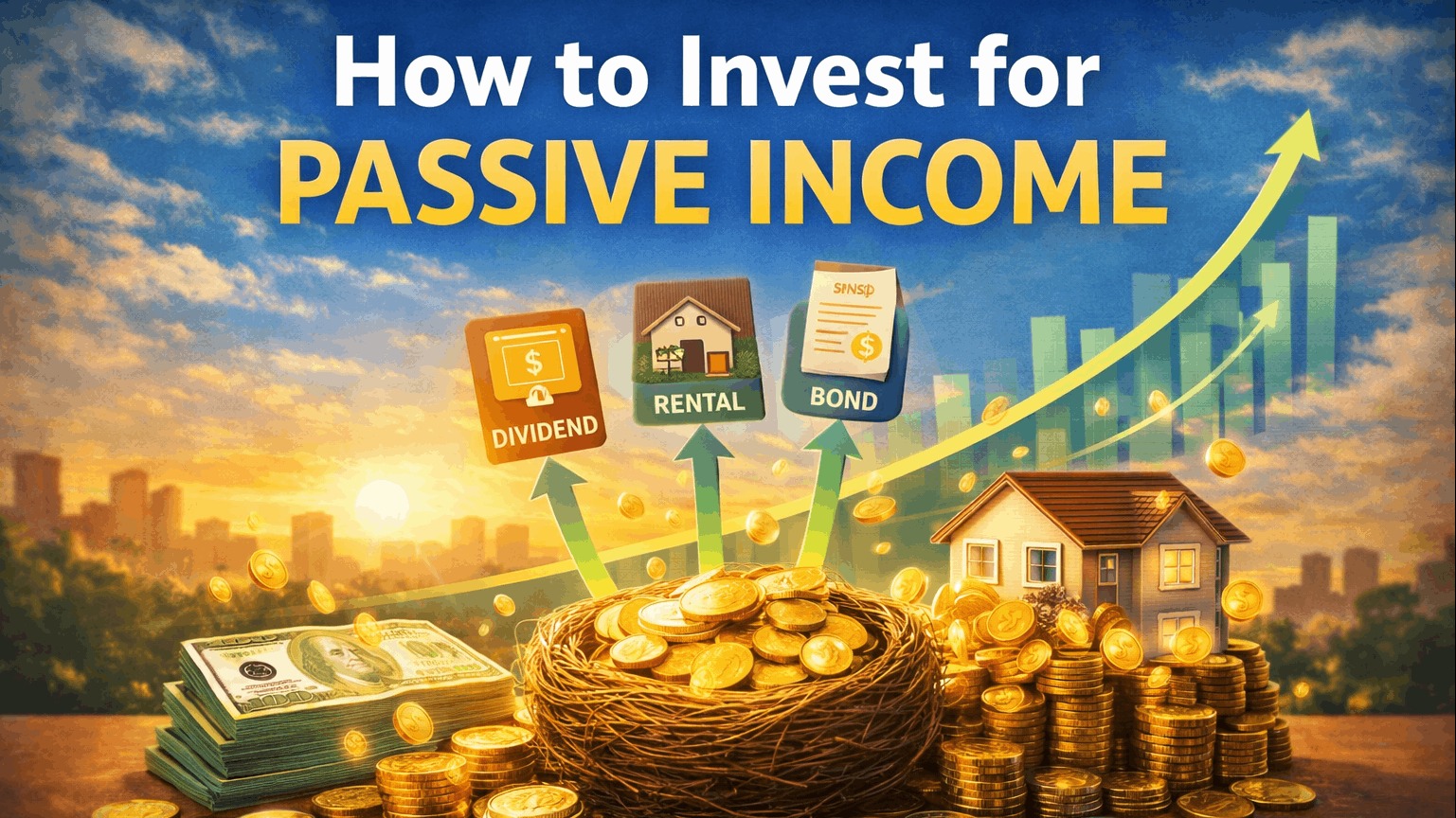
In the evolving economic landscape of 2026, the dream of "earning while you sleep" has transitioned from a luxury to a financial necessity. With the traditional "9-to-5" structure shifting toward gig-based and decentralized work, building a self-sustaining money machine is the ultimate hedge against economic volatility.
Investing for passive income isn't about getting rich quick; it is about the strategic deployment of capital into assets that do the heavy lifting for you. Whether you are looking to supplement your current salary or build a bridge toward early retirement, understanding the mechanics of cash-flow investing is your first step.
Definition Box:
Investing for passive income means putting money into assets that may produce recurring cash flow, such as dividends, interest payments, or income distributions.
The Philosophy of Passive Income
Most people are taught to trade their time for money. This is "active income." The limitation is obvious: you only have 24 hours in a day. Passive income flips the script. You trade your money for time. By owning assets that generate revenue, you decouple your survival from your daily labor.
In 2026, with inflation stabilized around 3%, simply saving money in a standard bank account is a losing strategy. To achieve true financial freedom, your passive income must not only exist but must grow faster than the cost of living.
Quick Example:
An investor may buy dividend ETFs, bond funds, or REITs and use the income payments as cash flow or reinvest them to grow future income.
1. Dividend-Yielding Equities: The Corporate Paycheck
Dividends are a share of a company's profits distributed to stockholders. For the passive investor, they represent a "loyalty bonus" for owning a piece of a successful business.
Dividend Aristocrats and Kings
In 2026, savvy investors focus on "Dividend Kings"—companies that have increased their dividends for at least 50 consecutive years. These companies (like Procter & Gamble or Johnson & Johnson) have weathered every recession, war, and technological shift of the last half-century.
- The Strategy: Focus on Dividend Growth Investing (DGI). You aren't just looking for the highest yield; you are looking for a yield that grows. A company paying a 3% dividend that increases that payout by 7% every year is far more valuable long-term than a stagnant 5% yielder.
Dividend ETFs
If picking individual stocks feels too risky, Exchange-Traded Funds (ETFs) like SCHD or VYM allow you to buy a basket of hundreds of dividend-paying companies. This provides instant diversification; if one company in the fund cuts its dividend, the others compensate, keeping your "passive paycheck" stable.
2. Real Estate: Bricks, Mortar, and Monthly Checks
Real estate is the historical champion of passive income. In 2026, the barrier to entry has lowered significantly thanks to digitization and new tax laws.
Real Estate Investment Trusts (REITs)
REITs are companies that own, operate, or finance income-producing real estate. They are required by law to distribute at least 90% of their taxable income to shareholders as dividends.
- Why they work in 2026: You can own a piece of data centers, cell towers, or apartment complexes without ever picking up a wrench. In 2026, Industrial REITs (warehouses for AI and E-commerce) and Data Center REITs are the high-performers of the sector.
Fractional Real Estate
New platforms now allow you to buy "shares" in individual rental properties for as little as $100. You receive your portion of the rent every month and a share of the appreciation when the property is eventually sold. This removes the "active" work of landlording while keeping the "passive" benefits of the asset class.
3. Fixed Income and the "Yield" Revolution
Following the interest rate shifts of 2024 and 2025, fixed income has returned as a viable passive income pillar.
High-Yield Savings and CDs
While not "exciting," keeping your emergency fund in a High-Yield Savings Account (HYSA) in 2026 is providing a reliable 3.5% to 4.5% APY.
- CD Ladders: By "laddering" Certificates of Deposit (buying CDs that mature at different intervals), you can ensure a steady stream of cash becomes available to you every few months while earning a higher interest rate than a standard savings account.
Treasury Bonds
U.S. Treasuries are considered the "risk-free" rate. In 2026, many investors use I-Bonds to protect their purchasing power against inflation. For passive income, Treasury Notes pay interest every six months, providing a state-tax-exempt income stream that is backed by the full faith and credit of the U.S. government.
4. Modern Passive Streams: Private Credit and Peer-to-Peer
The "Shadow Banking" sector has exploded in 2026. Private credit involves lending money directly to businesses.
- The Benefit: Because you are cutting out the traditional bank, you can often earn yields of 8% to 12%.
- The Risk: These are not insured by the FDIC. If the business fails, your income stream disappears. For this reason, private credit should only occupy a small "satellite" portion of a beginner's portfolio.
5. The "Three Pillars" of Passive Income Success
To succeed in 2026, your passive income strategy must rest on three foundations:
I. Automation
The "passive" in passive income comes from the systems you build. Set up Automatic Investment Plans (AIPs). If your dividends are automatically reinvested (DRIP) or your monthly savings are automatically moved into a REIT, you remove the "human error" factor.
II. Tax Efficiency
In 2026, wealth is about what you keep.
- Roth IRAs: These are the ultimate passive income tool. Any dividends or capital gains earned inside a Roth IRA are 100% tax-free upon withdrawal in retirement.
- Qualified Dividends: Ensure your stocks are held long enough to qualify for the lower long-term capital gains tax rates (usually 0%, 15%, or 20%) rather than being taxed as ordinary income.
III. Diversification
Never rely on a single source of passive income. A "Bulletproof" 2026 portfolio might look like this:
- 50% Dividend ETFs (The Core)
- 20% REITs (The Real Estate Hedge)
- 20% Bonds/Cash (The Stability)
- 10% "Aggressive" Yield (Private Credit or Covered Call ETFs)
6. Avoiding the "Yield Trap"
A common mistake for beginners is chasing the highest percentage. If a stock offers a 15% dividend yield, it is often a "Yield Trap." This high percentage usually means the stock price has crashed because the company is in trouble. Eventually, they will cut the dividend to zero, leaving you with a loss.
In 2026, a "healthy" passive income yield is generally in the 3% to 6% range. Anything higher requires deep due diligence.
Summary: Building Your Freedom
Starting your passive income journey in 2026 requires patience. In the beginning, your dividends might only buy you a cup of coffee once a month. However, through the power of Compounding, those small payments eventually grow to cover your phone bill, then your car payment, and eventually, your mortgage.
The goal of passive investing is to reach the "Crossover Point"—the moment where your monthly passive income exceeds your monthly expenses. Once you hit that point, work becomes an option, not a requirement.