In the financial landscape of March 2026, young investors—primarily Gen Z and the rising "Generation Alpha"—face a unique set of economic circumstances. While the cost of living remains high and interest rates have stabilized around 3.75%, the technological tools available to build wealth have never been more powerful. From AI-driven portfolio management to zero-commission fractional trading, the barriers to entry have vanished.
However, the "shiny object syndrome" of social media finance often distracts from the truth: the best investment strategy isn't about finding the next viral "meme stock" or a 100x crypto moonshot. It is about harnessing the most valuable asset a young person owns—Time.
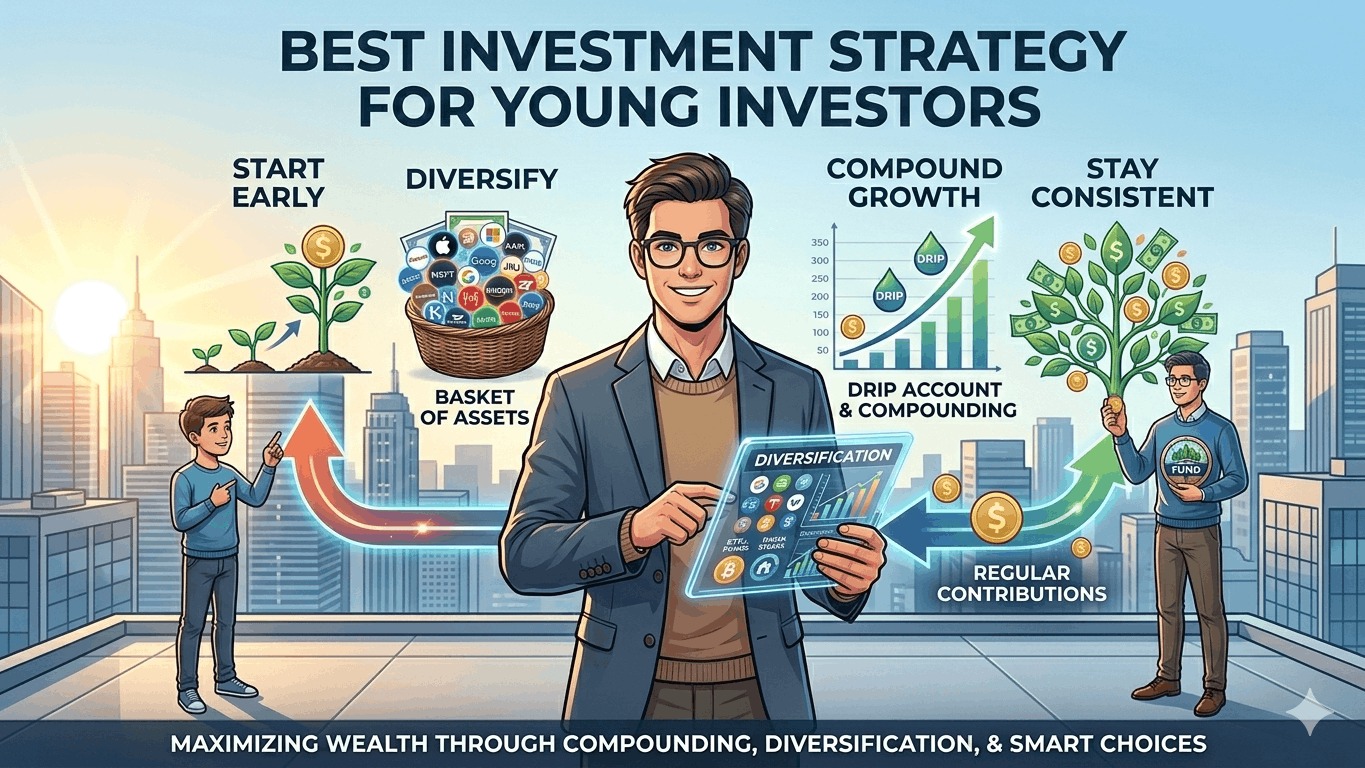
Definition Box: The best investment strategy for young investors is usually a long-term plan built around early investing, diversification, regular contributions, and disciplined habits.
1. The Ultimate Edge: The Power of Time
The most critical advantage a young investor has is a long "time horizon." In 2026, with medical advancements potentially extending working years and life expectancy, a 22-year-old might have a 45-year compounding window before traditional retirement.
The Math of Starting Early
If you invest $400 a month starting at age 20 and earn an average 8% annual return, you will have approximately $2.1 million by age 65. If you wait until age 30 to start that same $400 monthly investment, you will end up with roughly $900,000.
The Lesson: That ten-year delay costs you over $1.2 million. In the world of compounding, the "heavy lifting" is done in the final decade, but only if the engine started running forty years prior.
Quick Example: A young investor who puts money into index funds every month may benefit from decades of compounding and market growth.
2. Step One: The "Resilience" Layer
Before buying stocks, a young investor must build a "financial moat." In 2026, the job market can be volatile due to AI integration in various industries. You cannot invest effectively if you are one "car repair" away from total liquidation.
- The High-Yield Emergency Fund: Aim for 3 to 6 months of basic expenses. In 2026, keeping this in a High-Yield Savings Account (HYSA) or a Money Market Fund ensures your "safety net" is earning 3.5%–4.5% interest while staying completely liquid.
- Eliminate High-Interest Debt: If you have credit card debt at 22% interest, paying it off is a "guaranteed 22% return." No stock market strategy can consistently beat that.
3. Core Strategy: Broad-Market Indexing
For 95% of young investors, the "Core" of their portfolio should be low-cost, broad-market index funds or ETFs (Exchange-Traded Funds).
- Why Indexing? Instead of trying to guess which company will win, you buy the entire market. In 2026, funds like VTI (Total Stock Market) or VOO (S&P 500) give you a piece of every major profitable corporation in the U.S.
- The "Set and Forget" Factor: It removes the emotional stress of watching individual stock prices. If one tech company fails, the index simply replaces it with the next rising star, ensuring your wealth continues to track the overall growth of the economy.
4. The "Satellite" Strategy: AI and Emerging Tech
Because young investors have time to recover from volatility, they can afford a "satellite" allocation (typically 10–15% of the portfolio) to high-growth, high-risk sectors. In 2026, this focuses on:
- Agentic AI & Automation: Companies that aren't just building AI models, but deploying "agents" that perform real-world labor.
- Green Energy Infrastructure: As the 2026 global economy shifts further toward sustainability, the "picks and shovels" of the energy transition (battery storage, grid modernization) offer long-term growth potential.
- Fractional Real Estate: For young people priced out of traditional homeownership, 2026 platforms allow you to buy "slices" of rental properties, providing passive income and real estate exposure for as little as $100.
5. Tax-Advantaged "Buckets"
Wealth in 2026 is about what you keep, not just what you earn. Young investors should prioritize their "buckets" in this order:
- Employer Match (401k): If your job offers a 3% match, that is a 100% instant return. Never leave free money on the table.
- Roth IRA: This is the young investor’s best friend. You contribute "after-tax" money now, and every dollar of growth is 100% tax-free when you withdraw it in retirement.
- HSA (Health Savings Account): If you have a high-deductible health plan, the HSA is a "triple-tax-advantaged" secret. Contributions are tax-deductible, growth is tax-free, and withdrawals for medical expenses are tax-free. In 2026, many young investors treat the HSA as a second IRA.
6. Habits Over Hype: Dollar-Cost Averaging
The biggest mistake young investors make in 2026 is trying to "time the market." They wait for a crash to buy, or they wait for a "clear signal."
The Fix: Dollar-Cost Averaging (DCA). Set up an automated transfer of $100, $500, or whatever you can afford, to be invested on the 1st of every month.
- When the market is up, your money buys fewer shares (preventing you from over-buying at the peak).
- When the market is down, your money buys more shares (automatically "buying the dip").
7. Psychological Mastery: Ignoring the Noise
In 2026, the financial media and "finfluencers" thrive on panic and hype. To succeed, a young investor must develop "behavioral discipline."
- The 10-Year Rule: Never invest money in the stock market that you will need in the next 10 years. This mindset allows you to ignore "Red Days" or "Bear Markets" because you know your exit date is decades away.
- Delete the Apps (Mostly): You don't need to check your portfolio daily. Checking daily increases the urge to "do something," which usually leads to mistakes. A quarterly check-up is sufficient.
Summary: Your 2026 Action Plan
To build a multi-million dollar portfolio as a young investor, you don't need a high-frequency trading desk or an MBA. You need a System.
- Automate an amount you won't miss.
- Diversify into low-cost index funds.
- Shield your gains in a Roth IRA.
- Wait.
The 2026 economy will have its ups and downs, but the trajectory of human innovation and productivity is consistently upward. If you start today, you aren't just "saving"—you are hiring your dollars to work for you so that one day, you won't have to work at all.