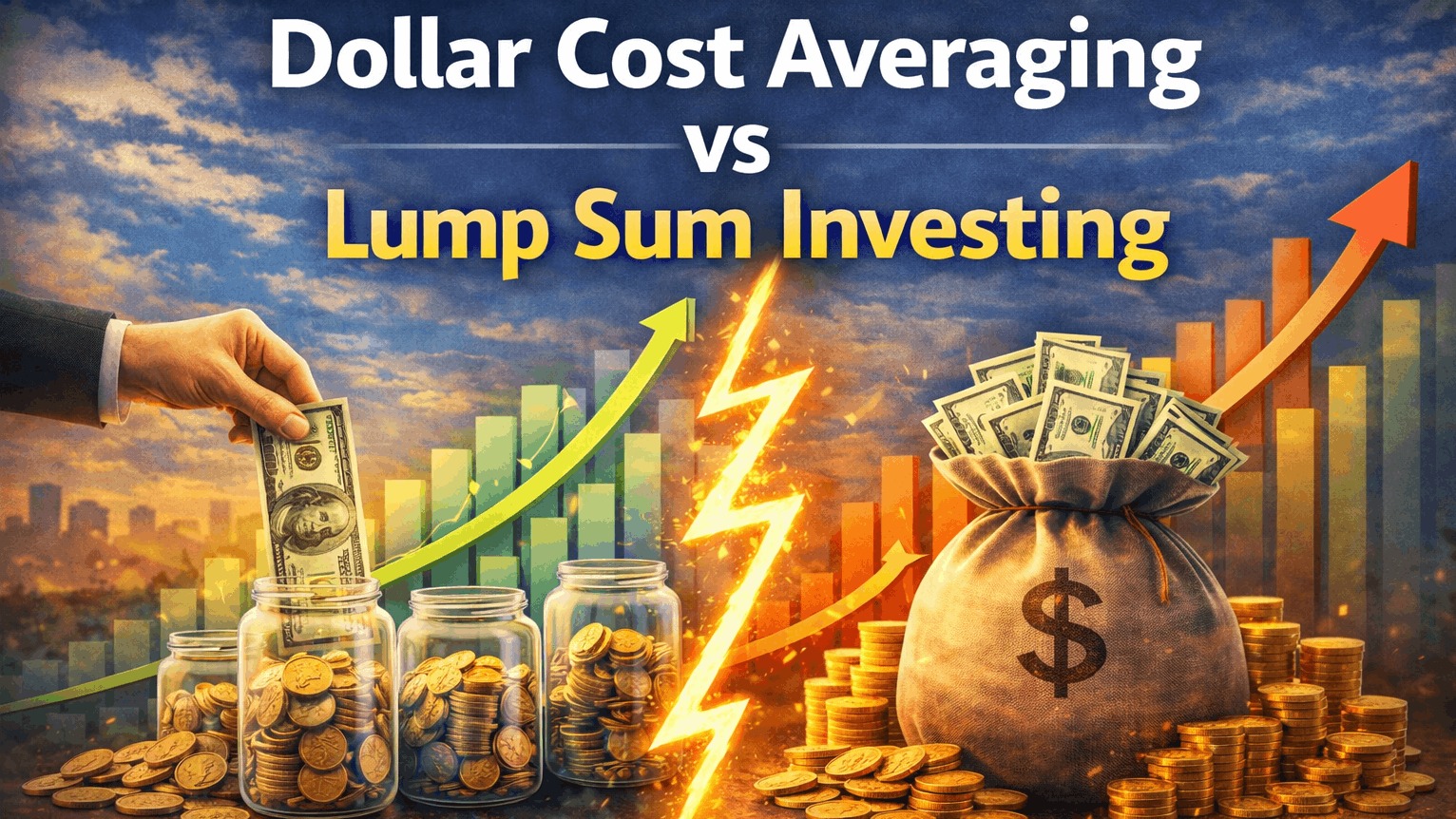
In the financial landscape of March 2026, where market volatility remains a constant companion to growth, investors often find themselves standing at a crossroads. You have a sum of money—perhaps from a year-end bonus, a tax refund, or the sale of an asset—and you face the ultimate tactical question: Should you put it all into the market today, or should you wade in slowly over the next several months?
This debate between Lump-Sum Investing (LSI) and Dollar-Cost Averaging (DCA) is one of the most enduring discussions in personal finance. While the mathematical answer often points in one direction, the psychological reality of the "2026 Costco Economy" often pulls investors in another.
Definition Box:
Dollar cost averaging means investing smaller fixed amounts over time, while lump sum investing means investing all available money at once.
1. The Mechanics of the Two Strategies
Lump-Sum Investing (LSI)
Lump-sum investing is exactly what it sounds like: taking 100% of your investable cash and placing it into your chosen assets (like an S&P 500 index fund or a diversified ETF) in a single transaction.
- The Philosophy: "Time in the market beats timing the market."
- The 2026 Context: With interest rates stabilizing, many investors use LSI to capture immediate dividend yields and ensure they don't miss out on "green days" in the tech or energy sectors.
Dollar-Cost Averaging (DCA)
Dollar-cost averaging involves dividing your total sum into equal parts and investing them at regular intervals (e.g., $1,000 every Monday for ten weeks).
- The Philosophy: "Slow and steady wins the race by avoiding the peak."
- The 2026 Context: In a year where AI-driven swings can move the Nasdaq by 2% in a single afternoon, DCA acts as a shock absorber for your portfolio and your blood pressure.
Quick Comparison:
Dollar cost averaging can reduce emotional stress and smooth entry prices, while lump sum investing gives your money more time in the market.
2. The Battle of Math: Why Lump Sum Usually Wins
If we look strictly at the historical data, Lump-Sum Investing is the mathematical champion approximately 65% to 75% of the time.
The reason is simple: markets tend to go up over the long term. By holding cash on the sidelines to "average in," you are essentially betting that the market will drop or stay flat in the short term. In 2026, as companies continue to integrate AI efficiencies and drive earnings growth, being "out of the pool" means you aren't earning dividends or participating in price appreciation.
The "Cash Drag" Effect: When you DCA, your uninvested money is likely sitting in a savings account. While 2026 interest rates provide a decent 3.5% to 4% APY, this usually pales in comparison to a surging bull market.
3. The Battle of Psychology: Why DCA is the "Human" Choice
While the math favors the lump sum, humans are not calculators. We are prone to Loss Aversion—the psychological pain of losing $1,000 is twice as intense as the joy of gaining $1,000.
The "Day After" Nightmare: Imagine you invest $50,000 in a lump sum on Tuesday. On Wednesday, a geopolitical event causes the market to slide 5%. You have just lost $2,500 in 24 hours. For many new investors, this leads to panic, regret, and the catastrophic mistake of selling at the bottom.
The DCA Safety Net: With dollar-cost averaging, a market drop is actually good news. If the market slides 5%, your next scheduled $5,000 investment buys shares at a discount. You aren't "losing money"; you are "lowering your average cost." This perspective shift keeps investors disciplined and prevents them from abandoning their long-term strategy.
4. Real-World 2026 Scenarios
Scenario A: The Inherited Windfall
You receive $100,000. In the 2026 market, where valuations are high but growth is steady, you might feel paralyzed.
- Strategy: A "Hybrid Approach." Invest $50,000 immediately (Lump Sum) to ensure you have "skin in the game," then move the remaining $50,000 into the market in $10,000 increments over the next five months.
Scenario B: The Monthly Paycheck
You save $1,000 from your salary every month.
- Strategy: This is Natural DCA. You don't have a choice but to average in. In 2026, automating this through your brokerage ensures that you are buying the dips and the peaks without overthinking.
5. Risk Management and Volatility
In 2026, the "Risk-Free Rate" is higher than it was in the early 2020s. This changes the DCA calculation slightly.
- Managed DCA: If you are averaging into the market over 6 months, you can keep your "sideline cash" in a High-Yield Savings Account or a Money Market Fund. This allows you to earn a safe 4% on your cash while waiting for your scheduled investment dates, partially offsetting the "cash drag" of not being in the stock market.
6. Which Strategy Should You Choose?
The "Right" answer depends more on your personality than your spreadsheet.
| Choose Lump Sum If... | Choose Dollar-Cost Averaging If... |
|---|---|
| You have a high risk tolerance and can ignore short-term red. | You are a new investor or prone to "buyer's remorse." |
| You have a long time horizon (10+ years). | The market is currently at an all-time high and looks "bubbly." |
| You want to capture dividends and yields immediately. | You want to build the habit of disciplined, consistent saving. |
| You believe the current 2026 growth trend will continue. | You want to minimize the impact of a potential "black swan" event. |
7. The 2026 Verdict
As we navigate the mid-2020s, the most important factor isn't how you enter the market, but that you enter and stay.
Lump-sum investing is statistically superior for maximizing total wealth, but dollar-cost averaging is superior for investor behavior. If a lump-sum investment will keep you awake at night checking your phone every ten minutes, it is the wrong choice. Conversely, if you have the discipline to "set it and forget it," the lump sum will likely give you a larger retirement "nest egg" thirty years from now.
Summary: The Final Rule
Don't let "Analysis Paralysis" keep you on the sidelines. In the 2026 economy, inflation is a silent thief of purchasing power. Whether you choose the "Big Splash" of a lump sum or the "Steady Drip" of DCA, the goal is to get your capital out of a depreciating currency and into productive, wealth-generating assets.