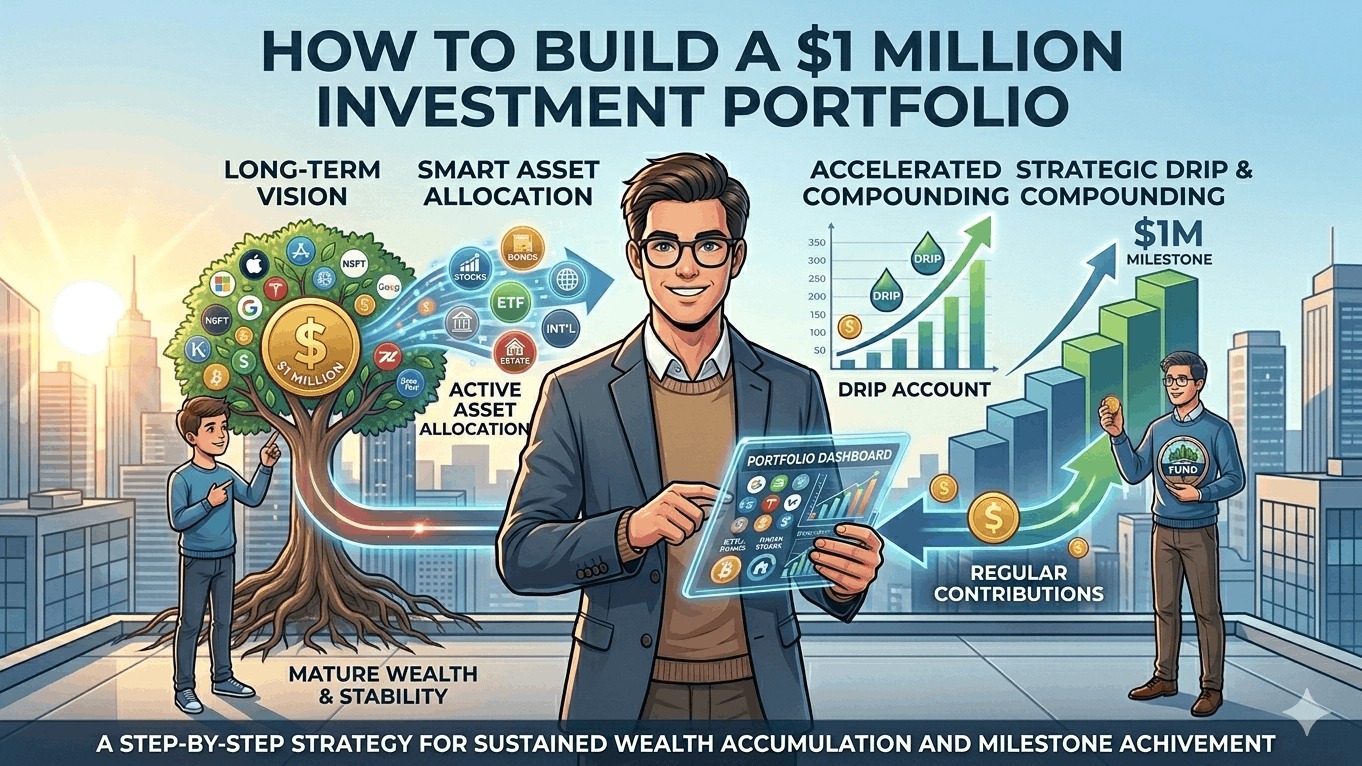
In the financial landscape of March 2026, the "million-dollar milestone" remains the gold standard for long-term financial security. While inflation has shifted the purchasing power of a million dollars over the decades, it still represents a "critical mass" of capital that can generate significant passive income, potentially covering a household’s baseline expenses indefinitely.
Building a seven-figure portfolio is rarely the result of a single "lucky" stock pick or a overnight windfall. Instead, it is a mechanical process driven by three specific variables: Time, Contribution Rate, and Rate of Return. By understanding how to manipulate these levers in the current 2026 economy, any disciplined investor can chart a course to the million-dollar mark.
Definition Box: Building a $1 million investment portfolio means growing your invested assets over time through regular contributions, market returns, diversification, and compounding.
1. The Mathematics of a Million
Before picking assets, you must understand the math. To reach $1 million, you need to know your "burn rate" and your timeline. In 2026, with the S&P 500 historically averaging around 10% (approximately 7% after inflation), the journey depends entirely on when you start.
- The 20-Year Path: To hit $1 million in 20 years at a 7% inflation-adjusted return, you need to invest roughly $1,900 per month.
- The 30-Year Path: To hit the same goal in 30 years, that monthly contribution drops significantly to roughly $820 per month.
- The 40-Year Path: Starting early is the ultimate "cheat code." Over 40 years, the monthly requirement is only about $380 per month.
Quick Example: An investor who contributes consistently to index funds or ETFs over many years may gradually build a portfolio that reaches $1 million, especially when returns are reinvested.
2. Choosing the Right "Vehicle" (Asset Allocation)
In 2026, the "60/40" portfolio has evolved into a more aggressive "Growth-First" model for those aiming for the million-dollar mark. To build wealth at this scale, you need exposure to productive assets—things that grow in value and produce cash.
The Core: Low-Cost Index Funds
The foundation of most 2026 million-dollar portfolios is the Total Stock Market Index Fund or an S&P 500 ETF (like VOO or VTI). These provide instant diversification across hundreds or thousands of the most profitable companies in the USA.
- Why it works: It removes "single-stock risk." You aren't betting on one company to succeed; you are betting on the collective ingenuity of the American economy.
The Satellite: High-Growth Sectors
In 2026, many investors add a 10–20% "satellite" portion to their portfolio to capture outsized returns in emerging fields.
- AI & Automation: Companies driving the "Agentic AI" revolution.
- Green Infrastructure: Supporting the global shift to renewable energy.
- Global Emerging Markets: Capturing growth in developing economies that may outperform the U.S. in the coming decade.
3. Maximizing Tax-Advantaged "Buckets"
You don't just want a million dollars; you want to keep as much of that million as possible. In 2026, tax efficiency is the secret to accelerating your timeline.
- The Roth IRA/401(k): This is the holy grail. You pay taxes on the money now, but once it's in the account, it grows 100% tax-free. If you withdraw $1 million from a Roth account in 30 years, you owe $0 to the IRS.
- The Health Savings Account (HSA): Often called the "Stealth IRA," the HSA offers a triple-tax advantage. In 2026, savvy investors use the HSA to invest in the stock market, letting the balance compound tax-free for decades to cover healthcare costs in retirement.
- The Brokerage Account: While taxable, a standard brokerage account provides liquidity. This is the money you can access before age 59.5 without penalties, acting as a bridge to early financial freedom.
4. The Power of "Automaticity"
The greatest enemy of the $1 million goal is Human Behavior. We are wired to spend what we see. To overcome this, successful 2026 investors use Automated Investing.
- Pay Yourself First: Set up a recurring transfer from your paycheck directly into your investment account on the same day you get paid. If the money never hits your checking account, you won't miss it.
- Reinvest Dividends (DRIP): Ensure your "Dividend Reinvestment Plan" is turned on. Those quarterly payouts may seem small at first, but over 30 years, they can account for nearly 40% of your total portfolio value.
5. Staying the Course: The "Boring" Middle
The journey to a million dollars is often described as "a long period of boredom punctuated by moments of terror."
- The "Moments of Terror": Market crashes (like a 20% bear market) are a mathematical certainty over a 30-year period. In 2026, with AI-driven volatility, these can happen fast. The million-dollar investor views these as "clearance sales" and continues buying.
- Lifestyle Creep: As your salary increases in the 2020s, the temptation to buy a bigger house or a luxury EV will grow. To hit $1 million, you must commit to investing at least 50% of every raise you receive.
6. Monitoring and Rebalancing
Once your portfolio reaches the mid-six figures ($500,000+), "Risk Management" becomes as important as "Growth."
- The Rebalance: If your tech stocks have performed so well that they now make up 80% of your portfolio, you are over-exposed. Selling some tech and buying "boring" assets like bonds or REITs ensures that one sector crash doesn't wipe out your progress.
- The 2026 Inflation Hedge: Ensure a portion of your wealth is in "real assets" like Real Estate (REITs) or Commodities to protect your million-dollar goal from the eroding effects of a 3%–4% inflation environment.
Summary: The Final Rule
Building a $1 million portfolio in 2026 is less about being a "genius" and more about being "relentless." If you can consistently invest a portion of your income, diversify into productive assets, and avoid the urge to panic-sell during downturns, the math of compounding makes the $1 million mark an inevitability rather than a dream.
Start where you are, use the tools available today, and let time do the heavy lifting.