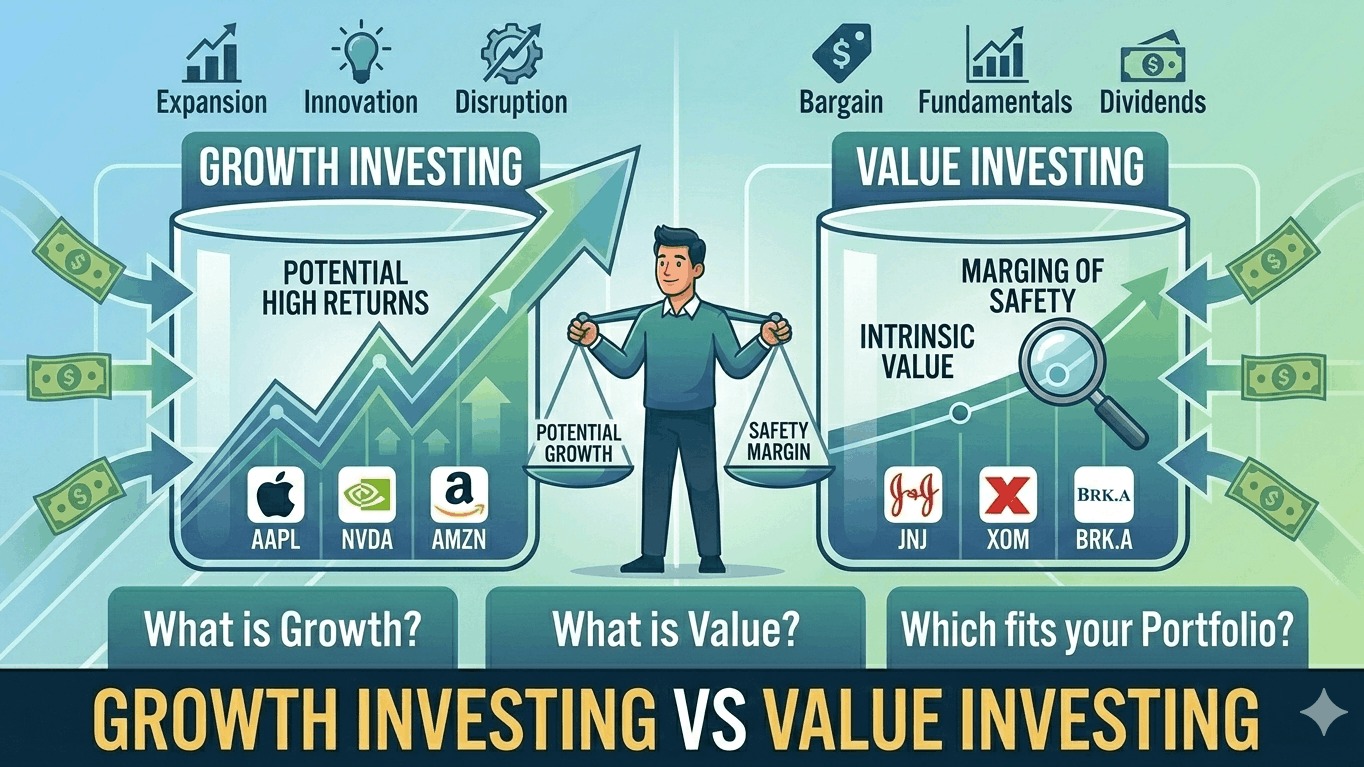
When people begin learning about the stock market, one of the first debates they often encounter is growth investing vs value investing. These two strategies represent different ways of looking at companies, market opportunities, and long-term returns. Both have been popular for decades in the United States, and both continue to shape how individual investors, financial advisors, and institutional fund managers build portfolios.
At first glance, the difference seems simple. Growth investors look for companies expected to expand quickly, while value investors look for companies that appear undervalued compared to their true worth. But once you go deeper, the comparison becomes much more interesting. These strategies differ in mindset, risk profile, market behavior, and even the type of patience they demand from investors.
Understanding the difference between growth and value investing can help you make better investment decisions, especially if you are building a long-term portfolio. Some investors strongly prefer one style. Others combine both. Neither strategy is automatically superior in every market environment. The better choice often depends on your goals, risk tolerance, time horizon, and investing personality.
This article explains what growth investing and value investing mean, how each strategy works, their pros and cons, and how investors in the U.S. can decide which approach may fit them best.
What Is Growth Investing?
Growth investing is an investment strategy focused on companies that are expected to grow revenue, earnings, market share, or overall business value faster than the broader market.
Growth investors are usually willing to pay a higher price for these companies because they believe future expansion will justify that premium. These companies often reinvest profits back into the business rather than paying large dividends. The goal is capital appreciation, meaning the stock price rises significantly over time as the company grows.
Growth companies are often found in sectors such as:
- Technology
- Consumer innovation
- Healthcare and biotech
- Communication services
- Emerging industries
A classic growth investor is less concerned with whether a stock looks cheap today and more interested in whether the company could become much bigger in the future.
For example, a company growing sales rapidly, expanding into new markets, and introducing new products may attract growth investors even if its stock trades at a high valuation compared with current earnings.
What Is Value Investing?
Value investing is an investment strategy focused on finding stocks that appear to trade below their intrinsic value. In simple terms, value investors try to buy good companies at prices they believe are lower than what those companies are truly worth.
This approach is built around the idea that the market sometimes misprices stocks. A company may be temporarily overlooked, misunderstood, or out of favor, causing its stock price to fall below its underlying business value. A value investor sees this gap as an opportunity.
Value stocks are often associated with:
- Lower price-to-earnings ratios
- Lower price-to-book ratios
- More established businesses
- Strong cash flow
- Dividend payments
- Slower but steadier growth
Rather than chasing fast-growing trends, value investors often look for stability, fundamentals, and a margin of safety.
For example, if a profitable, well-established company has a depressed stock price because of temporary market concerns, a value investor may believe the stock is worth buying before the broader market eventually recognizes its true value.
The Core Difference Between Growth and Value Investing
The main difference between growth and value investing lies in what the investor is paying for.
A growth investor is paying for future potential. They believe the company’s earnings, sales, or market position will expand significantly over time.
A value investor is paying for current mispricing. They believe the stock is already worth more than the market is currently recognizing.
That difference may sound small, but it changes everything about how these investors evaluate companies.
A growth investor may accept a high valuation if the company’s future looks strong enough. A value investor may avoid that same stock and instead look for one with lower expectations and a cheaper price.
How Growth Investors Evaluate Stocks
Growth investors often focus on a company’s ability to expand faster than average. They may examine:
- Revenue growth
- Earnings growth
- Product innovation
- Market opportunity
- Competitive advantage
- Industry leadership
- Future scalability
The key question is often: Can this business become much larger over time?
Growth investors are usually comfortable owning companies that look expensive by traditional valuation metrics if they believe those companies will grow into their price.
For instance, a company may have a high price-to-earnings ratio, but if it is doubling revenue, gaining market share, and dominating a fast-growing industry, a growth investor may still see it as attractive.
How Value Investors Evaluate Stocks
Value investors tend to focus more on fundamentals and valuation. They often look for signs that a stock is trading below what the business is reasonably worth.
Common areas of focus include:
- Price-to-earnings ratio
- Price-to-book ratio
- Free cash flow
- Dividend yield
- Debt levels
- Balance sheet strength
- Consistent profitability
The key question is often: Is this business worth more than the market price suggests?
Value investors usually want a margin of safety, meaning they buy at a price low enough to reduce downside risk if their estimate of value is slightly wrong.
Example Comparison Table
Here is a simple table that shows the difference between growth investing and value investing:
| Feature | Growth Investing | Value Investing |
|---|---|---|
| Main focus | Future business expansion | Undervalued current price |
| Typical company type | Fast-growing, innovative | Established, often overlooked |
| Valuation | Often high | Often lower |
| Dividend payments | Less common | More common |
| Investor mindset | Pay for future upside | Buy below intrinsic value |
| Risk style | Higher expectations risk | Higher re-rating patience risk |
| Common sectors | Tech, biotech, innovation | Financials, industrials, consumer staples |
This table simplifies the distinction, but it captures the broad idea behind each style.
Risks of Growth Investing
Growth investing can be rewarding, but it comes with important risks.
High expectations
Growth stocks often carry high valuations. If a company fails to grow as quickly as expected, the stock can fall sharply, even if the business itself is still doing fairly well.
Greater volatility
Growth stocks can be more sensitive to changing market sentiment, rising interest rates, or weak earnings reports. Their prices often move more dramatically than value-oriented stocks.
Overpaying for hype
In some cases, investors become too optimistic about a popular trend or story. That can push stock prices beyond what future results realistically support.
Risks of Value Investing
Value investing also has risks, even though it is often viewed as a more conservative strategy.
Value traps
Sometimes a stock looks cheap for a good reason. A company may face long-term decline, poor management, industry disruption, or weak financial strength. In that case, the stock may not be undervalued at all.
Slower market recognition
A value investor may be right about a company’s worth, but it can take a long time for the market to recognize it. This requires patience and conviction.
Missed growth opportunities
By focusing on low valuations, value investors may miss companies with powerful long-term growth potential simply because those stocks look expensive on the surface.
How Growth and Value Perform in Different Market Environments
One reason the debate between growth and value investing continues is that different market conditions tend to favor different styles.
Growth stocks often perform well when:
- Interest rates are lower
- Investors are optimistic
- Innovation-driven sectors are leading
- Earnings growth is highly rewarded
Value stocks often perform well when:
- Interest rates rise
- Investors shift toward fundamentals
- Cyclical or established sectors recover
- Markets become more price-conscious
These are broad patterns, not guarantees. There have been long stretches where growth outperformed and other periods where value led the market. Style leadership can change over time.
Example of Growth vs Value Mindset
Imagine two investors looking at two different companies.
One company is growing revenue rapidly, expanding into new markets, and gaining strong consumer attention, but the stock trades at a very high valuation.
Another company is mature, profitable, pays dividends, and trades at a lower valuation because the market sees it as boring or temporarily out of favor.
The growth investor may prefer the first company because of its future upside. The value investor may prefer the second because it offers a stronger margin of safety.
Both investors may be acting rationally based on their strategy. They are simply prioritizing different things.
Can You Invest in Both Growth and Value?
Yes, and many investors do.
In fact, many diversified portfolios include both growth and value exposure. This can happen through:
- Broad index funds
- Style ETFs
- Mutual funds
- A mix of individual stocks
- Total market funds
Owning both styles can help reduce dependence on one market environment. When growth stocks lead, that portion of the portfolio may perform well. When value stocks come back into favor, the value portion may help balance returns.
For many investors, combining growth and value creates a more flexible long-term strategy.
Example Portfolio Style Table
Here is a simple example of how different investors might approach growth and value exposure:
| Investor Style | Growth Allocation | Value Allocation | Possible Focus |
|---|---|---|---|
| Growth-focused investor | 70% | 30% | Capital appreciation |
| Balanced style investor | 50% | 50% | Blend of growth and stability |
| Value-focused investor | 30% | 70% | Lower valuation and dividends |
These are only examples, but they show how style preference can shape a portfolio.
Which Strategy Is Better?
There is no universal winner between growth investing and value investing.
Growth investing may be better for investors who:
- Want higher long-term upside potential
- Can tolerate more volatility
- Believe in innovation and expansion trends
- Are comfortable with higher valuations
Value investing may be better for investors who:
- Prefer buying at lower prices
- Focus on business fundamentals
- Want dividend income
- Appreciate a margin of safety
For many investors, the best answer is not choosing one side forever. It is understanding both and deciding how each fits into their broader portfolio.
How Beginners Should Think About Growth vs Value
Beginners do not always need to pick one style immediately. In many cases, broad index funds already provide exposure to both growth and value companies. That can be a smart starting point.
As investors learn more, they may choose to tilt slightly toward one style depending on their goals and beliefs.
A beginner who wants simplicity may start with a total market index fund or S&P 500 fund. Over time, they can decide whether they want more growth exposure, more value exposure, or a balanced blend.
Final Thoughts
The debate around growth investing vs value investing is not really about one strategy being permanently better than the other. It is about two different ways of finding opportunity in the stock market.
Growth investing is about believing in future expansion and paying for tomorrow’s potential. Value investing is about recognizing when today’s price may be lower than a company’s true worth. Both approaches have strengths, weaknesses, and periods when they shine.
For U.S. investors building a long-term portfolio, the best strategy often depends on personal goals, patience, risk tolerance, and how comfortable they are with market swings. Some investors feel more confident owning fast-growing companies. Others prefer established businesses trading at more modest valuations. Many choose a mix of both.
What matters most is not blindly following a style label. It is understanding how the strategy works, knowing the risks, and staying consistent with an approach that fits your long-term plan.