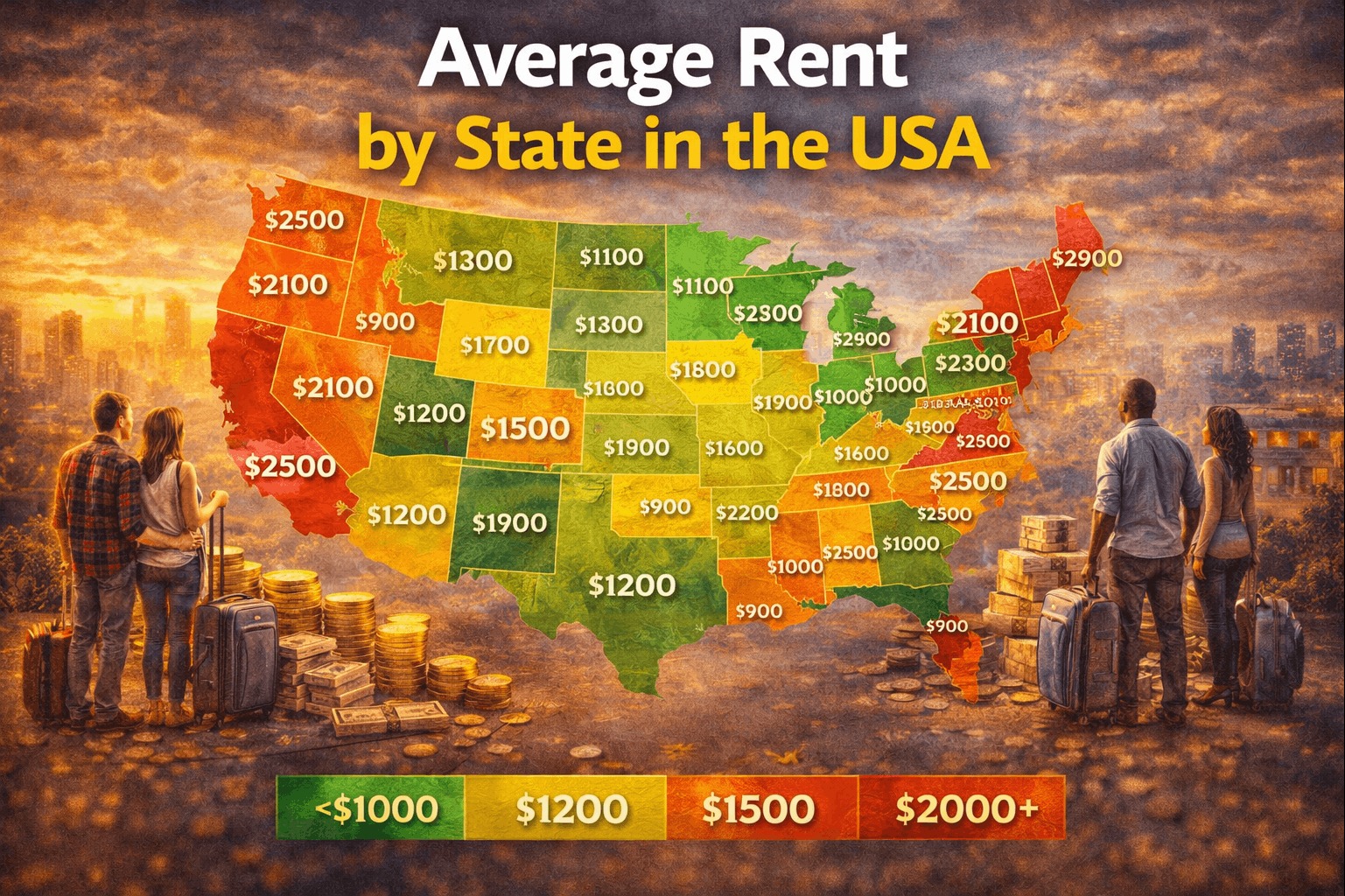
Rent is one of the biggest monthly expenses for households across the United States. But what many people don’t realize is how dramatically rent varies depending on the state you live in.
From high-cost coastal states to more affordable central regions, average rent differences can exceed $1,500 per month. Understanding these variations—along with real statistics—helps you make smarter financial decisions about where to live and how to budget.
Average Rent in the USA (National Overview)
Before comparing states, it’s important to understand the national benchmark.
- Average U.S. rent: ~$1,740/month (2026)
- Median 1-bedroom rent: ~$1,494/month (2026)
This gives you a baseline to compare whether a state is expensive or affordable.
Most renters in the U.S. fall within the $1,000–$1,500 range, showing that affordability is still a key concern nationwide.
Average Rent by State (Latest Statistics)
Here’s a detailed look at average monthly rent across major states:
| State | Average Rent (Monthly) | Cost Level |
|---|---|---|
| Massachusetts | $2,825 | Very High |
| California | $2,628 | Very High |
| New Jersey | $2,412 | Very High |
| New York | $2,385 | Very High |
| Washington | $2,026 | High |
| Florida | $1,966 | Above Average |
| Texas | $1,441 | Moderate |
| Georgia | $1,633 | Moderate |
| Ohio | $1,334 | Affordable |
| Arkansas | $1,139 | Low |
| Oklahoma | $1,063 | Very Low |
These numbers show a clear pattern: coastal and urban states dominate the high end, while central states remain more affordable.
Most Expensive States for Rent
Some states consistently rank at the top due to high demand, strong job markets, and limited housing supply.
Key High-Rent States
- Massachusetts: ~$2,825/month
- California: ~$2,628/month
- New York: ~$2,385/month
These states often have:
- Major cities (Boston, Los Angeles, NYC)
- High-paying jobs
- Limited housing availability
Real-World Example
Renting in California vs Oklahoma:
- California: ~$2,600/month
- Oklahoma: ~$1,000/month
That’s a difference of over $19,000 per year, which significantly impacts savings and lifestyle.
Most Affordable States for Rent
On the other end, several states offer much lower rent, especially in the Midwest and South.
Key Low-Rent States
- Oklahoma: ~$1,063/month
- Arkansas: ~$1,139/month
- North Dakota: ~$1,167/month
Some estimates show even lower averages:
- North Dakota: ~$821/month
- Iowa: ~$895/month
These states typically have:
- Lower population density
- Lower housing demand
- Lower overall cost of living
Why Rent Varies So Much by State
Rent differences are not random—they are driven by key economic factors.
Housing Supply and Demand
States with limited housing and high demand (like California) see higher rents.
Job Market and Income Levels
Higher wages often lead to higher rent because people can afford to pay more.
Population Growth
States experiencing population growth often see rising rent due to increased demand.
Urban vs Rural Areas
Cities are significantly more expensive than rural areas within the same state.
Rent Trends in Recent Years
Rent prices have changed significantly in recent years.
- National rent increased sharply after 2020
- Growth has slowed slightly in 2025–2026
- Average rent remains ~20% higher than pre-pandemic levels
Some cities are seeing stabilization, while others continue to rise due to demand.
Real-World Scenario
Let’s compare two renters:
Person A (New York)
- Rent: $2,400/month
- Income: $90,000
- Limited savings due to high expenses
Person B (Ohio)
- Rent: $1,300/month
- Income: $70,000
- Higher savings potential
Even with a lower income, Person B may have more financial flexibility.
Rent and Financial Pressure
Rent is a major factor in financial stress.
- Many renters spend 30% or more of income on housing
- Some spend 50% or more, especially in high-cost states
This makes it harder to:
- Save money
- Invest
- Build wealth
Rent vs Income Relationship
Rent affordability depends on how it compares to income.
| Scenario | Financial Impact |
|---|---|
| Low rent + moderate income | Easier to save and invest |
| High rent + high income | Limited savings |
| High rent + low income | Financial stress |
This is why cost of living matters just as much as salary.
To understand this better:
Average Cost of Living by State – https://statush.com/finance-statistics/average-cost-of-living-by-state
How Rent Impacts Wealth Building
High rent can slow down financial growth because:
- Less money is available for savings
- Investment contributions decrease
- Long-term wealth accumulation is delayed
Lower rent, on the other hand, allows:
- More savings
- Faster investing
- Better financial stability
To explore this:
How Taxes Impact Wealth Building – https://statush.com/finance-statistics/how-taxes-impact-wealth-building
Tools to Plan Your Rent Budget
Before choosing where to live, it helps to calculate affordability.
- Rent Affordability Calculator – https://statush.com/rent-affordability-calculator
- Paycheck Calculator – https://statush.com/paycheck-calculator
- Savings Goal Calculator – https://statush.com/savings-goal-calculator
These tools help you align rent with your income and goals.
A Practical Perspective
Instead of focusing only on averages, think about your personal situation.
Ask yourself:
- Is my rent within 30% of my income?
- Am I able to save consistently?
- Would relocating reduce my financial pressure?
Sometimes, moving to a lower-cost state can have a bigger impact than increasing income.
Final Thoughts
Average rent by state in the USA shows a clear pattern: where you live has a huge impact on your financial life.
The key takeaway is simple:
- Rent varies significantly across states
- Coastal states are the most expensive
- Central states offer more affordability
- Rent directly impacts savings and wealth building
When you understand these differences, you can make smarter decisions about where to live, how much to spend, and how to build long-term financial stability.