When it comes to retirement planning in the United States, a Roth IRA is often considered one of the most powerful—and flexible—accounts available.
Unlike traditional retirement accounts, a Roth IRA offers tax-free income in retirement, which can be a game-changer if you plan ahead.
In this guide, we’ll break down the tax benefits of a Roth IRA in simple terms, with real-world examples and practical tips you can actually use.
What Is a Roth IRA? (Simple Explanation)
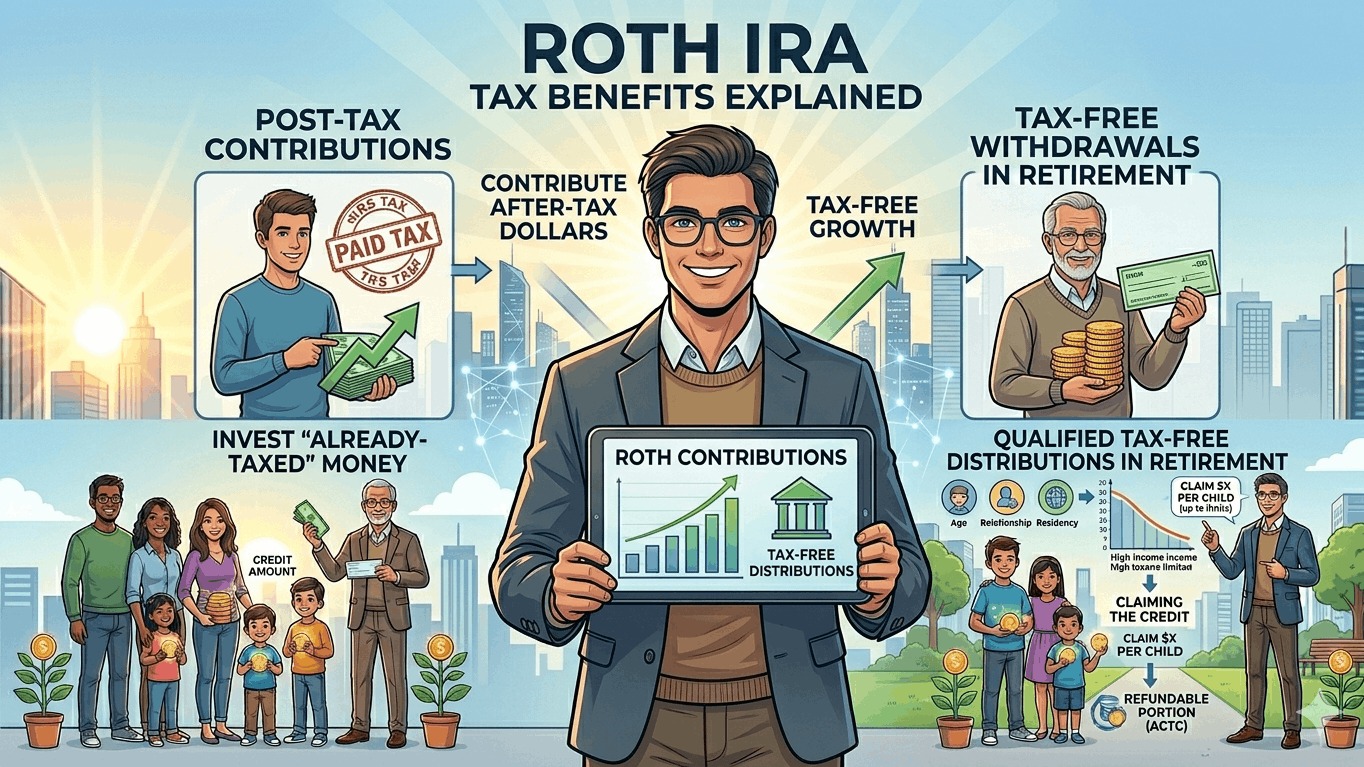
A Roth IRA (Individual Retirement Account) is a retirement account where:
- You contribute money after paying taxes
- Your investments grow over time
- Withdrawals in retirement are completely tax-free
Think of it this way:
You pay taxes now so you don’t have to worry about taxes later.
1. Tax-Free Withdrawals in Retirement
This is the biggest advantage of a Roth IRA.
How it works:
- You already paid taxes on your contributions
- All future growth is tax-free
- Withdrawals after age 59½ are not taxed
Real-world example:
- You invest $6,000 per year
- After 25 years, it grows to $400,000
With a Roth IRA:
- You pay zero tax on that $400,000 withdrawal
That’s a massive advantage compared to taxable accounts.
2. No Taxes on Investment Growth
Inside a Roth IRA:
- No taxes on dividends
- No taxes on capital gains
- No annual tax reporting
Why this matters:
Your full investment stays working for you, allowing maximum compounding.
Example:
In a taxable account, taxes reduce your returns every year.
In a Roth IRA, your money grows uninterrupted.
Related reading:
How Taxes Impact Wealth Building
https://statush.com/finance-statistics/how-taxes-impact-wealth-building
3. No Required Minimum Distributions (RMDs)
Unlike traditional retirement accounts, Roth IRAs do not require you to withdraw money at a certain age.
What this means:
- You can keep your money invested as long as you want
- More time for growth
- Better control over your retirement income
Practical example:
If you don’t need the money at 73, you can leave it invested and let it continue growing tax-free.
This flexibility is a major advantage for long-term investors.
4. Withdraw Contributions Anytime (Tax-Free)
One unique feature of a Roth IRA is flexibility.
You can withdraw:
- Your original contributions
- At any time
- Without taxes or penalties
Example:
If you contributed $30,000 over time:
- You can withdraw up to $30,000 anytime
- No tax, no penalty
Important note:
- This applies only to contributions, not earnings
This makes a Roth IRA useful as a backup emergency fund (though it’s best used for retirement).
5. Ideal for Future Higher Tax Rates
A Roth IRA is especially valuable if you expect your income (and tax rate) to increase.
Example:
- Current tax rate: 12%
- Future tax rate: 25%
By paying taxes now at a lower rate, you avoid higher taxes later.
My take:
If you’re early in your career, Roth accounts are often a smart choice.
6. No Capital Gains Tax Ever
In a regular brokerage account:
- You pay capital gains tax when selling investments
In a Roth IRA:
- You never pay capital gains tax
Related guide:
Capital Gains Tax Explained
https://statush.com/finance-statistics/capital-gains-tax-explained
This makes it ideal for long-term investing and portfolio adjustments.
7. Tax-Free Income Strategy in Retirement
A Roth IRA gives you a unique advantage when planning retirement withdrawals.
Why this matters:
- Withdrawals don’t increase taxable income
- Doesn’t affect Social Security taxation
- Helps reduce overall tax burden
Example strategy:
- Use traditional accounts for basic income
- Use Roth IRA for tax-free withdrawals
This combination can significantly reduce taxes in retirement.
8. Estate Planning Benefits
A Roth IRA is also a powerful tool for passing wealth to the next generation.
Benefits:
- Heirs receive tax-free distributions (with rules)
- Continued tax-free growth potential
- No income tax burden on beneficiaries
This makes it more efficient than many other inheritance options.
9. Diversification of Tax Risk
Most people don’t think about this, but it’s important.
Having both:
- Taxable accounts
- Tax-deferred accounts (like 401(k))
- Tax-free accounts (Roth IRA)
Gives you flexibility to manage taxes in retirement.
Related:
Tax Optimization Strategies
https://statush.com/finance-statistics/tax-optimization-strategies
10. Simple and Flexible Investment Options
Roth IRAs are easy to manage:
- Wide range of investment choices
- No employer dependency
- Full control over your portfolio
This makes it ideal for independent investors.
Roth IRA vs Traditional IRA (Quick Comparison)
| Feature | Roth IRA | Traditional IRA |
|---|---|---|
| Contributions | After-tax | Pre-tax |
| Tax benefit now | No | Yes |
| Tax on withdrawal | No | Yes |
| RMDs | No | Yes |
| Best for | Future higher taxes | Current tax savings |
When Should You Use a Roth IRA?
A Roth IRA is a great choice if:
- You expect higher future income
- You want tax-free retirement income
- You value flexibility in withdrawals
- You want long-term tax-free growth
Final Thoughts
A Roth IRA is one of the most tax-efficient investment tools available in the U.S. If used correctly, it can provide completely tax-free income in retirement, which is incredibly valuable.
In my opinion, the biggest advantages are:
- Tax-free withdrawals
- No required distributions
- Long-term compounding without tax
Simple strategy:
- Start early
- Contribute consistently
- Combine with other retirement accounts
Continue learning:
- Tax Planning for Retirement
https://statush.com/finance-statistics/tax-planning-for-retirement - How to Reduce Your Taxable Income
https://statush.com/finance-statistics/how-to-reduce-your-taxable-income - Long-Term Tax Planning Guide
https://statush.com/finance-statistics/long-term-tax-planning-guide