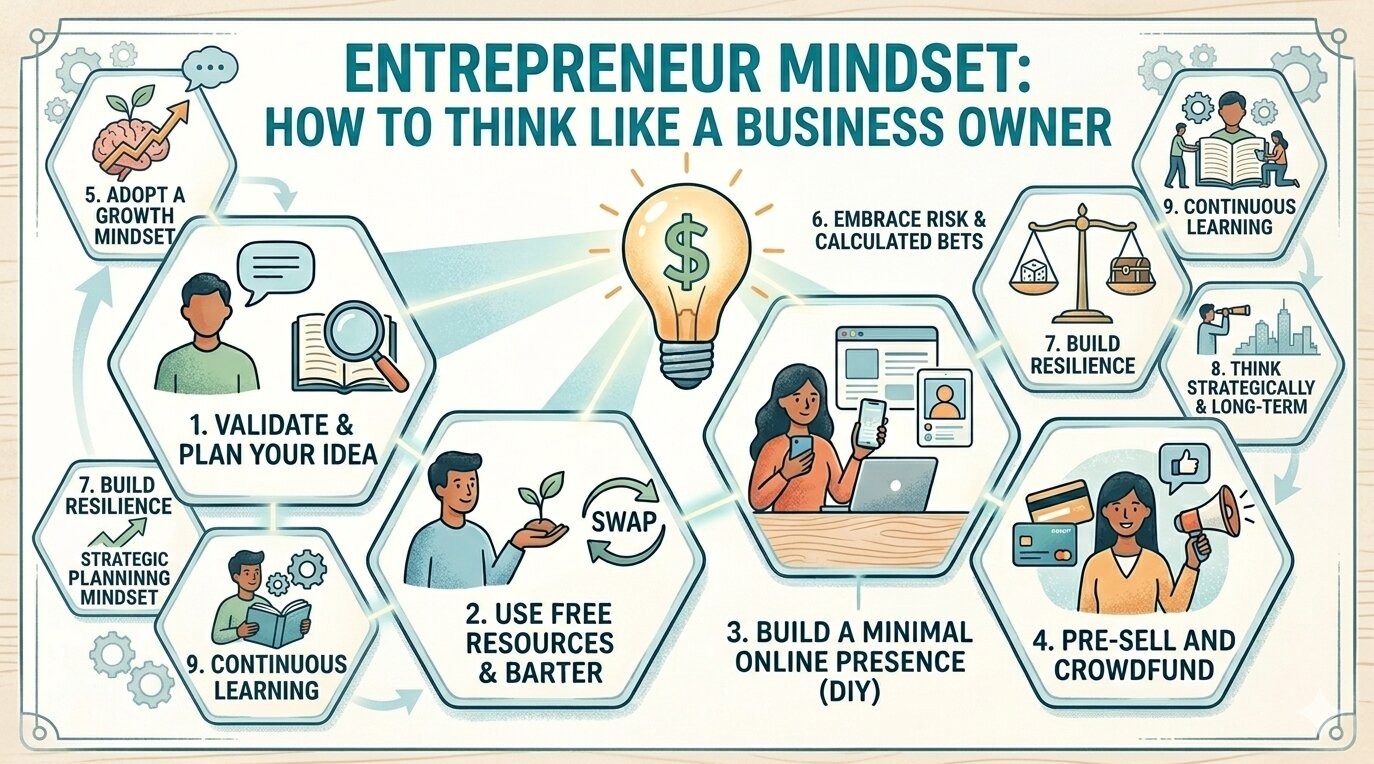
Most people think entrepreneurship is about ideas, money, or strategy. But in reality, the biggest difference between those who succeed and those who don’t is mindset.
You can have the best idea in the world, but without the right way of thinking, it’s hard to turn it into something meaningful.
The good news? Mindset is not something you’re born with—it’s something you can build.
In this guide, we’ll break down how to think like a business owner, using simple concepts, real-world examples, and practical ways to apply them in your daily life.
What Does It Mean to Think Like an Entrepreneur?
Thinking like a business owner means:
- Taking responsibility
- Looking for opportunities
- Solving problems instead of avoiding them
- Focusing on long-term growth
It’s a shift from:
“I need a job”
to
“I create value and opportunities”
1. Take Ownership of Everything
Entrepreneurs don’t blame circumstances, luck, or others. They take ownership.
Instead of saying:
- “This didn’t work because of the market”
They ask:
- “What could I have done better?”
Example:
If your product doesn’t sell, instead of blaming competition, analyze your pricing, marketing, or audience.
Ownership gives you control—and control leads to improvement.
2. Focus on Value, Not Just Money
Money is a result, not the starting point.
Successful entrepreneurs ask:
- How can I help people?
- What problem can I solve better?
Example:
A freelancer who focuses on delivering results (not just completing tasks) will naturally earn more over time.
3. Think Long-Term
Many beginners look for quick results. Entrepreneurs think long-term.
They understand:
- Growth takes time
- Skills take time
- Trust takes time
Real-world truth:
A business may take months to become stable—but that consistency creates long-term rewards.
4. Embrace Failure as Learning
Failure is not the opposite of success—it’s part of it.
Instead of fearing mistakes:
- Learn from them
- Adjust your approach
- Try again
Example:
If your first idea doesn’t work, refine it or try a different one.
If you’re still exploring ideas, read:
How to Find a Profitable Business Idea → https://statush.com/entrepreneur/how-to-find-a-profitable-business-idea
5. Take Action (Even When It’s Not Perfect)
Overthinking is one of the biggest obstacles.
Entrepreneurs:
- Start before they feel ready
- Learn by doing
- Improve along the way
Example:
Launching a basic version of your service is better than waiting months for perfection.
If you haven’t started yet, follow:
How to Start Your First Business Step-by-Step → https://statush.com/entrepreneur/how-to-start-your-first-business-step-by-step
6. Be Comfortable with Uncertainty
Entrepreneurship doesn’t come with guarantees.
Income may vary. Results may take time.
Instead of needing certainty, entrepreneurs:
- Adapt quickly
- Stay flexible
- Focus on what they can control
7. Learn Continuously
The business world changes constantly.
To stay relevant:
- Learn new skills
- Observe trends
- Improve your knowledge
But remember:
Learning without action has no value.
8. Build Discipline Over Motivation
Motivation comes and goes. Discipline stays.
Entrepreneurs rely on:
- Daily habits
- Consistent effort
- Focused routines
Example:
Working 1–2 hours daily on your business consistently is more powerful than occasional long sessions.
9. Think in Terms of Systems
Instead of doing everything manually, entrepreneurs think about systems.
This means:
- Creating repeatable processes
- Saving time
- Improving efficiency
Example:
Instead of replying to every customer manually, create templates or automated responses.
10. Surround Yourself with the Right Environment
Your environment influences your mindset.
Try to:
- Connect with like-minded people
- Learn from experienced individuals
- Avoid negativity and distractions
Even online communities can make a big difference.
Mindset Shift Summary
Here’s a simple comparison:
| Employee Thinking | Entrepreneur Thinking |
|---|---|
| Seek stability | Create opportunities |
| Avoid risk | Manage risk |
| Follow instructions | Make decisions |
| Short-term focus | Long-term vision |
| Fixed mindset | Growth mindset |
Connect Mindset with Action
Mindset alone isn’t enough—you need action.
If you have an idea, move forward with:
How to Turn Your Idea into a Business → https://statush.com/entrepreneur/how-to-turn-your-idea-into-a-business
If you’re starting with limited resources:
How to Start a Business with No Money → https://statush.com/entrepreneur/how-to-start-a-business-with-no-money
Common Mindset Mistakes
- Waiting for the “perfect time”
- Fear of failure
- Comparing with others
- Giving up too early
Reality:
Every successful entrepreneur faced these challenges—and moved forward anyway.
Final Thoughts
Thinking like a business owner is not about being fearless—it’s about moving forward despite fear.
Focus on:
- Taking responsibility
- Learning continuously
- Acting consistently
Your mindset shapes your actions, and your actions shape your results.
Once you start thinking differently, you’ll start seeing opportunities everywhere.