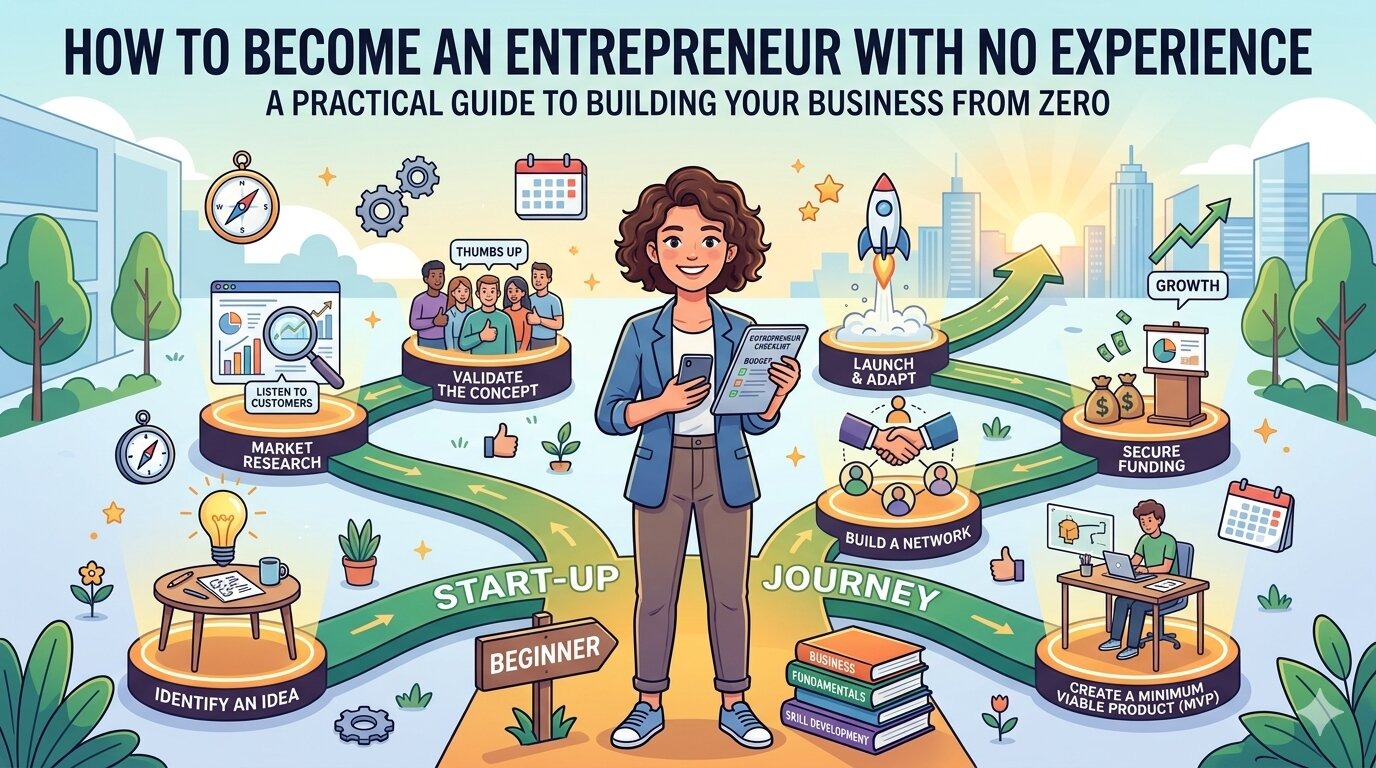
Starting something new without any prior experience can feel overwhelming. You might think entrepreneurship is only for people with business degrees, big investments, or years of expertise. But the truth is, many successful entrepreneurs started exactly where you are—confused, uncertain, and inexperienced.
What separates them isn’t knowledge at the beginning, but the willingness to start, learn, and adapt along the way.
In this guide, we’ll break down how you can become an entrepreneur from scratch, using simple steps, real-world examples, and practical strategies you can apply immediately.
Understanding What Entrepreneurship Really Means
Before diving in, it’s important to clear a common misconception: entrepreneurship is not about having a perfect idea or huge capital. It’s about solving problems and creating value.
At its core, an entrepreneur:
- Identifies a problem
- Finds a solution
- Delivers that solution in a way people are willing to pay for
You don’t need experience to do this—you need awareness and action.
Start with What You Already Know
You might feel like you know nothing, but that’s rarely true. Everyone has:
- Skills (even basic ones)
- Interests
- Life experiences
For example:
- A college student who knows social media can start managing Instagram pages for small businesses.
- Someone good at organizing can start a home decluttering service.
You don’t need expertise—you need a starting point.
If you’re struggling to identify ideas, you can explore this guide:
How to Find a Profitable Business Idea → https://statush.com/entrepreneur/how-to-find-a-profitable-business-idea
Learn by Doing (Not Just Watching)
One of the biggest mistakes beginners make is over-learning and under-doing. Watching videos, reading books, and taking courses feels productive—but it’s not a substitute for action.
Instead:
- Start small
- Take imperfect action
- Learn from real feedback
Example:
Instead of learning “everything about dropshipping,” create a basic store and try selling one product. You’ll learn more in a week than months of theory.
Simple Path to Start Without Experience
Here’s a practical breakdown:
| Step | What to Do | Example |
|---|---|---|
| Identify a problem | Look for daily frustrations | People struggle to find local services |
| Offer a solution | Create a simple service/product | Build a WhatsApp-based service directory |
| Start small | Test with minimal effort | Serve 5–10 customers first |
| Get feedback | Improve based on responses | Adjust pricing or offer |
| Scale gradually | Expand after validation | Add more services or automation |
This simple process removes the need for prior experience.
Build Confidence Through Small Wins
Confidence doesn’t come first—results do.
Start with achievable goals:
- Get your first customer
- Earn your first ₹500
- Complete your first service
Each small win builds momentum.
Real-world example:
A beginner freelancer might start by offering logo design at ₹200. After completing 10 projects, they improve skills and increase pricing to ₹2,000+.
Focus on Skills That Actually Matter
You don’t need to know everything, but a few core skills will take you far:
- Communication (talking to customers)
- Problem-solving
- Basic marketing (especially social media)
- Sales (convincing people to buy)
You can learn these while running your business.
If you're planning to launch properly, this guide will help:
How to Start Your First Business Step-by-Step → https://statush.com/entrepreneur/how-to-start-your-first-business-step-by-step
Start Without Money (Yes, It’s Possible)
A big myth is that you need money to start. Many businesses require more effort than capital.
Examples of zero-investment ideas:
- Freelancing (writing, design, marketing)
- Consulting
- Social media management
- Affiliate marketing
You can also read:
How to Start a Business with No Money → https://statush.com/entrepreneur/how-to-start-a-business-with-no-money
Turn Ideas into Action Quickly
Many beginners get stuck in the “idea stage.” But ideas don’t matter unless executed.
Here’s a simple framework:
- Write your idea in one sentence
- Identify who needs it
- Offer it to 10 people
- See if anyone is willing to pay
If yes → continue
If no → improve or change
You can dive deeper here:
How to Turn Your Idea into a Business → https://statush.com/entrepreneur/how-to-turn-your-idea-into-a-business
Accept That You Will Make Mistakes
This is unavoidable—and actually necessary.
Common beginner mistakes:
- Choosing the wrong idea
- Pricing too low or too high
- Targeting the wrong audience
- Giving up too early
But each mistake teaches something valuable.
Think of it this way: mistakes are your real education.
Build a Simple Network
You don’t need powerful connections, but having a small network helps:
- Friends who support your ideas
- Mentors or experienced people
- Online communities
Even WhatsApp groups or LinkedIn connections can open opportunities.
Stay Consistent (This Is the Real Secret)
Success in entrepreneurship rarely comes from one big move. It comes from consistent small actions:
- Posting regularly
- Reaching out to customers
- Improving your service
Most people quit too early. If you stay consistent, you already have an advantage.
Final Thoughts
Starting without experience is not a disadvantage—it’s a clean slate. You’re not limited by old habits or rigid thinking.
Focus on:
- Starting small
- Learning by doing
- Improving continuously
You don’t need to be perfect. You just need to begin.
If you’re ready to take the next step, explore:
How to Become an Entrepreneur with No Experience → https://statush.com/entrepreneur/how-to-become-an-entrepreneur-with-no-experience