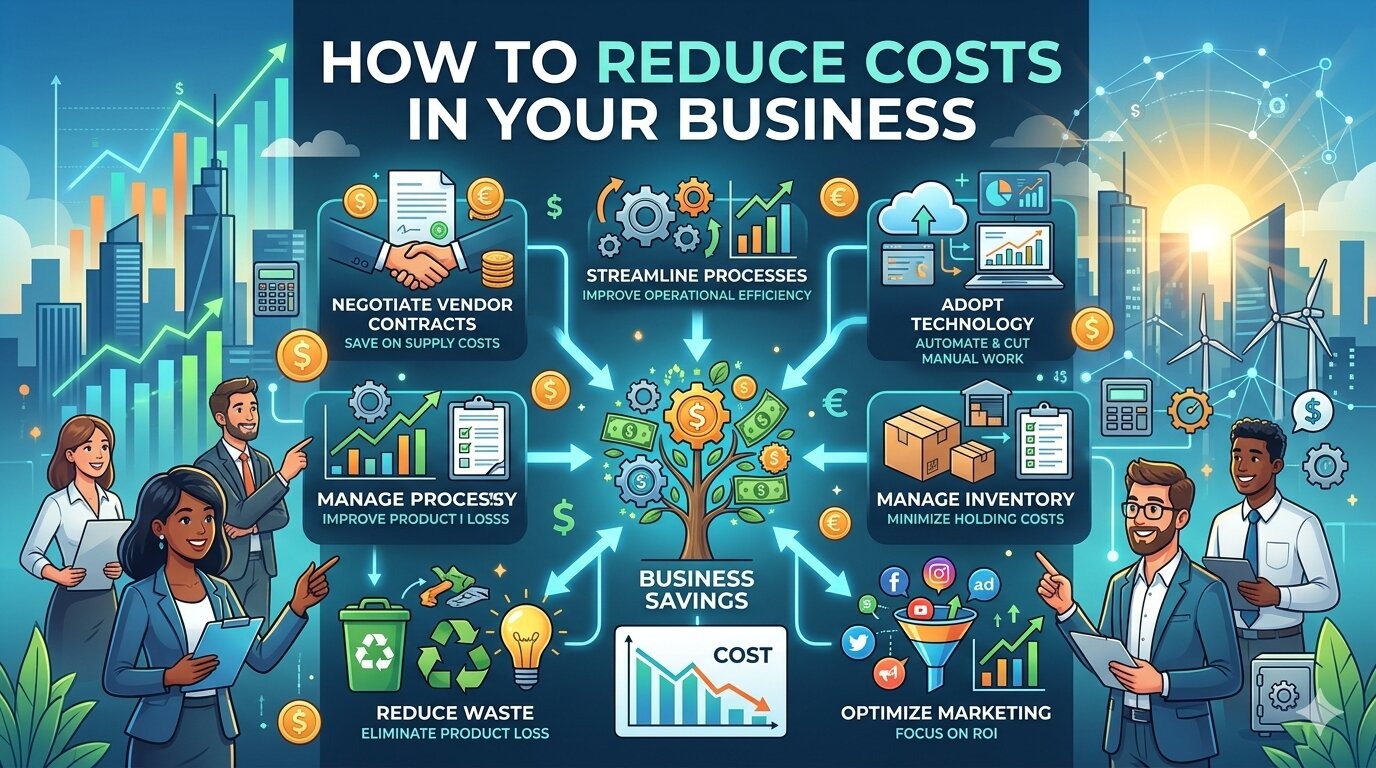
Reducing costs is one of the fastest ways to improve your business profitability. While many entrepreneurs focus only on increasing sales, smart cost management can instantly boost your bottom line—without needing more customers.
But cost reduction doesn’t mean cutting everything blindly. It means spending smarter, eliminating waste, and improving efficiency.
In this guide, we’ll break down practical ways to reduce costs in your business while maintaining quality and growth.
Why Cost Control Matters
Reducing costs helps you:
- Increase profit margins
- Improve cash flow
- Build a more sustainable business
Simple idea:
The less you spend (without affecting value), the more you keep.
1. Track Every Expense
You can’t reduce costs if you don’t know where your money is going.
Start by tracking:
- Monthly expenses
- Fixed costs (rent, tools)
- Variable costs (marketing, operations)
Example:
| Expense | Amount |
|---|---|
| Tools | ₹5,000 |
| Marketing | ₹10,000 |
| Misc | ₹3,000 |
Tracking gives clarity on where to cut.
If you need help managing finances, read:
How to Manage Business Finances as an Entrepreneur → https://statush.com/entrepreneur/how-to-manage-business-finances-as-an-entrepreneur
2. Eliminate Unnecessary Expenses
Many businesses pay for things they don’t actually use.
Check for:
- Unused subscriptions
- Duplicate tools
- Low-value services
Example:
- Paying for multiple design tools when one is enough
Cut anything that doesn’t directly add value.
3. Use Free or Affordable Tools
In the early stages, you don’t need expensive software.
Use:
- Free versions of tools
- Open-source alternatives
- Budget-friendly options
Example:
- Canva (free) instead of paid design tools
- Google Sheets instead of advanced software
4. Optimize Marketing Spend
Marketing is important—but it should be efficient.
Avoid:
- Spending without tracking results
- Using too many channels at once
Focus on:
- Channels that work best
- Organic methods (content, outreach)
Example:
- Instagram content instead of paid ads initially
5. Improve Operational Efficiency
Inefficiency increases costs.
Improve:
- Processes
- Workflow
- Time management
Example:
| Inefficient | Efficient |
|---|---|
| Manual tasks | Automated processes |
| Repeated work | Templates/systems |
Efficiency reduces time and cost.
6. Outsource Smartly (Instead of Hiring Full-Time)
Hiring full-time employees early can increase costs.
Instead:
- Hire freelancers
- Outsource specific tasks
- Pay only for what you need
Example:
- Hire a freelancer for design instead of a full-time designer
7. Negotiate Better Deals
Many expenses can be reduced through negotiation.
You can:
- Ask for discounts
- Compare vendors
- Renegotiate contracts
Example:
- Getting a lower rate from suppliers
8. Focus on High-Return Activities
Not all activities generate equal value.
Focus on:
- Revenue-generating tasks
- High-impact work
Avoid spending money on:
- Low-return activities
- Unnecessary experiments
9. Reduce Fixed Costs
Fixed costs are ongoing expenses.
Try to minimize:
- Office rent
- Utilities
- Long-term commitments
Example:
- Work from home instead of renting office space
10. Monitor and Adjust Regularly
Cost management is not one-time—it’s ongoing.
Regularly:
- Review expenses
- Adjust budgets
- Improve efficiency
Small improvements over time create big savings.
Cost Reduction Strategy
| Step | Action | Result |
|---|---|---|
| Track | Monitor expenses | Awareness |
| Cut | Remove waste | Savings |
| Optimize | Improve efficiency | Better use of resources |
| Review | Adjust regularly | Continuous improvement |
Real-World Example
Let’s say a business spends:
- ₹50,000/month
After optimization:
- Cuts ₹10,000 in unused tools
- Saves ₹10,000 in marketing
New expenses:
- ₹30,000 → higher profit
Same revenue—better cost control → more profit.
Avoid These Common Mistakes
- Cutting costs that affect quality
- Ignoring small expenses
- Not tracking spending
- Over-investing too early
If you want to avoid mistakes, read:
Common Entrepreneur Mistakes to Avoid → https://statush.com/entrepreneur/common-entrepreneur-mistakes-to-avoid
Connect Cost with Profit
Reducing costs directly increases profit.
To improve profitability, read:
How to Increase Business Profits → https://statush.com/entrepreneur/how-to-increase-business-profits
Final Thoughts
Reducing costs is not about limiting growth—it’s about optimizing it.
Focus on:
- Smart spending
- Efficient systems
- Value-driven decisions
You don’t need to cut everything.
You need to cut what doesn’t matter.
Over time, better cost control will make your business stronger, more stable, and more profitable.