Pricing is one of the most important—and most misunderstood—parts of running a business. Price too low, and you struggle to make profit. Price too high, and customers walk away. Get it right, and everything becomes easier: sales, growth, and sustainability.
In the U.S. market, where customers compare options quickly and competition is strong, pricing isn’t just about numbers—it’s about perceived value, positioning, and strategy.
Let’s break down how to price your products or services effectively, in a practical and real-world way.
Why Pricing Matters More Than You Think
Pricing directly affects:
- Profit margins
- Brand positioning
- Customer perception
- Sales volume
Real insight
Two businesses selling the same product can perform very differently—just because of pricing strategy.
If your business foundation isn’t clear yet, start here:
How to Build a Business from Scratch – https://statush.com/business/how-to-build-a-business-from-scratch
1. Understand Your Costs First
Before setting a price, you must know your numbers.
Calculate:
- Cost of goods/services (COGS)
- Operating expenses
- Marketing costs
- Overhead
Simple rule
Your price must cover all costs—and leave room for profit.
2. Know Your Market and Competition
In the U.S., customers often compare multiple options before buying.
Research:
- Competitor pricing
- Market expectations
- Customer willingness to pay
Practical tip
Don’t blindly copy competitors—but understand where you fit.
3. Choose the Right Pricing Strategy
Different businesses require different pricing models.
Common strategies:
Cost-Plus Pricing
Cost + profit margin
→ Simple but ignores market demand
Value-Based Pricing
Price based on perceived value
→ Best for branding and higher margins
Competitive Pricing
Based on market rates
→ Works in crowded markets
Premium Pricing
Higher price for higher perceived value
→ Works with strong branding
4. Position Your Brand Through Pricing
Price communicates value.
Low price signals:
- Budget option
- Basic features
High price signals:
- Premium quality
- Trust and expertise
Real-world example
Apple charges premium prices not just for products—but for brand perception.
5. Avoid Underpricing (Common Mistake)
Many small businesses start by pricing too low.
Why it’s risky:
- Low profit margins
- Difficult to scale
- Hard to increase prices later
Practical tip
Start with sustainable pricing—even if it feels slightly high.
6. Use Psychological Pricing
Small changes in pricing can influence buying decisions.
Examples:
- $99 instead of $100
- Bundled pricing
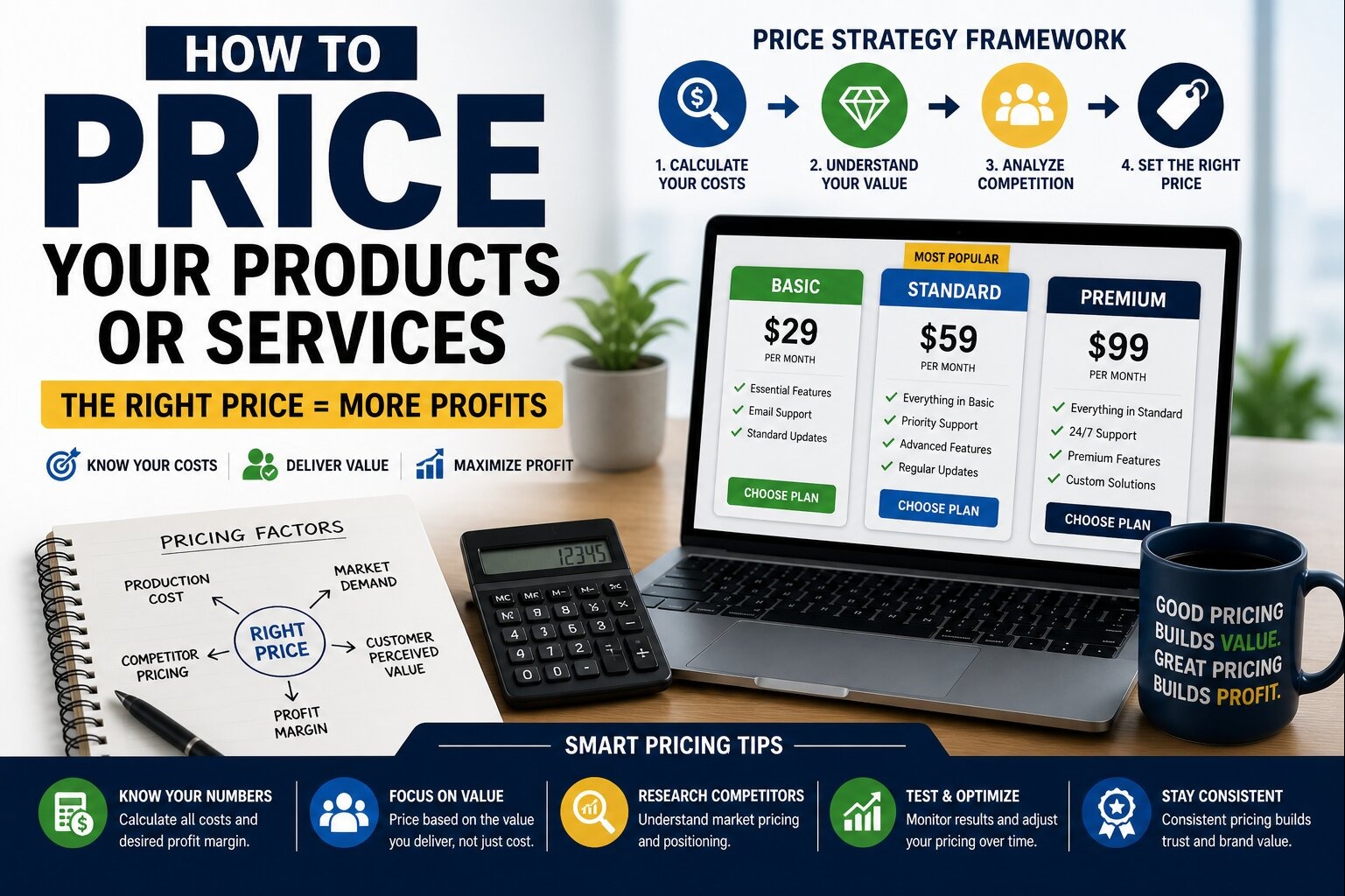
- Tiered pricing (Basic, Standard, Premium)
Why it works
Customers perceive value differently based on presentation.
7. Offer Tiered Pricing Options
Giving customers choices increases conversions.
Example:
- Basic plan → $29
- Standard plan → $59
- Premium plan → $99
Benefit
Customers often choose the middle option—boosting revenue.
8. Test and Adjust Pricing
Pricing is not fixed—it evolves.
Test:
- Different price points
- Discounts vs no discounts
- Bundles vs single products
Practical tip
Monitor results and adjust based on performance.
9. Factor in Customer Lifetime Value (LTV)
Don’t just focus on one sale—look at long-term value.
Example
A subscription business can charge lower upfront if long-term revenue is strong.
To improve LTV:
How to Retain Customers and Increase Lifetime Value – https://statush.com/business/how-to-retain-customers-and-increase-lifetime-value
10. Align Pricing with Business Goals
Your pricing should match your strategy.
If your goal is:
- Rapid growth → competitive pricing
- High profit → value-based pricing
- Premium positioning → higher pricing
Real insight
Pricing is not just financial—it’s strategic.
Pricing Strategy Comparison Table
| Strategy | Complexity | Profit Potential | Best For |
|---|---|---|---|
| Cost-Plus | Low | Medium | Beginners |
| Value-Based | Medium | High | Brand-driven businesses |
| Competitive | Medium | Medium | Crowded markets |
| Premium | High | High | Established brands |
| Tiered Pricing | Medium | High | SaaS & service businesses |
Common Pricing Mistakes (USA Market)
Avoid these common issues:
- Pricing based only on competitors
- Ignoring costs
- Underpricing to attract customers
- Not testing pricing
- Offering too many discounts
Connecting Pricing with Revenue
Pricing directly impacts your revenue and growth.
To increase revenue effectively:
How to Increase Business Revenue – https://statush.com/business/how-to-increase-business-revenue
To build a scalable model:
How to Build a Scalable Business Model – https://statush.com/business/how-to-build-a-scalable-business-model
To manage finances better:
How to Manage Business Finances Effectively – https://statush.com/business/how-to-manage-business-finances-effectively
Final Thoughts
Pricing isn’t about being the cheapest—it’s about being worth it.
Focus on:
- Understanding your costs
- Delivering real value
- Positioning your brand correctly
Start with a strong pricing foundation, test what works, and adjust over time.
Because in business, the right price doesn’t just increase sales—it builds a profitable and sustainable future.